
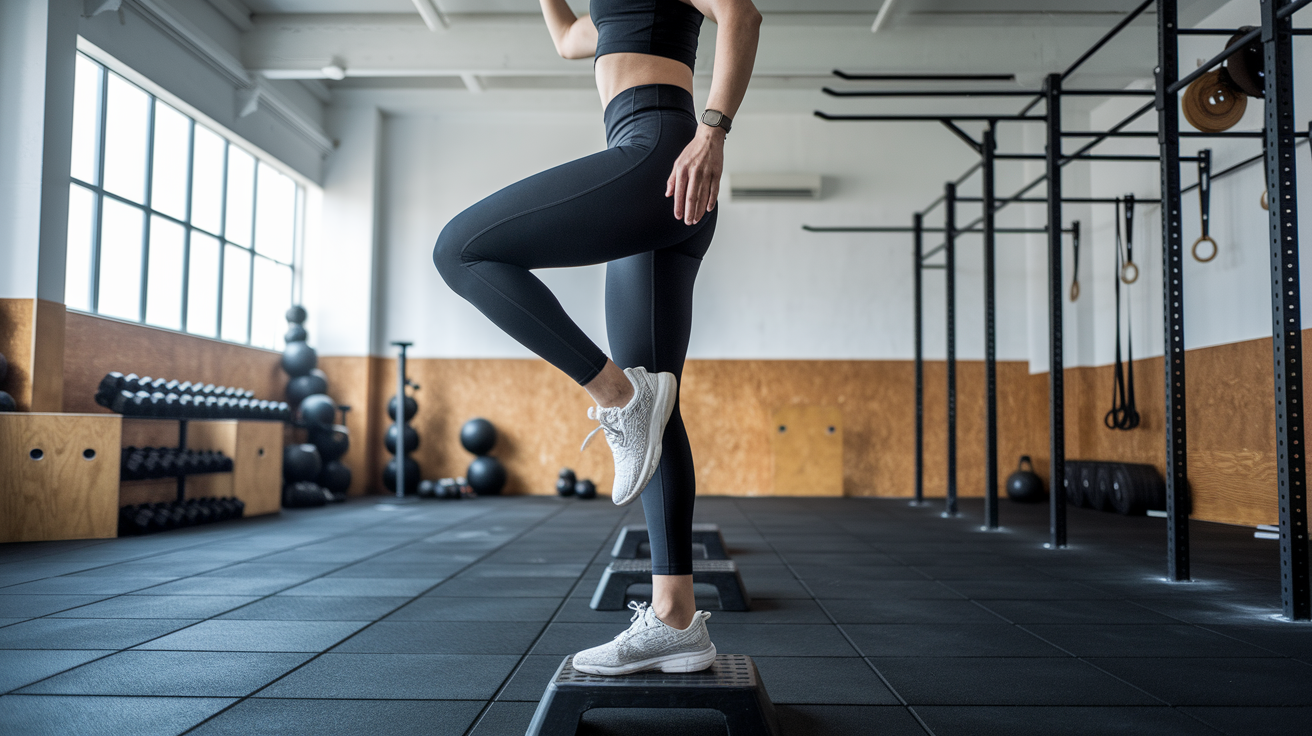
Think step ups are only for beginners? Think again.
A clean step ups workout builds one-leg strength, fixes left-right gaps, and protects your back while giving real-world power for stairs, hills, and sports.
In this post you’ll learn the exact cues for safe, effective form, like lifting your back toes 1 to 2 inches and driving through the front heel, plus scalable variations from a 6-inch starter box to heavy loaded step ups.
Options for beginners, busy days, and advanced lifters are included so you can pick what fits your schedule.
Mastering Proper Technique for a Step Ups Workout
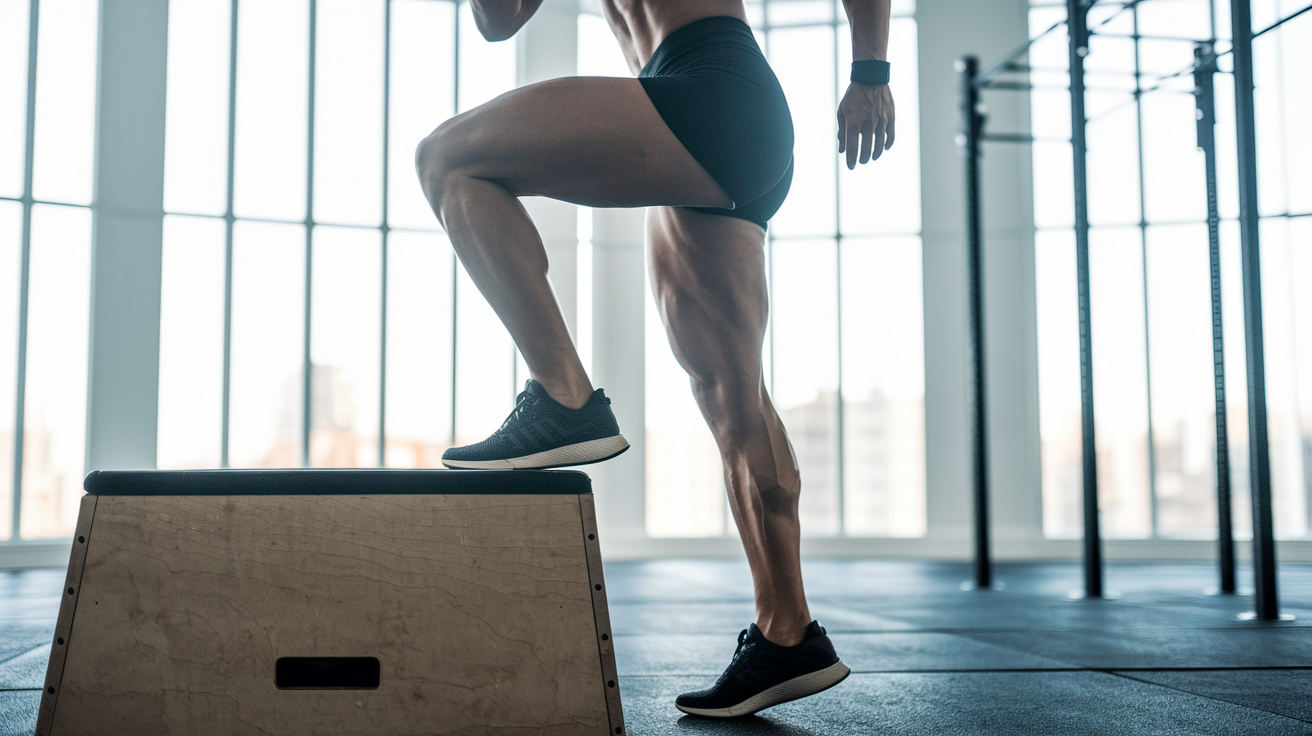
The foundation of an effective step ups workout is clean, controlled technique that isolates the working leg and eliminates momentum. The most critical cue? Actively disengage your back leg. Lift your back toes 1 to 2 inches off the floor so you can’t push off with the trailing foot. This simple adjustment forces your front leg to do nearly all the work and exposes strength imbalances immediately. Your entire front foot should be flat and stable on the platform, never just your toes. Your knee must track directly over your second toe throughout the movement to protect the joint and maximize glute activation.
Box height determines difficulty and muscle emphasis. Beginners should start at 6 to 8 inches to learn the movement pattern safely. Intermediate lifters work well with 8 to 12 inches, bringing the front thigh roughly parallel to the floor. Advanced athletes can use 16 to 24 inches, but only if they can maintain an upright torso and full hip extension at the top. Excessive height causes forward lean and compromises form. At the top of every rep, pause for 1 to 2 seconds, stand completely tall on the working leg only (don’t place the back foot on the box), and squeeze your glutes hard to lock out full hip extension. The descent is just as important as the drive: lower yourself with a deliberate 2 to 4 second eccentric, keeping tension in the working leg the entire way down. Rushing the descent wastes half the strength stimulus.
Step by Step Technique Breakdown:
-
Start Position – Stand facing the box with feet hip width apart, chest up, and core braced. Lift the toes of your back foot 1 to 2 inches off the ground to disable the trailing leg.
-
Drive Phase – Press through the heel of your front foot and drive your body upward in one smooth motion, keeping your torso vertical and your knee tracking over your second toe.
-
Top Position – Finish standing tall on the working leg only, with hips fully extended and glutes squeezed. Hold this position for 1 to 2 seconds and don’t let the back foot touch the box.
-
Controlled Descent – Lower yourself slowly over 2 to 4 seconds, maintaining tension in the working leg and keeping your chest lifted. Tap the floor lightly with the back foot.
-
Reset and Repeat – Complete all reps on one leg before switching, or alternate legs based on your training goal. Reset your posture and toe lift before each rep.
Key Benefits of Adding Step Ups Workout Training to Your Routine

Step ups deliver a rare combination of unilateral strength, functional movement, and joint friendly loading that most traditional leg exercises can’t match. Because you work one leg at a time, step ups expose and correct muscle imbalances that bilateral movements like squats often mask. Your stronger leg can’t compensate for a weaker one. This unilateral emphasis directly improves dynamic balance and proprioception, which translates to better performance in sports, hiking, stair climbing, and sprinting. Step ups also place significantly less compressive load on the spine compared to heavy barbell squats, making them a smart choice for building serious leg strength without the back fatigue or injury risk.
The movement pattern itself mimics real world demands like climbing stairs, stepping over obstacles, or accelerating uphill. The strength you build is immediately useful outside the gym. Your glutes, quads, hamstrings, and core all work together to stabilize and drive the body upward, creating a full posterior chain challenge with every rep.
Six Core Benefits of Step Ups:
- Correct left right strength imbalances by forcing each leg to handle the load independently
- Build glute and quad strength with a natural, knee friendly range of motion
- Improve balance, coordination, and single leg stability for athletic performance
- Reduce spinal compression and lower back strain compared to bilateral squats
- Strengthen deep core stabilizers that work to keep your torso upright
- Transfer directly to functional activities like hiking, sprinting, and stair climbing
Equipment and Setup Essentials for an Effective Step Ups Workout
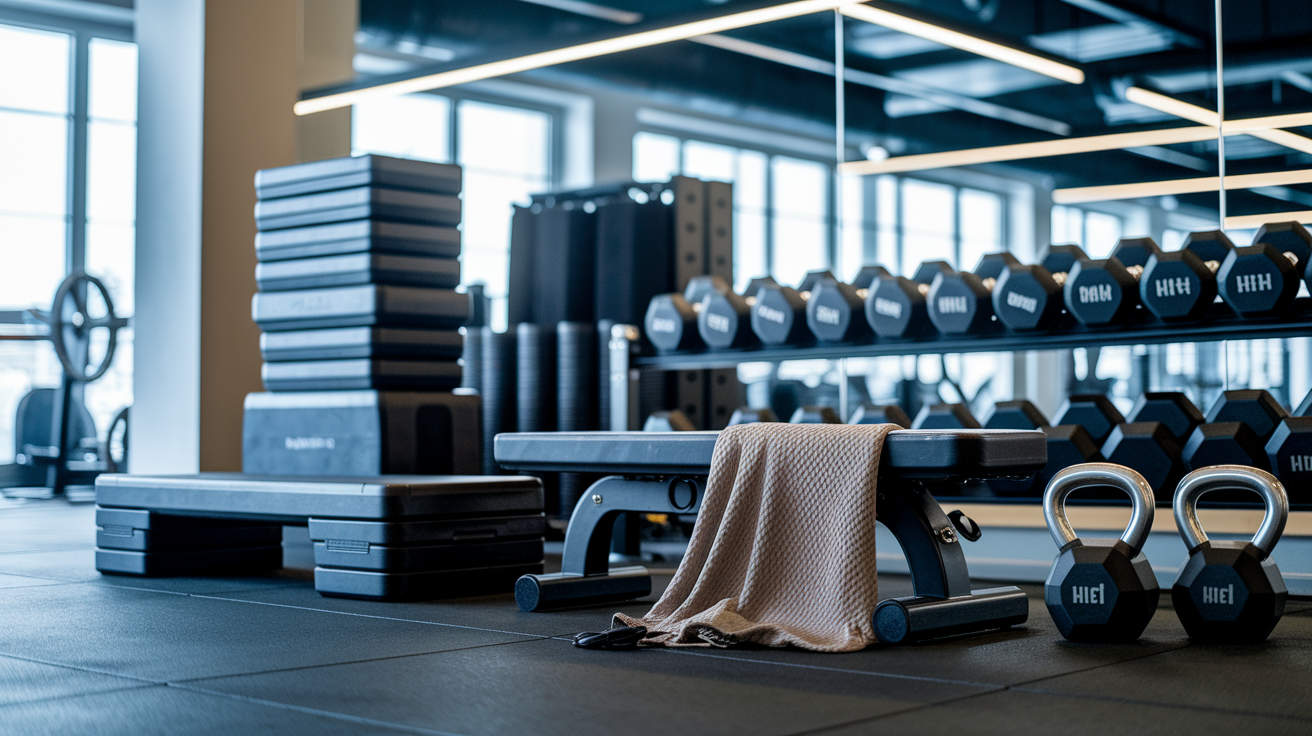
You can perform step ups on almost any stable, elevated surface, but the right equipment makes the movement safer and more scalable. In a gym, sturdy plyo boxes and flat weight benches are ideal because they offer consistent height and won’t shift mid rep. At home, a solid wooden box, a stable outdoor step, or an adjustable aerobic step platform works just as well. Avoid cushioned furniture like couches or soft chairs, which compromise ankle stability and increase fall risk. Adjustable aerobic steps are especially useful because you can fine tune the height in small increments as you progress.
For adding load, dumbbells are the most beginner friendly option because they’re easy to hold and don’t challenge your balance as much as a barbell. Kettlebells work well for goblet style step ups, held at chest height to increase core demand. Barbell step ups are advanced and require excellent balance and box placement, so save them until you’ve mastered lighter loads. Weighted vests and rucksacks are functional alternatives that keep your hands free and distribute load evenly, making them popular for tactical training and hiking prep.
Common Equipment Options:
- Plyo boxes (wood or foam) for gym training with fixed or adjustable heights
- Flat weight benches as a stable alternative when boxes aren’t available
- Adjustable aerobic step platforms for home use with stackable risers
- Stairs or outdoor steps for accessible, equipment free training
Muscles Targeted in a Step Ups Workout
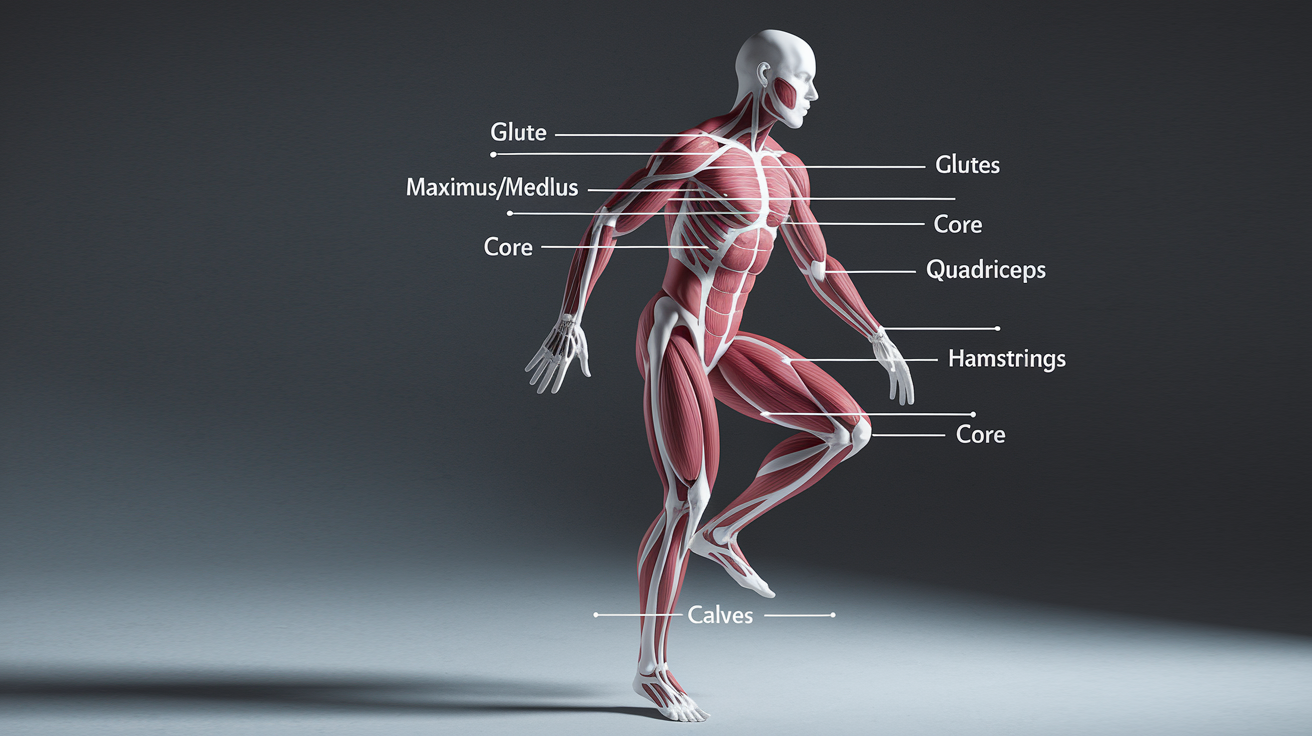
Step ups are a complete lower body movement that recruits nearly every major muscle group from your hips to your calves, with a strong emphasis on the posterior chain. The gluteus maximus drives hip extension at the top of the movement, while the gluteus medius and minimus stabilize your pelvis and prevent your knee from collapsing inward. Your quadriceps (especially the vastus lateralis, rectus femoris, and vastus medialis) control the knee throughout the ascent and descent. Your hamstrings (biceps femoris, semitendinosus, and semimembranosus) assist with hip extension and deceleration on the way down.
Beyond the legs, your core works hard to keep your torso upright and stable. The rectus abdominis, obliques, and erector spinae all fire to resist rotation and maintain alignment, especially when you add external load. Even your calves (the gastrocnemius and soleus) contribute by stabilizing your ankle and assisting with the push off. Because step ups challenge balance and coordination, smaller stabilizer muscles throughout the hip and ankle are constantly engaged, making this exercise exceptionally effective for building symmetry and preventing injury.
| Muscle Group | Primary Role |
|---|---|
| Glutes (maximus, medius, minimus) | Drive hip extension and stabilize the pelvis |
| Quadriceps (vastus lateralis, rectus femoris, vastus medialis) | Extend the knee and control the ascent and descent |
| Hamstrings (biceps femoris, semitendinosus, semimembranosus) | Assist hip extension and decelerate the lowering phase |
| Core (rectus abdominis, obliques, erector spinae) | Maintain upright posture and resist rotation |
| Calves (gastrocnemius, soleus) | Stabilize the ankle and assist with push off |
Step Ups Workout Variations for Every Fitness Level
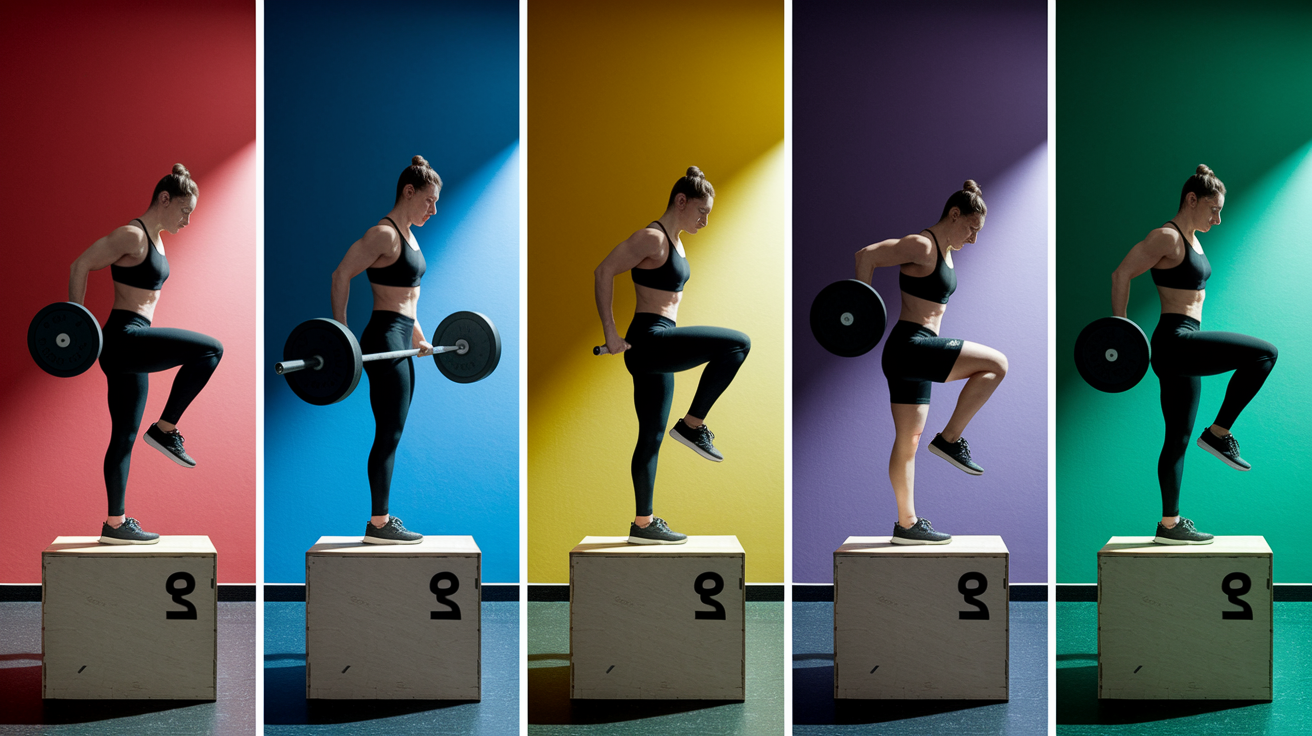
Different step up variations let you target specific goals, add variety, and scale difficulty without changing the core movement pattern. Each variation shifts the training emphasis slightly. Some prioritize strength and load, others focus on power or eccentric control, and a few target balance and lateral stability. Choosing the right variation depends on your current ability, available equipment, and whether you’re training for muscle growth, explosiveness, or conditioning.
Dumbbell Step Ups
Hold a dumbbell in each hand at your sides with a neutral grip. This is the most common weighted progression and works well for both strength and hypertrophy. Start with 5 to 10 pounds per hand and work up to 20 to 40 pounds as your form stays clean. Dumbbells are easier to balance than a barbell and let you bail safely if needed.
Barbell Step Ups
Place a barbell across your upper back in a high bar or low bar position, gripping it wider than shoulder width. Barbell step ups significantly increase core and balance demands, so use a lower box height initially and only add this variation once you can confidently perform 3 sets of 10 reps with moderate dumbbells. This is an advanced option best suited for experienced lifters focused on maximal strength.
Lateral Step Ups
Stand to the side of the box and step up sideways, placing your outside foot on the platform and driving through that leg to lift your body. This variation directly targets the glute medius, hip abductors, and adductors, improving frontal plane stability and reducing knee valgus risk. Use bodyweight or light dumbbells for 8 to 12 reps per leg.
Explosive Step Ups
Start with a box below knee height and perform each rep with maximum speed, driving powerfully off the front leg and optionally jumping off the top of the box on the working leg. Keep the movement unweighted to prioritize speed and landing mechanics. Do 3 to 6 explosive reps per leg for power development, resting fully between sets.
Slow Negative Step Ups
Focus entirely on the descent by lowering yourself over 3 to 4 seconds with deliberate control. This eccentric focused variation maximizes time under tension and is excellent for hypertrophy. Use a moderate box height and moderate load. Slow negatives are harder than they look. Perform 6 to 8 reps per leg for 3 to 4 sets.
Best Variations for Specific Goals:
- Strength and load capacity: dumbbell or barbell step ups with heavy weight and low reps
- Muscle growth and time under tension: slow negative step ups with controlled eccentric
- Power and explosiveness: explosive step ups or box jump step ups with short recovery
- Lateral stability and hip abductors: lateral step ups with bodyweight or light load
- Conditioning and work capacity: aerobic step ups for timed intervals or high rep circuits
Programming Your Step Ups Workout for Strength, Muscle, and Conditioning
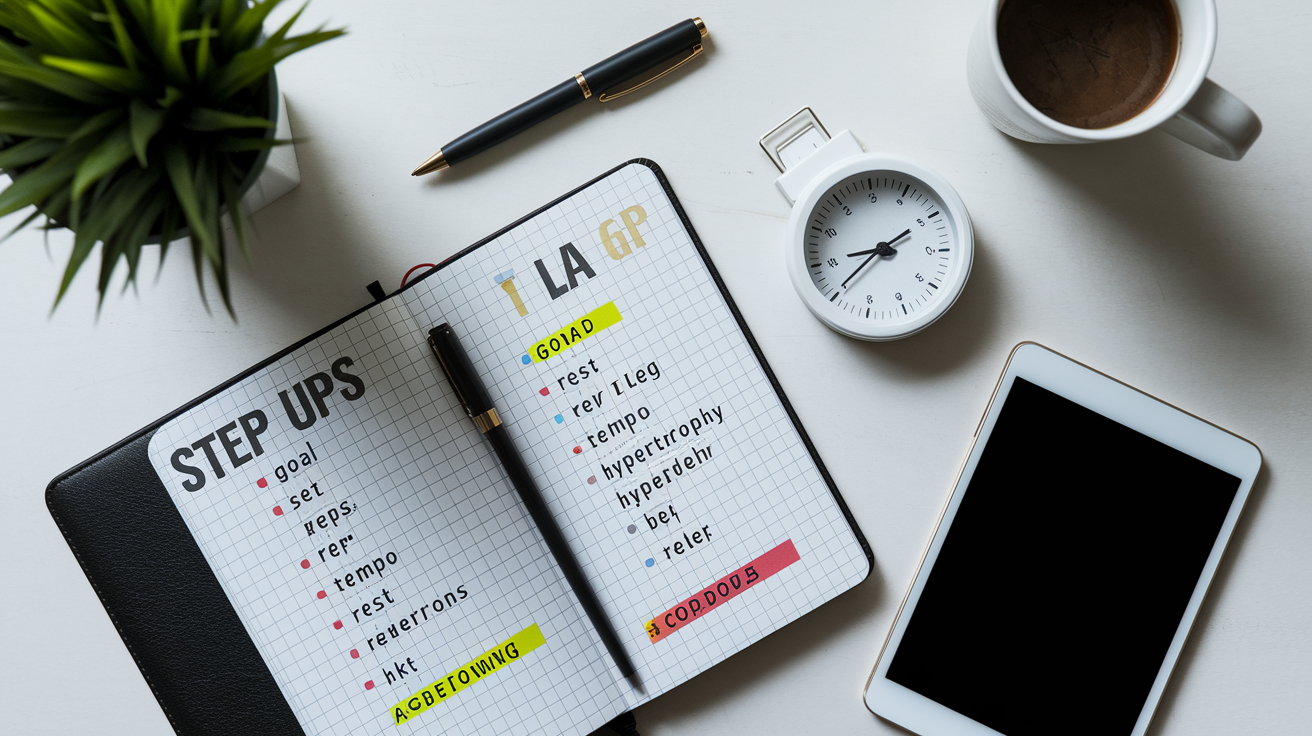
How you program step ups (sets, reps, tempo, and rest) determines whether you’re building maximal strength, hypertrophy, explosive power, or conditioning. The same movement can serve completely different training goals depending on the load you use, how fast or slow you move, and how long you rest between sets. For strength, you want heavy weight, low reps, and full recovery. For hypertrophy, you prioritize volume and time under tension with moderate rest. For conditioning, you reduce load and rest, focusing on density and metabolic demand.
Beginners should start with 1 to 2 step up sessions per week, using bodyweight or light dumbbells to master the pattern and build work capacity. Intermediate and advanced lifters can handle 2 to 3 sessions per week, alternating between strength focused sessions with heavy loads and higher rep accessory work. You can program step ups as your main unilateral movement on lower body days, or use them as a complement to squats and deadlifts. Alternating legs each rep works well for conditioning and keeps your heart rate up. Performing all reps on one leg before switching exposes imbalances and builds focused strength.
Time under tension matters. A slow, controlled eccentric (the lowering phase) creates more muscle damage and growth stimulus, while an explosive concentric (the drive up) builds power. Pausing at the top of each rep for 1 to 2 seconds eliminates momentum and forces your glutes to finish the movement completely.
| Goal | Sets | Reps per Leg | Tempo (Eccentric/Concentric) | Rest |
|---|---|---|---|---|
| Strength | 3–5 | 4–6 | 2–3s down, explosive up | 90–180 seconds |
| Hypertrophy | 3–4 | 8–12 | 3–4s down, controlled up | 60–90 seconds |
| Power | 3–5 | 3–6 | Explosive up, controlled down | 2–3 minutes |
| Conditioning | 2–3 | 15–20 or 30–60s intervals | Steady pace | 30–60 seconds |
Correcting Common Step Ups Workout Mistakes
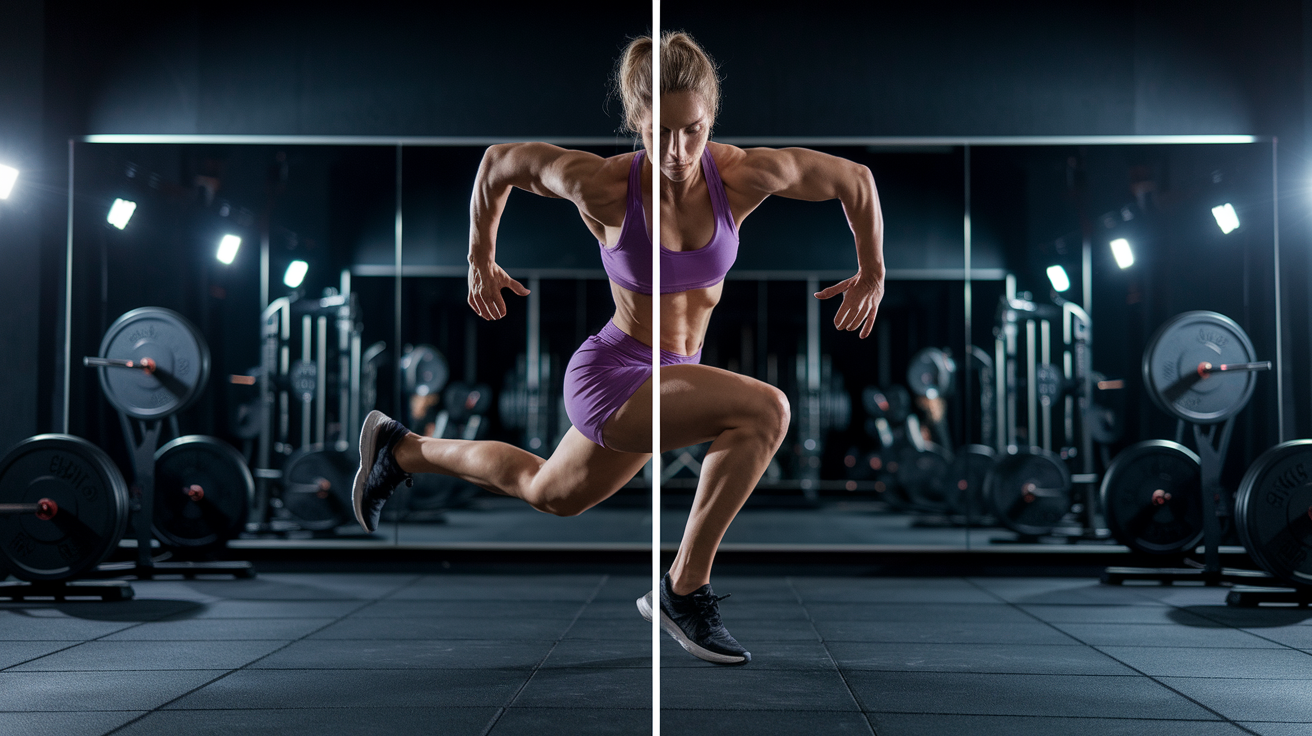
Most step up mistakes come from rushing the movement, using momentum, or letting the trailing leg do too much work. The fastest way to fix sloppy step ups? Slow down the eccentric and actively lift your back toes off the ground. If you’re still struggling with balance or alignment, drop the box height or remove external load until the pattern feels smooth and controlled.
Pushing off the back leg is the most common error. Your trailing leg should be almost passive, used only for balance and a light touch on the floor. If you find yourself springing off both feet, pause at the bottom and consciously lift your back toes before each rep. Leaning your torso too far forward usually means the box is too high or you’re not driving through your heel. Reduce the height and focus on staying upright with your chest lifted. Knee collapse (valgus) is another red flag. If your knee dives inward, cue yourself to push your knee slightly outward so it tracks over your second toe, and consider adding glute activation drills to your warm up.
Five Common Mistakes and Quick Fixes:
- Pushing off the back leg: Lift your back toes 1 to 2 inches off the floor and keep them elevated the entire set.
- Leaning forward excessively: Lower the box height, brace your core harder, and drive through your front heel instead of your toes.
- Knee collapsing inward: Actively push your knee outward and make sure it tracks over your second toe. Add banded glute work to your warm up.
- Using a box that’s too high: If your torso collapses forward or you can’t stand tall at the top, drop the height by 4 to 6 inches and rebuild from there.
- Rushing the descent: Control the eccentric over 2 to 4 seconds. If you’re dropping fast, you’re missing half the training stimulus.
Progressions and Regressions for an Adaptable Step Ups Workout
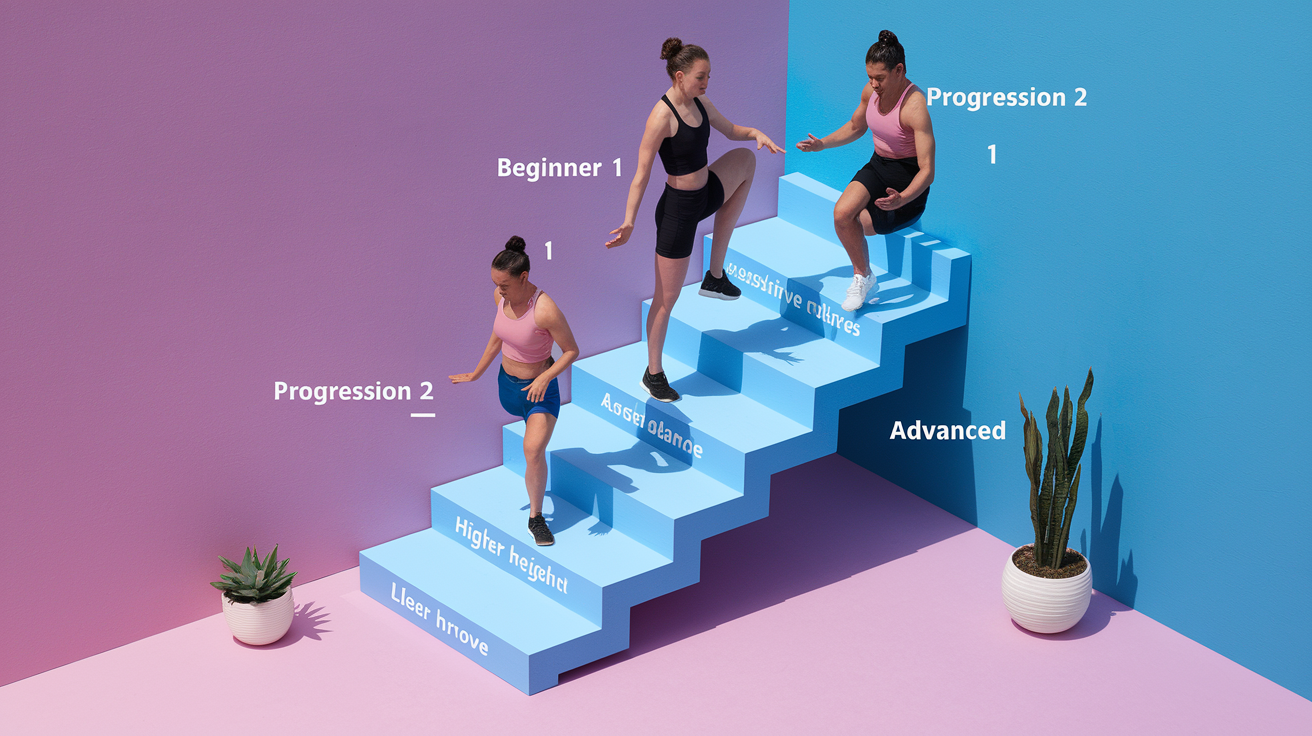
Step ups are infinitely scalable, making them suitable for complete beginners and advanced athletes alike. The key is choosing the right entry point and progressing in small, measurable steps. If you’re new to single leg training or recovering from an injury, start with regressions that reduce balance demands and range of motion. Once you can perform 3 sets of 12 clean reps at a given height and load, it’s time to progress by adding weight, increasing box height, or introducing tempo challenges.
A simple 6 week progression might look like this: Weeks 1 to 2, perform 3 sets of 8 to 12 bodyweight step ups on a low box (6 to 8 inches) to learn the pattern and build work capacity. Weeks 3 to 4, add light dumbbells (5 to 15 pounds per hand) and perform 3 sets of 8 reps per leg, focusing on a controlled 3 second eccentric. Weeks 5 to 6, increase the load to moderate dumbbells (20 to 30 pounds per hand) and drop to 3 to 5 sets of 5 to 8 reps, or introduce barbell step ups if balance and confidence allow. Track your reps, load, and box height every week so you can see clear progress.
Four Beginner Regressions:
- Use an ankle height step or aerobic platform (4 to 6 inches) to minimize range and balance demands
- Hold a stable object like a doorframe or railing lightly with one hand for balance support
- Perform assisted step ups by lightly pushing off the trailing leg until strength improves
- Start with slow, controlled reps (5 second eccentric) at bodyweight before adding any load
Four Advanced Progressions:
- Deficit step ups: stand on a small plate or platform to increase range of motion and glute stretch
- Heavy dumbbell or barbell step ups with loads that challenge 5 to 8 reps per leg
- Explosive or plyometric step ups that finish with a jump off the working leg
- Single leg box squats performed from the top of the step for added quad and eccentric demand
Integrating Step Ups Workout Training Into Full Body or Lower Body Programs
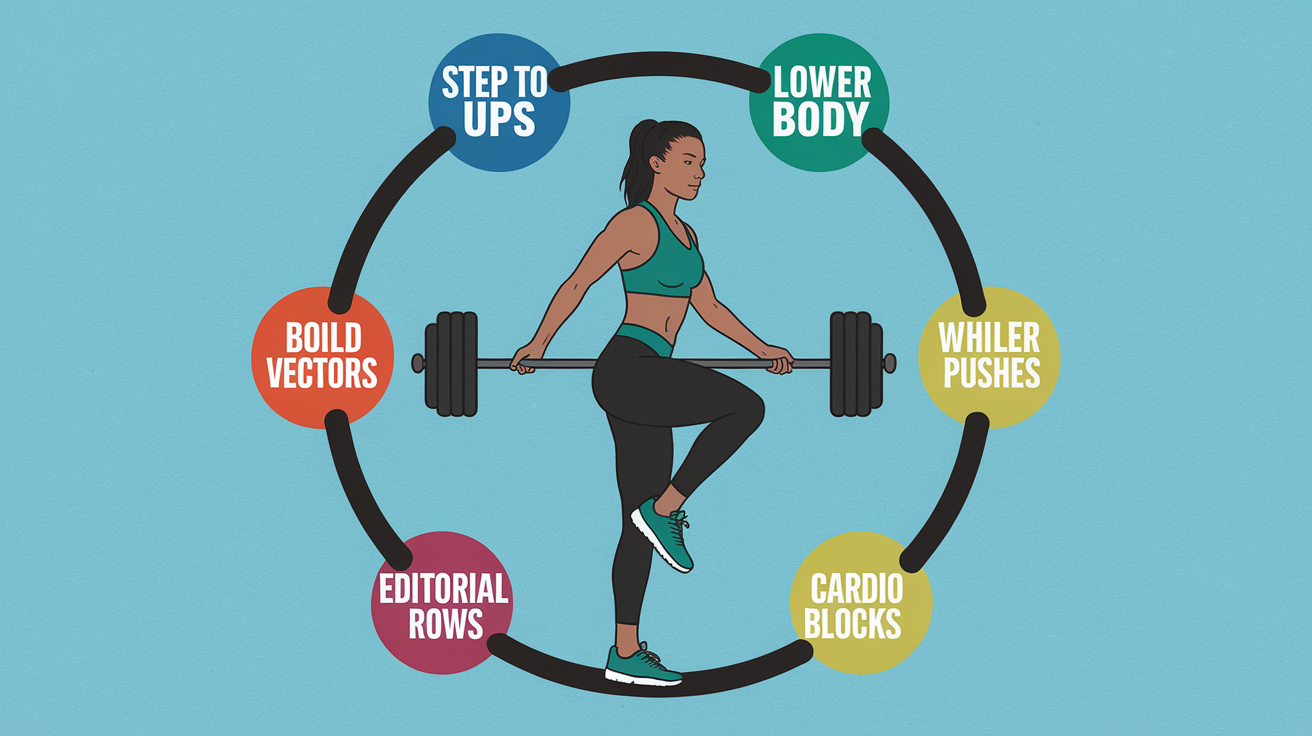
Step ups fit seamlessly into nearly any training split because they’re highly adaptable and pair well with both lower body and full body work. You can use them as your primary unilateral leg movement on a lower body strength day, as an accessory exercise after heavy squats or deadlifts, or as part of a metabolic conditioning circuit. Because step ups are less fatiguing to the central nervous system than bilateral squats, they’re also a smart choice for higher frequency training or active recovery sessions.
Pairing step ups with complementary exercises creates efficient, balanced workouts. Supersetting step ups with Romanian deadlifts or glute bridges hits the full posterior chain without overlapping fatigue patterns. You can also pair step ups with upper body exercises like rows or push ups in a full body circuit to keep your heart rate elevated and save time. For conditioning work, combine step ups with rowing intervals, kettlebell swings, or ski erg for a complete metabolic session that builds strength and work capacity at the same time.
Four Sample Training Templates:
-
Strength Day: After warm up, perform 4 sets of 5 to 8 weighted step ups per leg (heavy dumbbells or barbell), rest 2 minutes between sets. Follow with 3 sets of 8 Romanian deadlifts and 3 sets of 12 leg curls.
-
Hypertrophy Day: Perform 3 sets of 10 to 12 step ups per leg with moderate dumbbells (focus on slow 3 second eccentrics), superset with 3 sets of 12 goblet squats. Finish with 3 sets of 15 walking lunges.
-
Conditioning Day: Complete 3 rounds of 60 seconds of alternating step ups (bodyweight or light vest), 60 seconds of kettlebell swings, 60 seconds of rowing. Rest 90 seconds between rounds.
-
Full Body Day: Superset 3 sets of 8 step ups per leg with 3 sets of 10 push ups. Follow with 3 sets of 8 dumbbell rows and 3 sets of 12 single leg RDLs.
Safety, Mobility, and Pain Free Modifications for a Sustainable Step Ups Workout
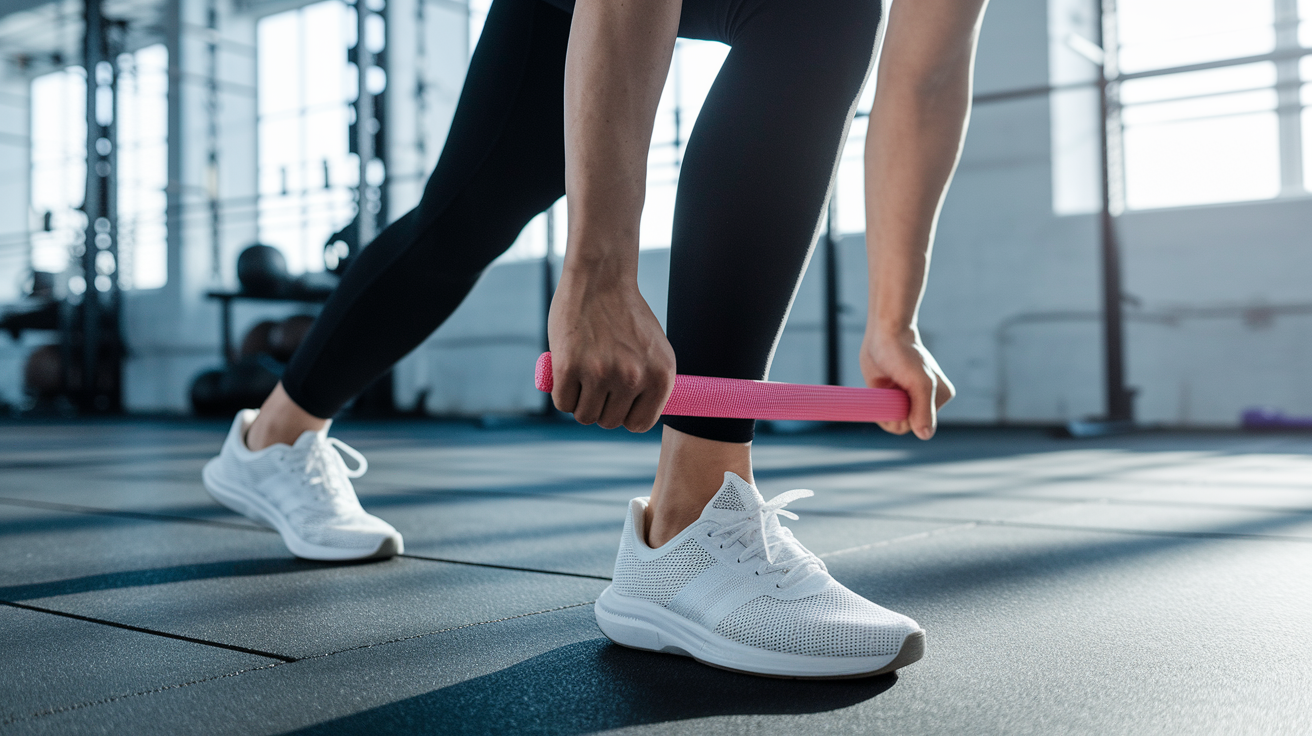
Step ups are generally knee friendly and joint friendly, but only if you have adequate mobility and use the correct setup. Before any loaded step up session, spend 5 to 10 minutes warming up your hips, ankles, and glutes with dynamic stretches and activation drills. If you experience knee pain during or after step ups, the most common culprits are box height that’s too high, poor knee tracking, or insufficient ankle mobility. Reduce the box height first. Many people can train pain free at 8 to 10 inches who struggle at 12 to 16 inches.
For older adults or anyone returning from injury, step ups offer a low impact way to rebuild leg strength without the spinal load of squats. Use a very low box (4 to 8 inches), prioritize slow tempos (3 to 4 seconds down, 2 seconds up), and perform higher reps (12 to 15 per leg) with bodyweight or very light dumbbells. Hold onto a stable surface lightly if balance is a concern. There’s no shame in using assistance while you build strength and confidence. If you have a history of ACL issues or patellofemoral pain, avoid explosive variations and keep the movement slow and controlled, cueing your knee to track outward slightly to reduce valgus stress.
Ankle mobility is often the hidden limiter in step ups. If your heel lifts off the box or your knee dives forward excessively, your ankle dorsiflexion is likely restricted. Add ankle mobility drills like calf stretches, ankle rocks, and banded distractions to your warm up, and consider using a slightly lower box until your range improves.
Four Essential Warm Up Elements:
- Glute activation: banded clamshells or lateral walks for 2 sets of 15 reps to wake up hip stabilizers
- Ankle mobility: ankle rocks or wall dorsiflexion stretches for 10 reps per side
- Quad and hip prep: leg swings (forward/back and side to side) for 10 reps per leg
- Core bracing: dead bugs or planks for 2 sets of 20 seconds to prepare spinal stability
A Complete Sample Step Ups Workout Template (Strength, Muscle, or Conditioning Focus)
A well structured step ups workout balances targeted unilateral work with complementary movements that round out your leg training. The template below includes warm up, main work, and finishers, with progressions built in over four weeks. You can adjust the focus (strength, hypertrophy, or conditioning) by changing the load, reps, and rest intervals as outlined earlier, but the structure stays the same.
Start every session with a 5 to 10 minute warm up that includes light cardio (rowing or bike), dynamic stretches for the hips and ankles, and glute activation drills. Move into your main step up sets, then follow with 1 to 2 accessory exercises that target the posterior chain or address any weak points. Finish with optional core work or a short conditioning finisher if your goal is fat loss or work capacity.
Four Week Progression Plan:
-
Week 1: Perform 3 sets of 10 bodyweight step ups per leg on an 8 inch box. Focus on perfect form, slow eccentric (3 seconds), and full hip extension at the top.
-
Week 2: Add light dumbbells (10 to 15 pounds per hand) and complete 3 sets of 10 reps per leg. Maintain the same box height and tempo.
-
Week 3: Increase load to moderate dumbbells (20 to 25 pounds per hand) and drop to 3 sets of 8 reps per leg. Increase box height to 10 to 12 inches if form stays clean.
-
Week 4: Progress to heavier dumbbells (30 to 40 pounds per hand) and perform 4 sets of 6 to 8 reps per leg, or introduce barbell step ups at a lower box height (8 to 10 inches) for advanced lifters.
Sample HIIT and Conditioning Options:
- 4 rounds of 45 seconds alternating step ups, 15 seconds rest, then 45 seconds kettlebell swings, 15 seconds rest
- 3 rounds of 60 seconds continuous step ups (bodyweight), 60 seconds rowing, 90 seconds rest between rounds
- Tabata style step ups: 20 seconds max effort step ups, 10 seconds rest, repeat for 8 rounds (4 minutes total)
Final Words
You practiced the setup, lifted the back toes, drove up through the front leg, paused at the top, and lowered with a slow 2 to 4 second eccentric. Those steps build unilateral strength, balance, and cleaner knee tracking.
You also covered equipment options, the main muscles involved, useful variations, programming ranges, and quick fixes for common mistakes. Regressions and progressions let you scale work each week.
Keep using the step ups workout as a regular habit, and small, steady practice adds up fast.
FAQ
Q: What are step-up exercises good for?
A: Step-up exercises are great for building single-leg strength, fixing side-to-side imbalances, and boosting balance. They target glutes, quads, and hamstrings while being joint-friendly and useful for stairs, hiking, and daily movement.
Q: Can a 60 year old woman get a six pack?
A: A 60-year-old woman can improve core strength and may reveal abdominal definition with consistent core and full-body training plus protein-forward nutrition; visible abs depend on body fat, hormones, and genetics.
Q: What is the most neglected muscle?
A: The gluteus medius is often the most neglected muscle. It stabilizes the hip, aids balance, and helps proper knee tracking—targeting it reduces imbalance and lowers injury risk.
Q: Can leg workouts reduce knee pain?
A: Leg workouts can reduce knee pain by strengthening quads, glutes, and hamstrings to improve stability and movement. Progress gradually, pick knee-friendly options, and see a clinician if pain continues.