
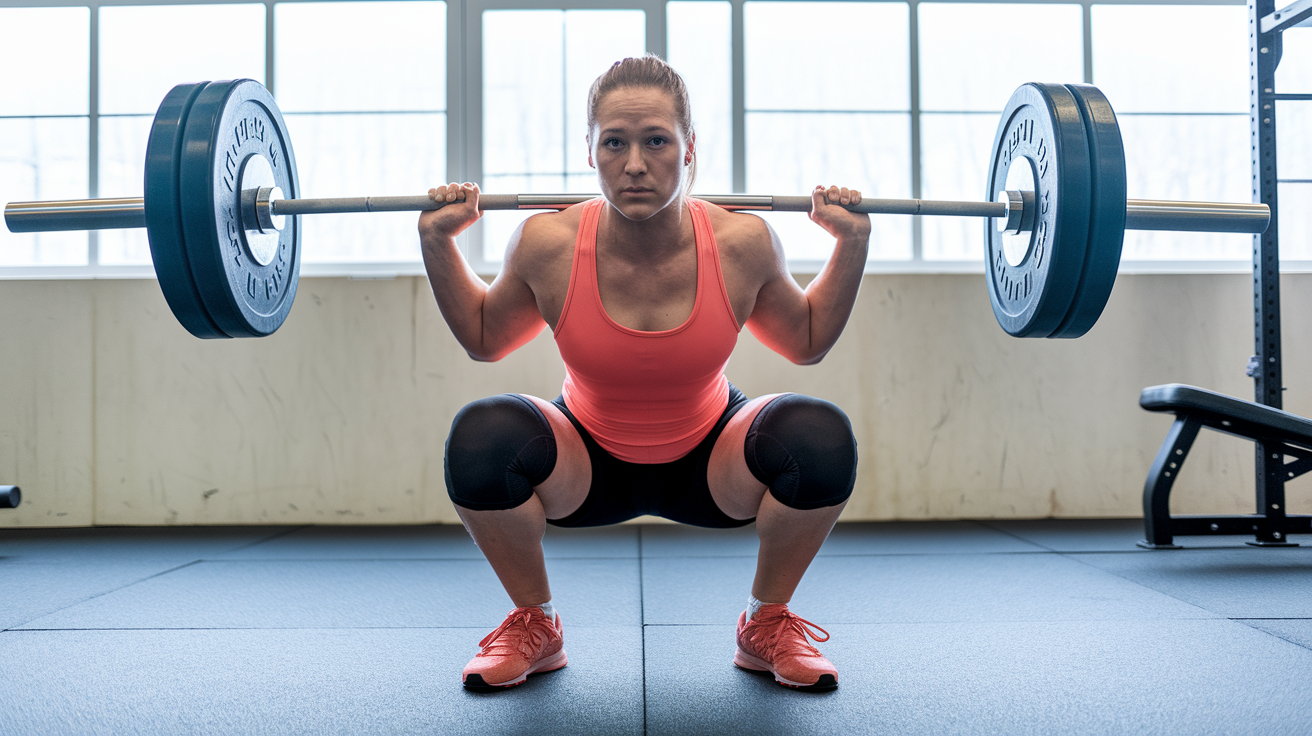
Think you need to live at the gym to build muscle?
You don’t.
With 3 to 4 workouts a week, 45 to 75 minutes each, you can learn the big lifts, get stronger, and add real muscle without burning out.
This beginner plan gives a simple, full-week template that lays out three full-body days or an optional four-day push/pull/legs split so you know what to do each session.
It focuses on compound moves, steady progression, and recovery so you make real, sustainable gains even with a busy life.
A Complete Beginner-Friendly Muscle Building Workout Plan (Full Weekly Template)
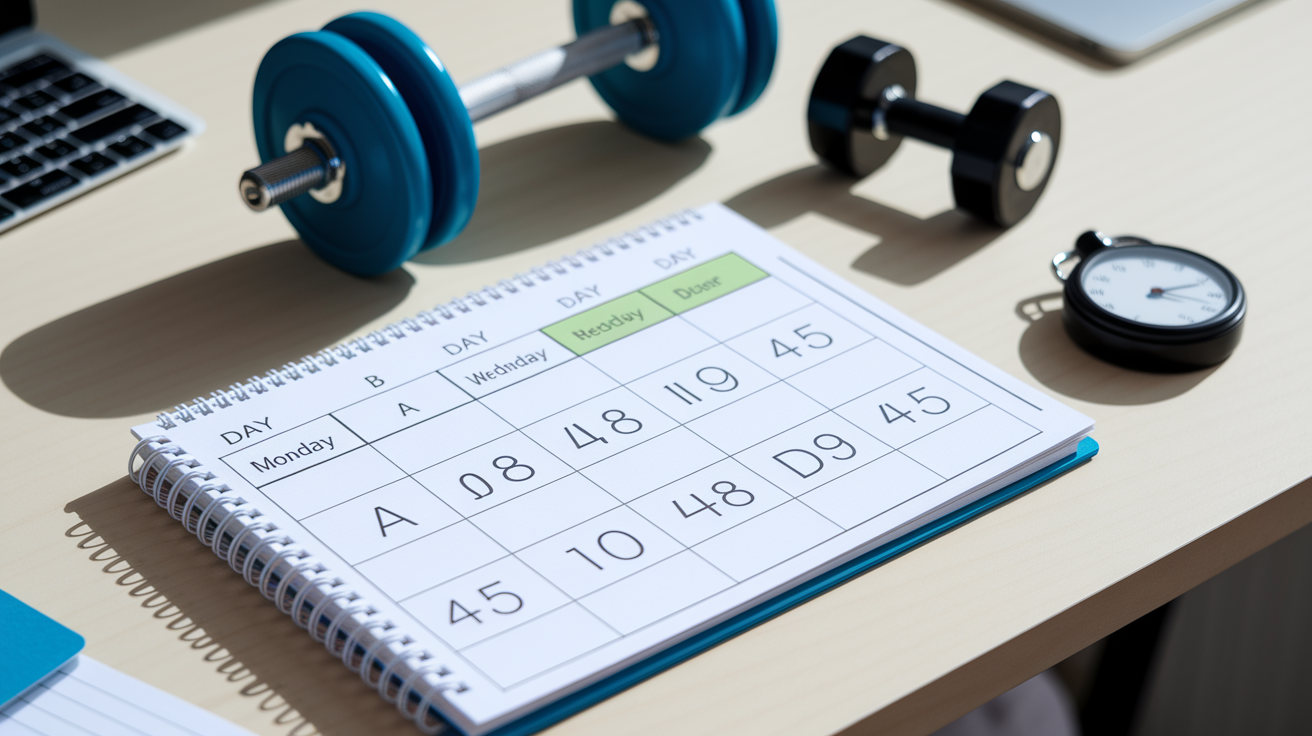
You can build muscle with 3–4 sessions a week, 45–75 minutes each. That’s enough to hit the major muscle groups, learn proper form, and trigger growth without camping out at the gym. Most beginners do best with full-body training three times a week. Monday, Wednesday, Friday works. Weekends and off days are for recovery. If you’ve got four days available, a push/pull/legs split spreads things out and gives each muscle group more focused attention.
Each session revolves around big compound movements that involve multiple joints and muscle groups at once. Squats, bench press, deadlifts, overhead press, barbell rows, pull-ups or lat pulldowns. These exercises deliver the most bang for your effort. A typical full-body day includes one lower-body push (squat or leg press), one upper-body push (bench or overhead press), one upper-body pull (row or pull-up), and a core or accessory movement to finish. Keep sets in the 3–4 range per exercise, with reps between 8 and 12 for most lifts.
Stick to this structure and you’ll see measurable strength increases within 2–4 weeks. Lean muscle gain over eight weeks typically lands around 4–8 pounds when training and nutrition line up. That pace is sustainable and safe, especially when you’re learning how to lift correctly and building work capacity for the first time.
Weekly full-body template (3 days per week):
- Day A (Monday): Barbell back squat 3×8–10, bench press 3×8–10, barbell row 3×8–10, plank 3×45–60 seconds
- Day B (Wednesday): Deadlift 3×5–8, overhead press 3×8–10, pull-up or lat pulldown 3×6–10, Romanian deadlift 3×8–10
- Day C (Friday): Front squat or goblet squat 3×8–12, incline dumbbell press 3×8–12, dumbbell row 3×8–12, walking lunges 3×8–12 per leg
- Rest days: Tuesday, Thursday, Saturday, Sunday
- Session length: 45–75 minutes including warm-up and cool-down
- Progression: Add weight or reps each week when you complete all sets within the target range
Key Muscle-Building Exercises for Beginners (Compounds to Prioritize)

Compound lifts move multiple joints and recruit large amounts of muscle in a single movement. They’re efficient for building strength and size, especially when you’re new and every session counts. Squats, deadlifts, bench press, overhead press, and barbell rows form the foundation of nearly every beginner muscle building workout plan because they train the legs, chest, back, shoulders, and core all at once.
You’ll perform 3–5 working sets of each main lift, resting 90–180 seconds between sets to allow full recovery before the next effort. Form matters more than the number on the bar. Learning proper cues early prevents bad habits and keeps you training consistently without setbacks.
Squat
Stand with feet roughly hip-width apart and toes slightly turned out. Your knees should track in the same direction as your toes throughout the movement. Keep your chest up and push your hips back as you descend, like sitting into a chair. Go as deep as your mobility allows while keeping your lower back neutral and your heels planted on the floor. Brace your core before each rep. Pull your ribcage down toward your hips and tighten your abs like someone’s about to poke your stomach.
Deadlift
Set up with the barbell over the middle of your feet, close to your shins. Hinge at the hips and grab the bar with both hands just outside your legs. Pull your chest up and keep your spine neutral. No rounding through your lower back. Push the floor away with your legs as you stand up, driving through your heels. Lock your hips at the top by squeezing your glutes, but don’t lean back or hyperextend your lower back.
Bench Press
Lie on the bench with your shoulder blades pulled back and down. Imagine pinching a pencil between them. Plant your feet flat on the floor. Grip the bar slightly wider than shoulder width. Lower the bar to your lower chest in a controlled motion, keeping your elbows at about a 45-degree angle from your torso. Press the bar back up by driving through your chest and using leg drive for stability.
Overhead Press
Stand with your feet about hip-width apart and the barbell resting on your front shoulders. Brace your core and keep your ribcage stacked over your hips. Press the bar straight up, moving your head slightly back to let the bar clear your face. Lock your elbows overhead and finish with the bar directly over the middle of your foot. Lower the bar with control back to your shoulders.
Beginner Sets, Reps, Rest, and Tempo for Muscle Growth
The primary hypertrophy rep range sits between 8 and 12 reps per set. That range balances enough weight to challenge the muscle with enough reps to accumulate fatigue and stimulate growth. Occasionally you’ll see strength-focused blocks with 5–8 reps using heavier loads, and accessory work might go up to 12–15 reps for a pump and extra volume. Beginners should aim for 10–20 total sets per muscle group each week, spread across all your sessions, to trigger adaptation without overdoing recovery demands.
Rest intervals depend on the exercise. For lighter accessory movements like dumbbell curls or lateral raises, 60–90 seconds is plenty. For heavy compound lifts like squats and deadlifts, take 90–180 seconds so your muscles and nervous system can recover enough to perform the next set with good form and intensity. Cutting rest too short turns strength work into cardio. That’s not the goal here.
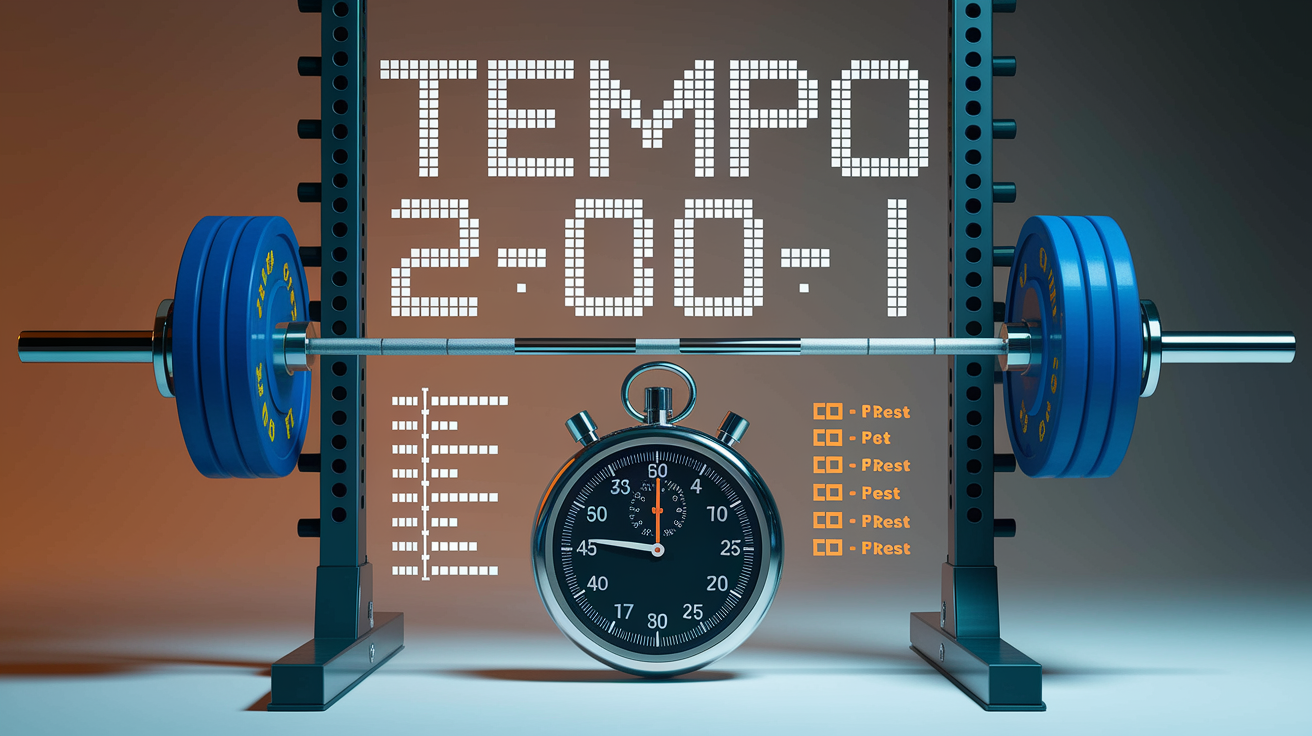
Tempo guidelines for controlled reps:
- Lower the weight for about 2 seconds (eccentric phase)
- Pause briefly at the bottom, 0 to 1 second
- Lift the weight explosively but with control (concentric phase)
- Example tempo notation: 2-0-1 (2 seconds down, no pause, 1 second up)
Warm-Up and Mobility Routine Before Lifting

A proper warm-up takes 5–10 minutes and prepares your joints, muscles, and nervous system for the work ahead. Start with light cardio. Bike, row, or a slow jog. Just enough to raise your heart rate and break a light sweat. Follow that with dynamic stretches and mobility drills that match the movements you’re about to do. Save static stretching for after the session when your muscles are warm and pliable.
Before you load the barbell for your first working set, run through 2–4 progressively heavier ramp sets. Start with the empty bar, then add weight in small jumps until you reach your working load. These ramp sets groove the movement pattern and give your body a chance to adjust to heavier weights without causing fatigue that interferes with your actual training sets.
Dynamic warm-up drills (pick 3–5 and perform 8–12 reps each):
- Arm circles forward and backward to open the shoulders
- Bodyweight walking lunges to activate hips and legs
- Leg swings front-to-back and side-to-side for hip mobility
- Inchworms or walkouts to warm the core and hamstrings
- Cat-cow stretches or thoracic rotations if you’re squatting or pressing that day
Progressive Overload for New Lifters
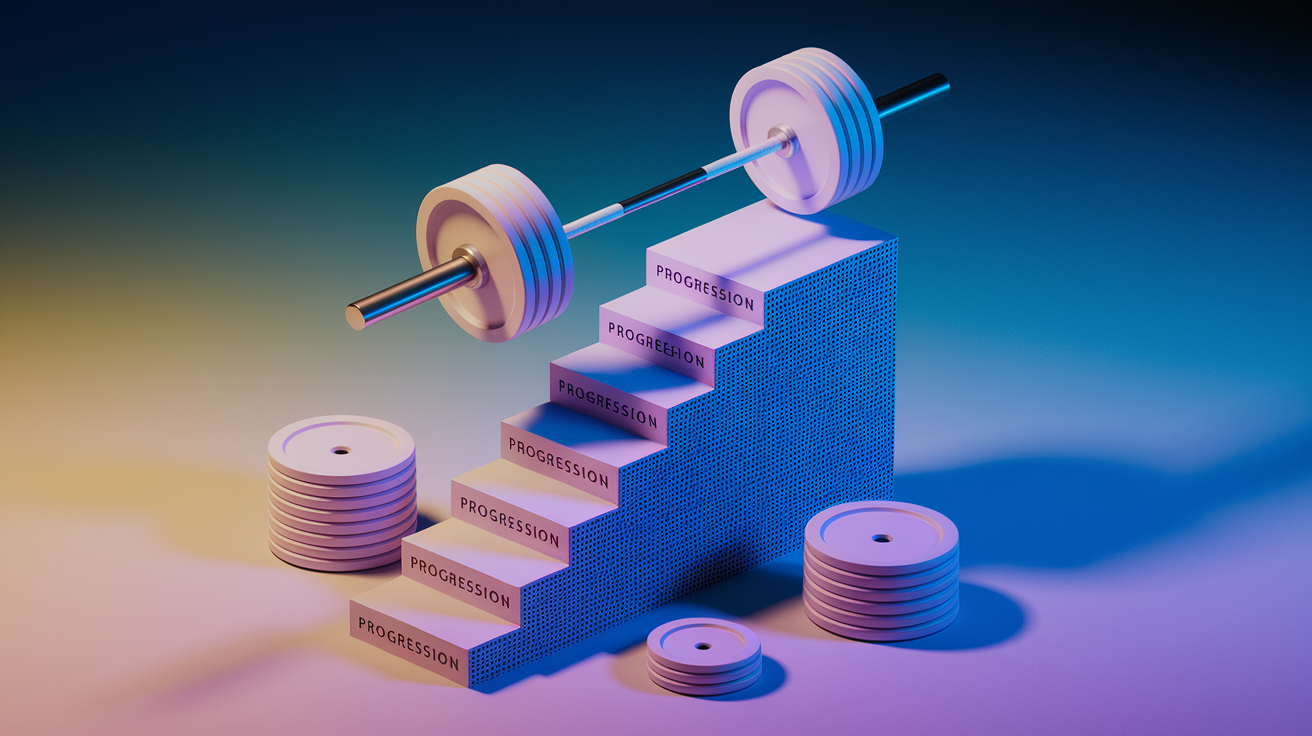
Progressive overload means doing a little more over time. More weight, more reps, or more total sets. For beginners, the simplest method is linear progression: when you complete all your sets and reps within the target range, add a small amount of weight the next session. If you’re hitting 3 sets of 10 reps on the bench press at 95 pounds, try 100 pounds the following week. If you can’t complete all the reps at the new weight, that’s fine. Work up to it over the next session or two, then add weight again.
Tracking every session keeps you honest and helps you spot patterns. Write down the exercise, the weight used, how many reps you completed in each set, how hard it felt (rate of perceived exertion or RPE), and how long you rested. Over a few weeks, you’ll see clear progress in black and white. That removes the guesswork from when to push harder or when to hold steady.
| Current Performance | Next Step |
|---|---|
| Completed all sets at the top of your rep range (e.g., 3×12) | Add 2.5–5% more weight and work back up through the rep range |
| Completed all sets in the middle of the range (e.g., 3×10) | Add 1–2 reps per set next session until you hit the top of the range |
| Stalled at the same weight and reps for 2+ weeks | Add one extra set to each exercise or insert an additional accessory movement |
Beginner-Friendly Training Split Options (Full Body vs PPL)

A full-body routine trains every major muscle group in each session, three times per week. Each day includes 3–4 compound movements. One lower-body push, one upper-body push, one upper-body pull, and one or two accessory exercises. This structure works well for beginners because it maximizes practice frequency on the big lifts, builds motor patterns quickly, and fits into a manageable weekly schedule with plenty of rest days.
A push/pull/legs split divides the work by movement type. Push days cover chest, shoulders, and triceps. Pull days handle back and biceps. Legs days focus on quads, hamstrings, glutes, and calves. This split typically runs four days per week. Push, pull, legs, then either a second push day or a full accessory session. It gives each muscle group more focused volume in a single session and can feel less fatiguing per workout because you’re not training everything at once.
Full-body advantages:
- High frequency on major lifts (practice squat, bench, deadlift multiple times per week)
- Simpler scheduling with only three training days
- Easier recovery management for true beginners still building work capacity
Push/pull/legs advantages:
- More total volume per muscle group in one session
- Less overlap between sessions, so fatigue from one day doesn’t carry into the next as much
- Flexibility to add extra accessory work without making sessions too long
Sample 4-Week Beginner Muscle Building Program
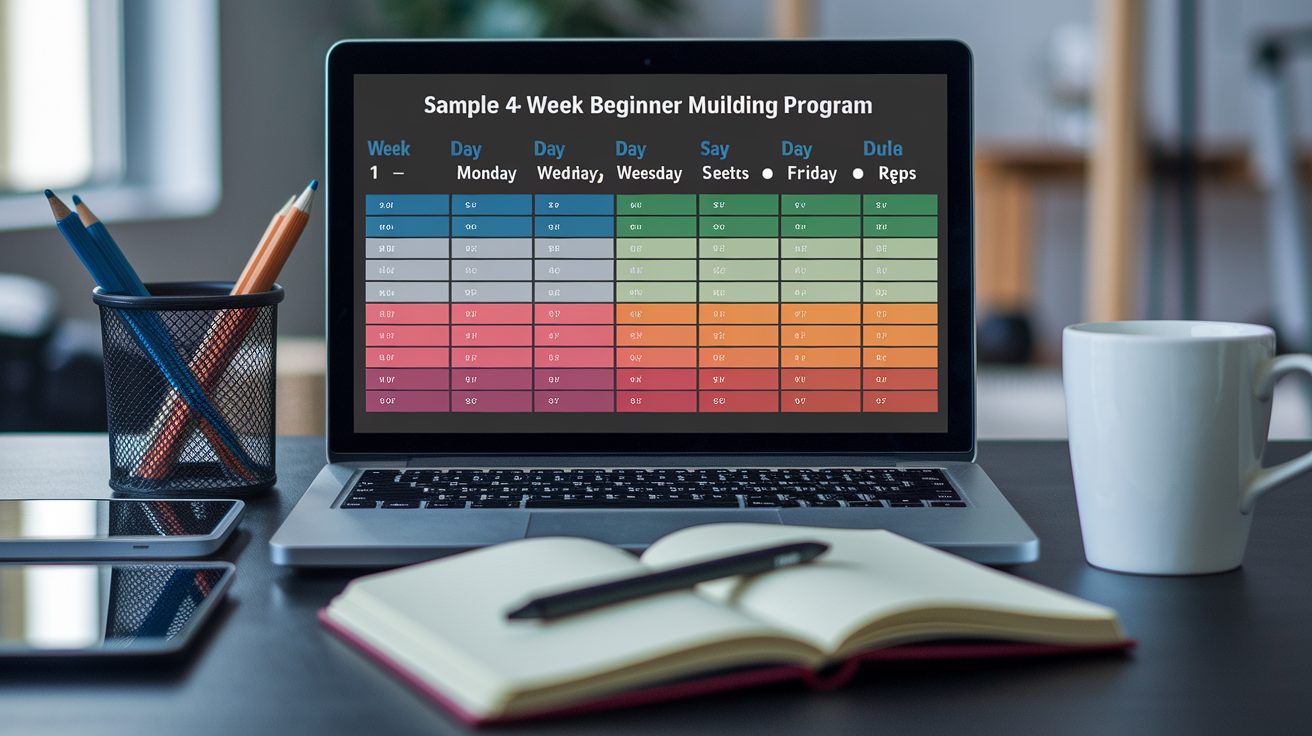
The first four weeks of a beginner muscle building workout plan focus on learning technique, building work capacity, and establishing consistent training habits. You’ll use moderate weights that allow full control through the entire rep range, and the volume stays manageable so recovery never becomes a limiting factor. The goal isn’t to set personal records every session. It’s to show up, move well, and slowly increase the challenge as your body adapts.
Sessions include the core barbell movements. Squat, bench press, deadlift, overhead press, and barbell row, along with pull-ups or lat pulldowns and one or two accessory exercises. Sets stay in the 3–4 range per exercise, and reps typically fall between 8 and 12. Rest days are built into the schedule to allow muscles to recover and grow. By the end of week four, you should feel noticeably stronger, more confident under the bar, and ready to handle slightly heavier loads.
This sample program uses a three-day full-body structure, training Monday, Wednesday, and Friday. If you prefer a four-day push/pull/legs split, you can rearrange these exercises across four sessions instead, grouping push movements together, pull movements together, and leg movements on their own day.
| Week | Day | Exercises (Sets × Reps) |
|---|---|---|
| 1–2 | Monday | Barbell back squat 3×8–10, bench press 3×8–10, barbell row 3×8–10, plank 3×45s |
| 1–2 | Wednesday | Deadlift 3×5–8, overhead press 3×8–10, lat pulldown 3×8–10, Romanian deadlift 3×8–10 |
| 1–2 | Friday | Goblet squat 3×10–12, incline dumbbell press 3×8–12, dumbbell row 3×8–12, walking lunges 3×10 per leg |
| 3–4 | Monday | Barbell back squat 4×8–10, bench press 4×8–10, barbell row 4×8–10, hanging knee raises 3×10 |
| 3–4 | Wednesday | Deadlift 3×5–8, overhead press 4×8–10, pull-ups 3×6–10, leg curls 3×10–12 |
| 3–4 | Friday | Front squat 3×8–10, dumbbell bench press 3×10–12, seated cable row 3×10–12, Bulgarian split squat 3×8 per leg |
| All weeks | Rest days | Tuesday, Thursday, Saturday, Sunday |
Nutrition Basics for Beginner Muscle Gain

Building muscle requires enough raw material for your body to repair and grow tissue. That means eating in a slight calorie surplus, about 250–500 calories above what you burn each day. You don’t need a huge surplus. Eating too much just adds unnecessary fat without speeding up muscle growth. A small, consistent surplus gives your body what it needs without overshooting.
Protein is the most important macronutrient for muscle building. Aim for 0.7–1.0 grams of protein per pound of bodyweight, or 1.6–2.2 grams per kilogram if you prefer metric. That means a 150-pound beginner should target roughly 105–150 grams of protein daily, spread across three or four meals. Chicken, fish, eggs, Greek yogurt, lean beef, and protein powder all count. Carbohydrates fuel your training sessions and help with recovery, so don’t cut them too low. Healthy fats support hormone production and overall health. Hydration matters too. Drink 2.5–4 liters of water per day depending on your size and activity level.
Nutrition targets for beginner muscle gain:
- Calorie surplus: +250–500 calories per day above maintenance
- Protein: 0.7–1.0 g per pound of bodyweight (1.6–2.2 g per kilogram)
- Carbohydrates: prioritize around training sessions for energy and recovery
- Hydration: 2.5–4 liters of water daily, more if you sweat heavily or train in heat
Recovery Habits That Support a Beginner Muscle Building Workout Plan

Muscle doesn’t grow in the gym. It grows when you’re resting, eating, and sleeping. Beginners often underestimate how much recovery contributes to progress, especially in the first few months when your body is adapting to a new training stimulus. Sleep is the single most important recovery tool. Aim for 7–9 hours per night. During deep sleep, your body releases growth hormone, repairs damaged muscle fibers, and consolidates the motor patterns you practiced during training.
Hydration supports every recovery process in your body, from nutrient transport to waste removal. Stick to the 2.5–4 liter daily target, and drink more on training days. After four to six weeks of consistent training, some beginners benefit from a deload week. Reduce the weight by 40–60% or cut the total number of sets in half for one week. This gives your joints, tendons, and central nervous system a chance to catch up without losing momentum. If you’re feeling persistently sore, sleeping poorly, or your lifts start moving backward instead of forward, a deload is usually the fix.
Common Beginner Mistakes When Starting a Muscle Building Plan

The biggest mistake beginners make is adding weight too fast. You get excited after a good session, throw an extra 10 pounds on the bar the next week, and suddenly your form breaks down. Progressive overload works when it’s gradual. Jumping ahead by more than 2.5–5% per session increases injury risk and teaches bad movement patterns that take weeks to unlearn.
Skipping warm-ups is another common shortcut that backfires. Walking straight to the squat rack and loading your working weight without any ramp sets or mobility work is a recipe for strains and tweaks. Your body needs time to prepare for heavy loads. Poor technique under load is the third big issue. Chasing numbers on the bar instead of controlling the weight through a full range of motion with proper form. If you can’t complete a rep without your lower back rounding, your elbows flaring out, or your knees caving in, the weight is too heavy.
Mistakes to avoid:
- Increasing weight too quickly (more than 2.5–5% per session)
- Neglecting warm-up sets and mobility drills before lifting
- Prioritizing heavy loads over proper form and full range of motion
- Eating too little protein or staying in a calorie deficit while trying to build muscle
- Skipping rest days or training the same muscles without 48 hours of recovery
- Not tracking workouts, which makes it impossible to know if you’re progressing
Tracking Progress in a Beginner Muscle Building Routine
Without tracking, you’re guessing. Write down the weight, sets, reps, and how hard each set felt every time you train. A simple notebook works fine. Note the exercise name, the load you used, how many reps you completed in each set, and your rest intervals. Over time, you’ll see clear patterns. Weeks where you added reps, sessions where you moved up in weight, or days when fatigue held you back and you needed an extra rest day.
Strength improvements show up first. Most beginners notice they can lift more weight or complete more reps within 2–4 weeks. Visible muscle growth takes longer, typically 6–8 weeks before you or others start to notice changes in size. True beginners can gain roughly 4–8 pounds of lean muscle over an eight-week program when training and nutrition are dialed in. That pace slows down after the first few months, but the initial “newbie gains” phase is real and worth capturing while it lasts.
What to track each week:
- Weight used for each exercise and number of reps completed per set
- Rate of perceived exertion (RPE) on a scale of 1–10 for your hardest sets
- Total weekly volume per muscle group (sets × reps × load)
- Body measurements (optional): waist, chest, arms, thighs to monitor size changes over time
Final Words
Get moving: pick a 3- or 4-day schedule, focus on squats, bench, deadlift, overhead press, rows, and pull-ups, and use 8–12 reps for most work.
Warm up with light cardio and ramp sets, follow simple progression rules (add small weight or reps), and keep sessions around 45–75 minutes.
Track lifts, eat enough protein, sleep, and don’t skip recovery. This beginner muscle building workout plan gives a clear, doable path. Start small, stay consistent, and you’ll see steady progress.
FAQ
Q: How often should a beginner train and how long are sessions?
A: Beginners should train 3–4 days per week, with sessions lasting 45–75 minutes. Use full-body 3×/week or PPL 4×/week, focus on core compounds, and include warm-up plus a couple accessories.
Q: Should I do full-body or push/pull/legs as a beginner?
A: Choosing full-body or PPL depends on schedule and recovery: full-body 3×/week is simple and frequent; PPL 4×/week gives more volume and focus—pick what you can do consistently.
Q: Which exercises should beginners prioritize?
A: Beginners should prioritize compound lifts: back squat, deadlift, bench press, overhead press, and barbell row. These build strength and muscle efficiently—learn basic cues and practice light sets for technique.
Q: What sets, reps, and rest should beginners use for muscle growth?
A: Use hypertrophy sets of 8–12 reps, 3–4 working sets per lift. For strength phases use 5–6 reps. Rest 90–180 seconds for compounds and 60–90 seconds for accessory work.
Q: What warm-up and mobility should I do before lifting?
A: Warm up with 5–10 minutes light cardio, dynamic mobility, then 2–4 ramp sets before heavy lifts. Include leg swings, hip circles, band pull-aparts, shoulder dislocates, and inchworms for readiness.
Q: How do I progress safely as a new lifter?
A: Progress by adding 2.5–5% load or 1–2 extra reps once you hit target reps. Track weights, reps, and RPE so you know when to increase load, volume, or session difficulty.
Q: What does a 4-week beginner program look like and what should I expect?
A: A 4-week beginner program emphasizes technique and work capacity with squats, presses, rows, deadlifts, and lunges, 3–4 sets of 8–12 reps. Expect strength improvements in weeks 2–4 and modest gains over time.
Q: How should I eat to gain muscle as a beginner?
A: To gain muscle aim for a daily calorie surplus of 250–500 kcal and protein 0.7–1.0 g per pound (1.6–2.2 g/kg). Drink 2.5–4 L water daily and prioritize whole, protein-forward meals most days.
Q: How much rest and recovery do beginners need?
A: Beginners should aim for 7–9 hours sleep, 2.5–4 L hydration, and plan a deload every 4–6 weeks (reduce load 40–60%). Active recovery, walking, and mobility speed return to training.
Q: What common mistakes should I avoid starting a muscle-building plan?
A: Common mistakes include progressing too fast, poor technique, skipping warm-ups, insufficient protein/calories, not tracking workouts, and neglecting sleep. Fix by slowing increases and tracking consistently.
Q: How should I track progress and when will I see results?
A: Track lifts, loads, reps, RPE, and weekly volume; take monthly photos or measurements. You may notice strength gains in 2–4 weeks—use the data to tweak training and nutrition.