
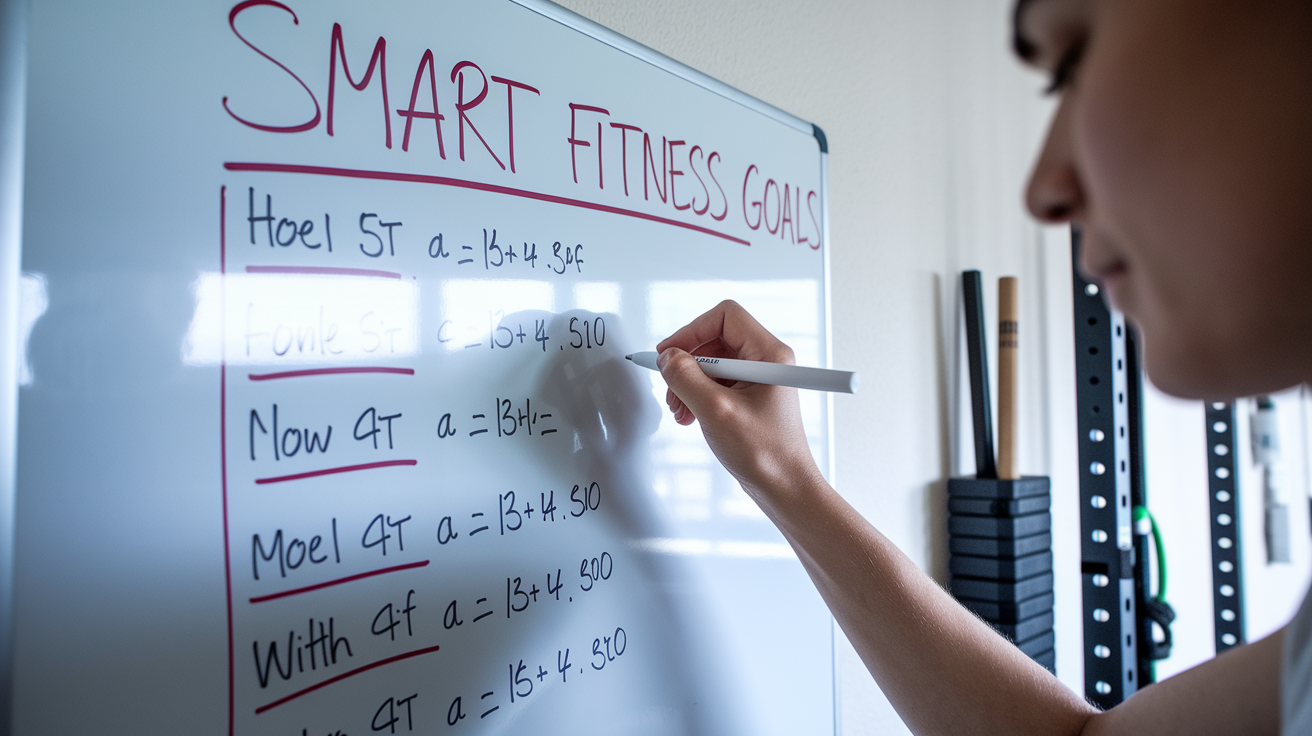
What if most fitness goals fail before you lace up your shoes?
Vague aims like “get fit” sound motivating, but they leave you guessing and quitting.
SMART goals—specific, measurable, achievable, relevant, time-bound—turn fuzzy intentions into clear plans you can schedule, track, and finish.
That clarity makes skipped workouts obvious, small wins visible, and progress steady instead of random.
In this post you’ll learn how to write SMART fitness goals you can actually stick to and use this week to get better results.
Defining SMART Criteria for Effective Fitness Goals

Vague stuff like “get fit” or “exercise more” sounds good when you say it out loud. But it falls apart fast. You don’t know what counts as success, when you’re done, or if missing two days means you failed. SMART goals fix this by turning every intention into something real—something you can see, track, and finish.
SMART means Specific, Measurable, Achievable, Relevant, and Time-bound. Each part adds structure so you don’t drift. Specific means you pick an actual target. “Walk 10,000 steps per day” instead of “walk more.” Measurable gives you units: miles, steps, pounds lifted, pounds lost, minutes. Achievable checks if your target makes sense from where you are now. If 10,000 steps feels impossible, then 6,000 becomes your starting point. Relevant makes sure the activity matches what you’re trying to do. If you need flexibility, adding five more miles won’t help like a daily stretch routine will. Time-bound sets a deadline. Short-term goals wrap up in six months or less, long-term stretches past that.
- Specific — “Walk 10,000 steps per day” instead of “be more active.”
- Measurable — Track steps, pounds lifted, pounds lost, miles, minutes. Use fitness trackers, smartwatches, written logs.
- Achievable — Start where you are. If 10,000 steps is too much, go for 6,000 and build up.
- Relevant — Pick activities that match your goal. Want flexibility? Focus on stretching, not distance running.
- Time-bound — Goals under six months are short-term, beyond that are long-term. Set checkpoints along the way.
SMART criteria turn motivation into momentum. You know what you’re doing today, what it’s building toward, and when you’ll check if it worked. That specificity makes skipped workouts obvious and progress undeniable.
How to Set SMART Fitness Goals Step-by-Step

Creating a SMART fitness goal starts with an honest look at where you are right now. If you don’t know your current step count, typical lifting loads, or average workout minutes, you’re guessing. Not planning. Baseline assessment stops unrealistic jumps and grounds your target in what you can actually do.
- Figure out your baseline — Log your current steps, weights, workout times, or body metrics for at least a week to get an honest starting point.
- Write a specific and measurable target — Pick a number and a unit: “8,000 steps per day, five days per week” or “squat 3×5 at 155 pounds.”
- Make sure it’s attainable from where you are — If you’re at 5,000 steps today, aim for 6,000 first, then 8,000, then 10,000 over weeks. Staged targets stop burnout.
- Check if it’s relevant — Ask why this goal matters to your health, function, or sport. If the answer’s weak, pick something else.
- Set a deadline with milestones — Use weekly or monthly checkpoints (hit 6,000 steps by week 2, 8,000 by week 4, 10,000 by week 6) and a final deadline.
- Put workouts on your calendar — Block specific times and treat them like meetings you can’t skip. Record progress after every session.
Scheduling removes the daily “when should I work out?” question and replaces it with a pre-committed block. Treat exercise like a meeting with yourself. Put it in your calendar, set a reminder, prep what you need the night before. Calendar blocks also make it obvious when life conflicts pop up, so you can reschedule instead of just skipping.
SMART Goal Examples for Fitness Results (Weight Loss, Strength, Endurance)

Comparing a vague goal to a SMART version shows where clarity actually lives. The vague version leaves you guessing if you did enough. The SMART version gives you a checklist you can mark complete or incomplete every week.
The table below shows how specificity turns common fitness aims into plans with measurable outcomes and realistic timelines.
| Goal Type | Bad Example | SMART Example |
|---|---|---|
| Weight Loss | “Lose weight.” | “Lose 12 pounds in 3 months by doing 150 minutes per week of moderate cardio, two full-body strength sessions per week, and maintaining a 300 to 500 calorie per day deficit. Track weight weekly.” |
| Strength | “Get stronger.” | “Increase barbell back squat from 150 lb to 190 lb in 4 months by squatting twice per week with progressive sets of 3 to 5 reps, tracking load each session.” |
| Endurance | “Improve cardio.” | “Run a 10K in under 55 minutes within 12 weeks by following a 3-run per week plan (one interval session, one tempo run, one long run), tracking pace and distance with a GPS watch.” |
Each SMART example includes a number you can hit or miss, a timeline that creates urgency, and behaviors you can schedule. That specificity doesn’t just improve results. It increases your chances of sticking with the plan because you always know if you’re on track or need to adjust.
Templates and Worksheets for Writing SMART Fitness Goals

Templates reduce the overwhelm of starting from scratch. They give you a proven structure to fill in with your own numbers. When goal setting feels complicated, a simple plug-and-play format keeps you moving instead of stuck.
Here are two fill-in-the-blank SMART templates you can use right now. For a daily habit goal: “I will [activity] for [duration/units] at [intensity] on [days per week] to achieve [measurable outcome] by [date].” Example: “Walk 8,000 steps per day, five days per week, to average 56,000 steps per week for 12 weeks (target date: August 15, 2026).” For a strength goal: “Increase my [exercise] 1-rep max from [current lb/kg] to [target lb/kg] in [months] by training [sessions per week] with progressive overload.” Example: “Increase my bench press 1-rep max from 135 lb to 155 lb in 8 weeks by training three sessions per week with progressive sets.”
- Date — The day you completed the session.
- Activity — Type of workout (run, lift, walk, stretch).
- Duration/Distance/Steps — Time spent, miles covered, or steps logged.
- Intensity or Weight — Heart rate zone, perceived effort, or pounds lifted.
- Measured Value vs Target — Your result compared to your weekly or daily target.
Add a weekly summary row at the bottom of your log to total minutes, steps, distance, or best lifts. That summary shows if you hit your process goals for the week and reveals patterns like consistently missing Friday sessions that need scheduling fixes.
Tracking Fitness Progress Using SMART Metrics

Objective metrics eliminate guesswork. They replace “I think I’m doing better” with “I ran 90 seconds faster this month.” Feedback loops built on real numbers keep you going when progress feels invisible and help you course-correct before small gaps become big problems.
- Fitness trackers and smartwatches — Monitor steps, distance, heart rate, active minutes automatically. Sync data to apps for trend analysis.
- Written logs — Record workouts in a notebook or spreadsheet with date, time, activity, key metrics. Useful for spotting weekly patterns.
- Monthly performance tests — Run a timed 5K or test your 10-rep max on key lifts to measure improvement objectively.
- Tracking apps — Use apps that log reps, sets, weights, and calculate volume or intensity over time.
Monthly performance tests give you clear checkpoints. If your SMART goal is to run a 10K in under 55 minutes within 12 weeks, schedule a 10K time trial at weeks 4, 8, and 12. If you’re trying to increase your squat, test your 10-rep max every four weeks. Those tests provide proof your process is working or signal when you need to adjust volume, intensity, or recovery.
Tracking also makes small wins visible. When you see your average weekly step count climb from 42,000 to 56,000 over six weeks, that progress becomes fuel to keep going. Especially on days when you don’t feel like moving.
Accountability Strategies That Support SMART Fitness Goals
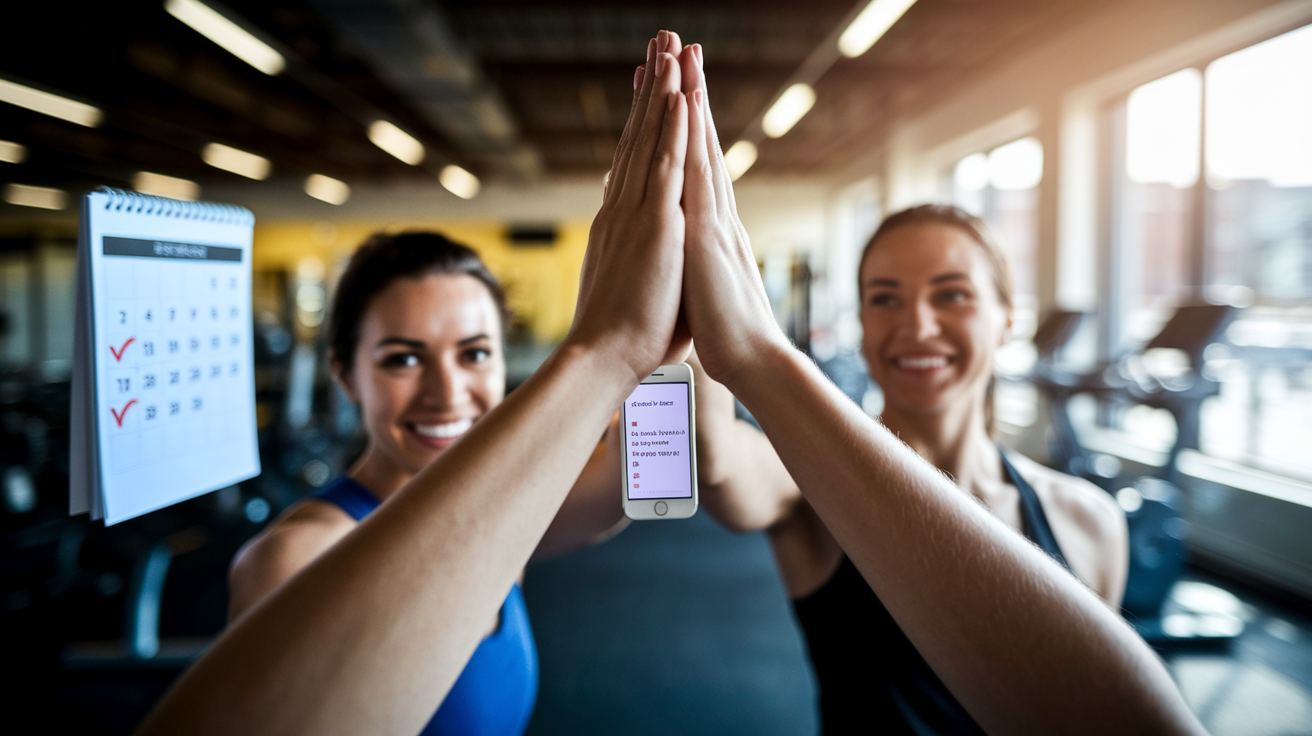
Accountability turns private intentions into shared commitments. And shared commitments are harder to ignore when your alarm goes off at 6 a.m. External support doesn’t replace your discipline, but it creates friction against skipping that makes consistency easier.
Use a daily checklist tied to your SMART goal. If your goal is three strength sessions per week, check off each session as you complete it. Share your goal with a friend, family member, or workout buddy who’ll ask how it’s going and notice when you go quiet. Partner accountability works especially well when it’s practical. Someone who gives you a ride to the gym, texts you before your scheduled session, or meets you for a walk creates logistical momentum that makes showing up the path of least resistance.
Research from 2015 shows that self-regulation improves when you schedule difficult tasks earlier in the day, before competing demands drain your energy and decision-making capacity. If your hardest workout is interval training, put it in your calendar for morning rather than evening. You’ll face fewer excuses and more follow-through because you haven’t spent the day building up reasons to skip.
Common Mistakes When Setting SMART Fitness Goals

Avoiding predictable mistakes improves your odds of long-term follow-through more than adding extra motivation ever will. Most goal failures come from structural problems, not lack of willpower. Vague targets, ignored baselines, overloaded priorities.
- Setting vague outcomes — Goals like “get in shape” or “work out more” have no measurable unit or deadline, so you never know if you succeeded.
- Ignoring your baseline — Jumping from 3,000 steps per day to 10,000 without intermediate targets leads to burnout or injury. Staged progression stops overreach.
- Overloading multiple big goals at once — Trying to lose weight, build strength, and train for a race at the same time splits focus and increases dropout risk. Prioritize one primary goal.
- Failing to track progress — Skipping logs or measurements means you can’t spot trends, celebrate wins, or correct course when something isn’t working.
- Losing sight of your motivating “why” — When you forget why the goal matters to your health or life, adherence drops. Revisit and restate your reason regularly.
Correcting these mistakes doesn’t require more discipline. It requires better structure. A SMART goal with tracking, staged targets, and a clear reason will carry you further than vague ambition and daily willpower ever could.
Adjusting, Evolving, and Reviewing SMART Fitness Goals Over Time

SMART goals aren’t carved in stone. They’re iterative. Life changes, progress stalls, priorities shift, and rigid plans break under real-world pressure. The goal is to build a habit of setting, tracking, reaching, and resetting goals in manageable cycles. Typically one to three months for short-term targets, beyond six months for bigger outcomes.
Schedule weekly or monthly reviews where you compare your tracked metrics to your milestones. If you aimed to hit 8,000 steps per day by week four but you’re averaging 6,500, ask if the target was too aggressive, if life circumstances changed, or if you need to adjust your schedule. Monthly reviews also let you celebrate progress like running your first full 5K or adding 10 pounds to your squat before setting the next SMART goal in the sequence.
When setbacks happen (injury, travel, illness, schedule chaos), pivot to a smaller, more attainable goal instead of abandoning the system. If your 12-week plan to run a 10K gets derailed at week six, reset with a 6-week goal to rebuild your base mileage. Revisit your “why” during tough weeks. Remind yourself if this goal still matters and if the process still fits your life.
Small celebrations reinforce progress too. Buy new workout gear after hitting a milestone, share your success with your accountability partner, or simply acknowledge you showed up consistently for a full month. That recognition builds momentum for the next cycle.
Final Words
Start by writing one clear, measurable target—like walk 8,000 steps/day for 12 weeks or increase squat 150→190 lb in four months. These examples show the Specific, Measurable, Achievable, Relevant, Time-bound steps you learned: baseline, realistic ramps (6,000→8,000→10,000), deadlines, and simple tracking.
Use the templates, test progress monthly, and set small check-ins or a buddy for accountability. SMART goals for fitness make progress easier to see and keep you moving forward. Small steps add up. You’ve got this.
FAQ
Q: What is an example of a SMART goal in fitness?
A: An example of a SMART goal in fitness is walk 10,000 steps per day for 12 weeks, five days a week, measurable in steps, achievable from baseline, relevant to daily activity, and time-bound.
Q: What is the 3-3-3 rule for fitness?
A: The 3-3-3 rule for fitness is a simple habit framework: pick three exercises, do three sets each, three times per week for a few weeks, then reassess progress and adjust as needed.
Q: What are the 10 fitness goals examples?
A: Ten fitness goal examples are: walk 8,000 steps/day; run a 5K; run a 10K in 55 minutes; lose 12 lb in 3 months; gain muscle; add 40 lb to squat; do 10 pull-ups; train 4x/week; touch toes; sleep 7 hours.
Q: What are 5 SMART goals examples?
A: Five SMART goals examples are: Walk 8k steps/day, 5 days/week for 12 wks; Lose 12 lb in 3 months (300–500 kcal/day); Increase squat 150→190 lb in 4 months; Run a 10K under 55 min in 12 weeks; Strength train 3x/week.