

What if rest is the missing step, and moving safely, rather than avoiding movement, helps sore knees heal faster?
Low-impact recovery exercises move your knee through safe ranges without pounding, bringing lubrication, blood flow, and gentle strength to sore tissues.
They cut morning stiffness, protect cartilage, and rebuild the muscles that act like shock absorbers so pain doesn’t keep returning.
Below you’ll find simple, at-home moves with clear progressions and easy options for busier or more sensitive days, so you can feel better and stay active.
Key Low-Impact Recovery Exercises That Immediately Help Sore Knees

Low-impact recovery exercises work because they move your knee through safe ranges without the pounding that makes inflammation worse. When you’re sore, the last thing you need is extra compression or shear stress. These movements gently pull synovial fluid through the joint, lubricating cartilage and feeding nutrients to tissues that actually depend on movement to heal. They also keep the muscles around your knee engaged so everything doesn’t stiffen into patterns that make life harder down the road.
Sore knees respond well to controlled, non-compressive work. It maintains blood flow and reduces swelling without triggering pain. Starting with movements that limit how much body weight loads the joint lets you rebuild strength before progressing to heavier demands. Most people notice less morning stiffness and better range of motion within the first week of consistent, gentle activity.
The exercises below target mobility and muscle activation while keeping forces light. You can do each one at home with minimal or no equipment, which makes them practical for busy days or when getting to a gym feels like too much.
Straight-leg raises: Lie on your back with one leg bent and the other extended. Lift the straight leg to hip height, hold one second, lower without touching the floor. 2 to 3 sets of 8 to 12 reps per side.
Quad sets: Sit or lie with legs extended. Press the back of your knee into the floor by tightening your thigh, hold 5 seconds, release. 2 to 3 sets of 10 to 15 reps per leg.
Heel slides: Lie flat. Slowly bend one knee by sliding your heel toward your glutes, then extend back out. Move only as far as comfortable. 2 to 3 sets of 10 to 12 reps per side.
Seated leg extensions: Sit in a sturdy chair. Straighten one knee to lift your foot, pause at the top, lower controlled. 2 to 3 sets of 10 to 12 reps per leg.
Gentle stationary cycling: Set the bike seat so your knee stays slightly bent at the bottom of the pedal stroke. Pedal with minimal resistance for 10 to 20 minutes at a comfortable pace.
Supported mini-squats: Stand facing a counter or sturdy table. Lower your hips only 15 to 30 degrees (about a quarter of full squat depth), push through your heels to stand. 2 to 3 sets of 8 to 10 reps.
Start with 2 to 3 sets of 8 to 12 reps for strength moves and 10 to 20 minutes for continuous activities like cycling. If you feel sharp pain or see swelling increase, back off the range or intensity and focus on what feels tolerable.
Low-Impact Knee Strengthening Movements to Support Joint Stability

Strengthening the muscles around your knee reduces how much load the joint itself has to absorb. When your quads, hamstrings, glutes, and hips are strong and coordinated, they act like shock absorbers. They protect cartilage and connective tissue from excessive wear. Research shows that weak hip and thigh muscles correlate with higher knee pain rates, making targeted strengthening one of the most reliable long-term strategies for recovery and prevention.
Low-impact resistance work builds that protective strength without aggravating sore tissues. Movements that avoid deep knee flexion, twisting under load, or explosive force let you progressively load muscles in ranges that feel safe. Over time, this controlled stress improves how well your knee handles stairs, walking, and daily tasks without flaring up.
The five exercises below target the major muscle groups that stabilize your knee. Use controlled tempo, keep your core engaged, breathe evenly through each rep.
Half squats: Feet shoulder-width apart, lower your hips halfway down (thighs roughly parallel to the floor or slightly above), keep your chest proud and knees aligned with toes, push through heels to stand. 2 to 3 sets of 10 to 12 reps.
Clamshells with optional band: Lie on your side, knees bent, feet together. Lift your top knee without rotating your pelvis, hold one second, lower. Add a light resistance band around your thighs to increase load. 2 to 3 sets of 12 to 15 reps per side.
Glute bridges: Lie on your back, feet flat and hip-width apart, knees bent. Lift your hips until shoulders, hips, and knees form a line. Squeeze glutes at the top, lower controlled. 2 to 3 sets of 12 to 15 reps.
Side-lying hip abduction: Lie on your side, legs stacked and straight or slightly bent. Lift your top leg about 30 degrees, hold briefly, lower. Keep your hips stacked to isolate the glute medius. 2 to 3 sets of 12 to 15 reps per side.
Calf raises: Stand with feet slightly wider than shoulder-width. Rise onto the balls of your feet (heels lifting about 5 to 10 cm), pause at the top, lower slowly. 2 to 3 sets of 12 to 15 reps.
Aim for 2 to 3 sets of 8 to 15 reps per exercise, performed 3 to 4 times weekly. Rest at least one day between sessions to allow recovery. Increase reps or resistance only when the current level feels consistently easy and pain-free.
Low-Impact Cardio Options That Protect Sore Knees
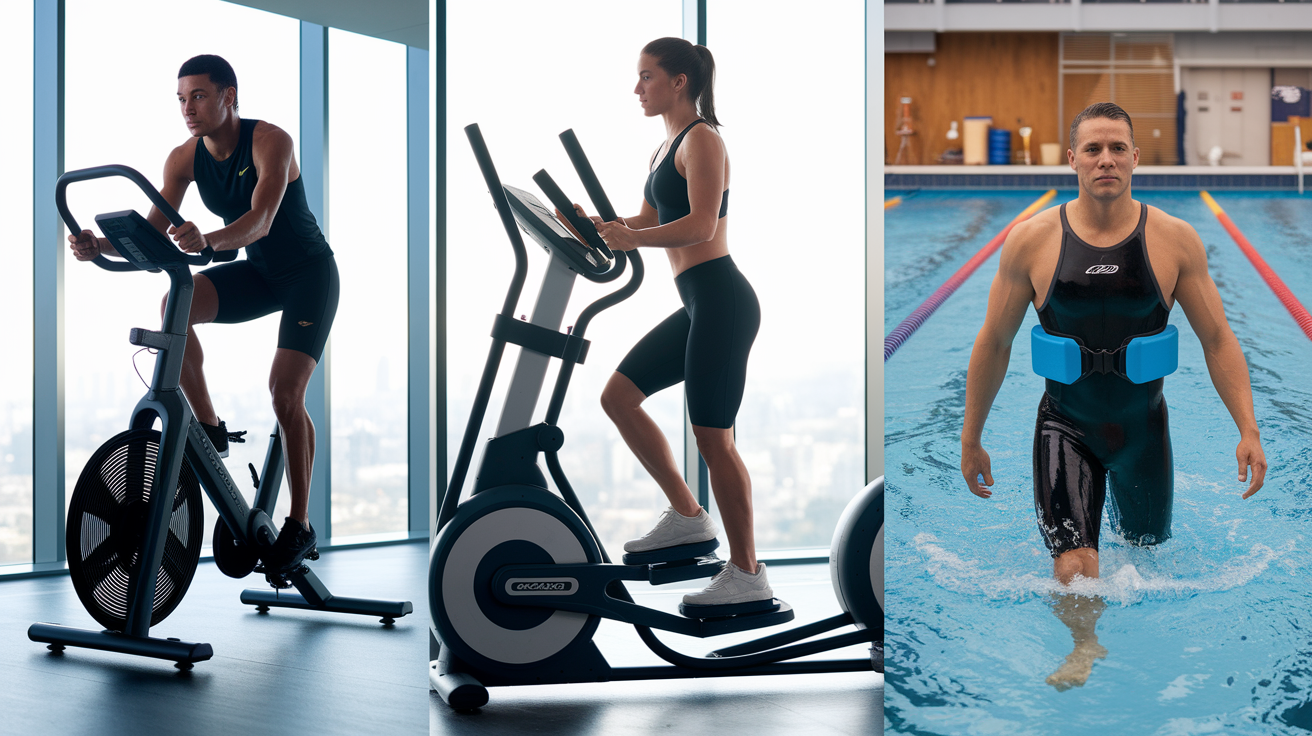
Staying active for cardiovascular health doesn’t require high-impact pounding. Low-impact cardio keeps your heart rate up, supports calorie burn, and improves endurance without the repetitive shock that aggravates sore knees. These options also help maintain fitness during recovery so you don’t lose ground while your joint heals.
Choosing the right modality matters. Activities that let you control resistance, cadence, and range of motion give you flexibility to adjust on higher-pain days without skipping the session entirely. Water-based movement adds the benefit of buoyancy, which offloads your body weight and reduces compressive forces across the knee joint. Walking remains one of the simplest and most accessible options when done on flat, even surfaces with supportive footwear.
Start with 10 to 20 minutes per session and build toward 30 to 40 minutes as tolerated. Frequency of 3 to 5 times per week provides enough stimulus to maintain conditioning without overloading healing tissues.
| Cardio Type | Why It’s Knee-Friendly |
|---|---|
| Stationary bike | No impact. Adjustable seat height and resistance allow precise control. Strengthens quads and hamstrings in a supported position. |
| Elliptical machine | Mimics walking/running motion without foot-strike impact. Smooth, continuous glide reduces joint shear. Handles allow upper-body assistance if needed. |
| Swimming / Water aerobics | Buoyancy reduces body-weight load by roughly 80 to 90%. Water resistance strengthens muscles. Warmth can ease stiffness and improve circulation. |
Set the stationary bike saddle so your knee stays slightly bent (about 5 to 10 degrees) at the bottom of each pedal stroke. Too low increases knee flexion stress, too high can hyperextend. On the elliptical, use a stride length and resistance that feel smooth without forcing your knee into awkward angles. In the pool, chest-deep water provides enough buoyancy to protect joints while allowing effective movement. Level-surface walking with cushioned, supportive shoes minimizes impact compared to uneven trails or hard pavement.
Stretching and Mobility Work to Reduce Knee Stiffness

Stretching helps manage the tightness that often comes with knee soreness, especially in the hamstrings, calves, quads, and hip flexors. When these muscles are short or tense, they alter how your knee tracks during movement. That increases strain on already irritated structures. Gentle, consistent stretching preserves range of motion and reduces the compensatory patterns that can lead to chronic issues.
Dynamic stretching works well as part of your warm-up before exercise. Think leg swings or walking lunges with minimal depth to prepare tissues for activity. Static stretching is better saved for your cool-down, when muscles are warm and receptive to lengthening. Hold each stretch 20 to 30 seconds without bouncing, breathing slowly to encourage relaxation. Perform stretches 1 to 3 times daily, especially after sitting for long periods or following workouts.
Hamstring stretch: Lie on your back, loop a towel or resistance band around one foot, gently pull your straight leg toward your chest until you feel a mild stretch along the back of your thigh. Keep your opposite leg extended on the floor.
Standing quad stretch: Stand near a wall for balance. Bend one knee and grasp your ankle behind you, gently pulling your heel toward your glutes. Keep your knees close together and avoid arching your lower back.
Calf stretch (inverted-V): Start on hands and knees, lift your hips to form an inverted V. Press one heel toward the floor, bend the opposite knee slightly to isolate the calf, hold, then switch sides.
Hip-flexor stretch (low lunge): Kneel on one knee with your opposite foot forward in a lunge. Shift your hips forward slightly until you feel a stretch along the front of your back hip. Keep your torso upright and core engaged.
Listen to what your body tolerates. A stretch should feel like gentle tension, never sharp or pinching pain. If a position aggravates your knee, reduce the range or try a modified version. Seated stretches often feel more controlled than standing options when knees are extra sore.
How to Perform Low-Impact Exercises Safely When Knees Are Sore

Safe execution prevents flare-ups and builds confidence that movement helps rather than harms. Sore knees need structure and attention to detail. Skipping steps or rushing intensity increases the risk of setbacks that can derail weeks of progress. Following a consistent warm-up, monitoring how your body responds during and after activity, and knowing when to modify or stop are all part of sustainable recovery.
Pain is information, not something to ignore. Sharp, worsening, or swelling-inducing pain means your knee isn’t ready for that movement at that intensity. Dull, manageable discomfort that fades quickly after you stop is more common during early rehab. It often improves as strength and mobility increase. The goal is to stay in the range where you’re doing enough to promote healing without crossing into tissue irritation.
Progression should be gradual. Increase duration, resistance, or range of motion by small increments. Typically no more than 10% per week, and only when current sessions feel consistently easy and pain-free. Trying to “catch up” or push through because you feel behind almost always backfires with sore knees.
Warm up for 5 to 10 minutes: Use light cardio like walking, stationary cycling, or gentle marching in place to increase blood flow and joint lubrication before strengthening or stretching.
Maintain proper form throughout each movement: Keep your knees aligned with your toes, avoid letting them collapse inward, distribute weight through your heels, engage your core to protect your lower back and hips.
Start with low intensity and short duration: Begin with 10 to 15 minutes or 1 to 2 sets of 8 to 10 reps, then build up as your knee adapts. It’s better to undershoot and add more next week than overshoot and trigger a setback.
Listen to your body during and after exercise: Stop or modify any movement that causes sharp pain, swelling, or a feeling of instability. Mild soreness that resolves within an hour is usually acceptable. Pain that lasts into the next day or worsens suggests you did too much.
Cool down and stretch for 5 to 10 minutes: Use static stretches for hamstrings, quads, calves, and hips to reduce post-exercise stiffness and maintain flexibility gains.
If you notice increased swelling, persistent sharp pain, or mechanical symptoms like locking or giving way, stop and consult a healthcare professional before continuing. These signs indicate your knee needs assessment or modified programming beyond general low-impact guidelines.
Low-Impact Water-Based Movements for Accelerated Knee Recovery

Water provides a uniquely protective environment for sore knees. Buoyancy offloads a significant portion of your body weight. Chest-deep immersion reduces load by roughly 80%, allowing you to perform strengthening and conditioning work that would be too painful on land. Water resistance creates gentle, multidirectional load that builds muscle without requiring weights or machines.
Aquatic exercise also promotes circulation and reduces post-activity soreness. The hydrostatic pressure of water helps manage swelling, and the warmth of most therapy or lap pools can ease stiffness and improve range of motion before you even start moving. For people dealing with acute flare-ups or significant limitations, water-based training often becomes the bridge back to land-based activity.
Pool walking: Walk forward, backward, and sideways in waist to chest-deep water. Maintain an upright posture, engage your core, move at a pace that feels challenging but controlled. Start with 10 to 15 minutes and build toward 20 to 30 minutes.
Water aerobics or aqua jogging: Join a structured class or mimic jogging motions in deep water with a flotation belt. The continuous movement provides cardiovascular conditioning without impact. Aim for 20 to 30 minutes, 2 to 4 times per week.
Swimming laps: Freestyle, backstroke, or breaststroke (if your knee tolerates the kick) offer full-body conditioning with minimal joint stress. Begin with 10 to 20 minutes of easy-paced laps and gradually increase duration as endurance improves.
If formal swimming feels uncomfortable due to kicking mechanics, stick with pool walking or aqua jogging. The key is consistent, pain-free movement in the water, not matching a specific stroke technique. Many people find water work especially helpful on higher-pain days when land-based exercise feels too aggravating.
Modifying Everyday Movements and Functional Training for Knee Relief

Functional training adapts the movements you do every day (sitting, standing, climbing steps, carrying groceries) so they strengthen your knee instead of straining it. When you practice these patterns with good form and controlled load, you build resilience that translates directly into less pain during normal life. It also reduces the fear and compensation that often develop after injury or chronic soreness.
Daily tasks become low-grade strength training when performed with intention. A sit-to-stand from a chair trains the same muscles as a squat but with built-in depth control. Step-ups onto a low platform mimic stair climbing in a way you can scale by adjusting height and speed. Small tweaks to how you walk (cadence, stride length, foot placement) can reduce knee stress and improve long-term gait mechanics.
Sit-to-stand practice: Use a sturdy chair. Sit down and stand up slowly, keeping your weight through your heels and your knees aligned with your toes. Perform 2 to 3 sets of 8 to 10 reps. Lower the chair height (add a cushion to raise the seat) if standing from a standard height is too difficult.
Low step-ups: Place one foot on a 4 to 6-inch step or sturdy box. Step up by pressing through your heel, bring the other foot to meet it, then step back down. Alternate lead legs. 2 to 3 sets of 8 to 10 reps per leg. Use a rail or counter for light balance support if needed.
Controlled stair descent: Going down stairs stresses knees more than going up. Practice lowering one step at a time, landing softly with your weight centered over your midfoot. Lead with your stronger leg going down if one knee is more sore.
Walking with shortened stride: Take slightly shorter, quicker steps instead of long strides. This reduces the braking force at your knee with each foot strike and often feels more comfortable during flare-ups.
Start with fewer reps or lower step heights and increase gradually. These movements should feel like practice, not punishment. When your form stays clean and pain stays low, your knee is learning to handle real-world demands safely.
Equipment and Home Setup for Knee-Friendly Training

You don’t need a full gym to support knee recovery, but a few simple tools make programming more effective and adaptable. Resistance bands, a sturdy chair, and supportive footwear cover most home-based strengthening and mobility work. If you have access to a stationary bike or pool, even better. But those aren’t required to make consistent progress.
Proper setup matters as much as the equipment itself. A stationary bike seat that’s too low forces excessive knee flexion. One that’s too high can hyperextend your knee or create hip rocking. Resistance bands should provide enough tension to challenge your muscles in the final few reps without pulling you out of good alignment. Footwear with cushioning and arch support reduces impact and helps control how your foot strikes the ground during walking or standing exercises.
Resistance bands (light to medium tension): Compact, affordable, versatile for hip abduction, clamshells, leg extensions, and assisted stretching. Choose a set with multiple resistance levels so you can progress over time.
Sturdy chair with armrests: Use for seated leg lifts, sit-to-stand practice, and balance support during single-leg work. The armrests provide stability without removing the challenge entirely.
Supportive footwear: Well-cushioned athletic shoes with proper arch support reduce impact and improve alignment during walking, step-ups, and standing exercises. Replace shoes every 300 to 500 miles of use.
Optional: yoga mat: Provides cushioning for floor-based exercises like bridges, clamshells, and stretching. A folded towel works if you don’t have a mat.
Optional: knee brace or compression sleeve: Can provide proprioceptive feedback and mild support during activity. Not a substitute for strengthening, but some people find it helpful for confidence during early-stage rehab. Consult a healthcare provider for specific brace recommendations if you have a diagnosed condition.
Adjust equipment to fit your body and current tolerance. If a movement feels awkward or painful despite good form, check your setup before assuming the exercise isn’t right for you. Small changes (seat height, band tension, step height) often make a big difference in how your knee responds.
When Sore Knees Require Professional Assessment
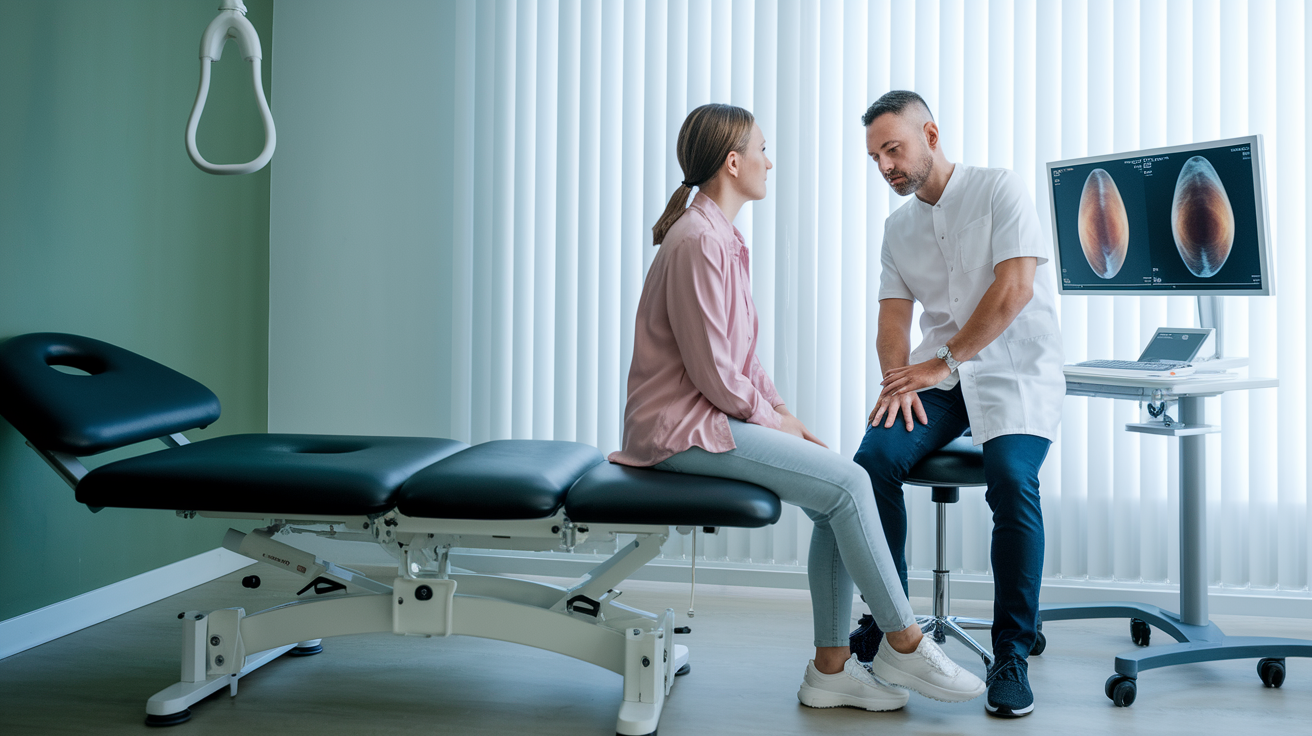
Most knee soreness improves with rest, activity modification, and consistent low-impact exercise over 2 to 4 weeks. But certain symptoms signal that self-management alone isn’t enough. Ignoring red flags can turn a manageable issue into a chronic problem or mask an injury that needs specific treatment.
Professional assessment from a physical therapist, sports medicine physician, or orthopedic specialist gives you a clear diagnosis, personalized programming, and peace of mind that you’re not making things worse. If you have a history of knee injuries, arthritis, or other joint conditions, starting a new exercise routine under guidance reduces risk and improves outcomes.
Pain that worsens over 2 to 4 weeks despite activity modification: If your knee hurts more, not less, after a month of low-impact work and rest, it’s time for evaluation. Persistent or increasing pain suggests an underlying issue that needs targeted intervention.
Swelling that doesn’t resolve with rest and ice: Ongoing joint swelling, especially if it’s warm to the touch or accompanied by redness, warrants medical evaluation to rule out infection, significant inflammation, or structural damage.
Mechanical symptoms like locking, clicking, or giving way: A knee that locks in place, buckles unexpectedly, or produces loud, painful clicking might have a meniscus tear, loose body, or ligament injury. These symptoms require imaging and professional diagnosis.
Sudden, severe pain or inability to bear weight: Acute injuries (falls, twists, direct blows) that result in immediate severe pain, inability to walk, or visible deformity need same-day or emergency evaluation to assess for fracture, dislocation, or major ligament rupture.
If you’re managing osteoarthritis, patellofemoral pain syndrome, tendinopathy, or recovering from surgery, a physical therapist can design a progressive program tailored to your condition and monitor your response over time. Early professional involvement often prevents compensations that lead to pain in other joints and speeds up your return to normal activity.
Final Words
Start with a gentle warm-up, then try the low-impact moves we covered: straight-leg raises, heel slides, seated extensions, gentle cycling, water work, and supported mini-squats to ease pain and restore motion.
Add hip and quad-strengthening like clamshells and glute bridges, plus short cardio sessions. Progress slowly and stop for sharp pain or swelling.
These low-impact recovery exercises for sore knees are practical and doable most days. Small steps add up, and you’ll likely feel steadier and less stiff soon.
FAQ
Q: What is the best low impact exercise for bad knees? / What is the best exercise if you have sore knees?
A: The best low-impact exercises for bad or sore knees are straight-leg raises, gentle stationary cycling, swimming, water walking, and seated leg work—start 10–20 minutes or 2–3 sets of 8–12 reps.
Q: What is the #1 mistake that makes bad knees worse?
A: The #1 mistake that makes bad knees worse is pushing through sharp pain or increasing high-impact activity too fast; instead, progress slowly, prioritize good form, and rest when pain or swelling appears.
Q: What are the three C’s of knee injuries?
A: The three C’s of knee injuries are contact, collision, and change-of-direction (cutting); they describe impact, direct blows, and sharp turns that commonly cause ligament or meniscal damage.