

What if stiff ankles are the reason your walks feel harder and your balance feels shaky?
Limited ankle motion shortens your stride, forces your knee and hip to compensate, and quietly raises your risk of trips and aches.
The good news: a few focused exercises can restore range of motion, strengthen tiny stabilizers, and make walking feel easier and steadier.
This post gives a simple 10–15 minute routine and progressions you can start today—no gym, no fancy gear, just slow, consistent reps.
Practical Ankle Mobility Exercises You Can Start Today

Limited ankle mobility shows up fast when you walk. Your stride gets shorter, your balance feels wobbly, and your knees or hips start doing work your ankles can’t handle. Over time, that compensation turns into tightness, discomfort, and a higher chance of getting hurt.
But here’s the good news: a handful of targeted exercises can restore ankle range of motion, strengthen the small stabilizers around the joint, and give you a more efficient, confident stride. You don’t need a gym or fancy equipment. Just a few minutes, a couple of days a week, and the commitment to move with control.
The five exercises below cover the ankle’s full range of motion: up, down, side to side, and under load. Do them 3 to 5 days per week. Slow, controlled reps beat speed every time. Each movement builds the flexibility, strength, and proprioception your ankles need to keep you stable on uneven ground, stairs, and long walks.
1. Ankle Circles
Sit in a chair or lie on your back with one leg extended. Lift your foot slightly off the ground. Slowly trace large circles with your big toe. Ten circles clockwise, then ten counterclockwise. Keep the movement isolated to your ankle. Don’t let your entire leg swing. Repeat on the other side.
This drill wakes up all the small muscles and lubricates the joint before any loaded work. Common mistake: moving from the hip or knee instead of the ankle, which defeats the purpose.
2. Ankle Dorsiflexion Stretch
Sit on the floor with one leg extended. Loop a resistance band or towel around the ball of your foot and gently pull your toes toward your body until you feel a stretch through your calf and the front of your ankle. Hold for 30 seconds, release, and repeat 2 to 3 times per side.
If you don’t have a band, just reach forward and pull your toes back with your hand. Keep your knee straight to get the most stretch along the calf and Achilles. Common mistake: bending the knee, which lets the calf off the hook.
3. Calf Raises (Plantarflexion Strength)
Stand with your feet shoulder width apart, hands on a wall or chair for balance. Rise onto the balls of your feet as high as you can, pause for a beat at the top, then lower slowly. Take 3 seconds on the way down. Do 8 to 12 reps for 2 to 3 sets.
Push through your big toe and second toe, not the outside of your foot. This strengthens your calves and builds the plantarflexion strength you need to push off efficiently with each step. Common mistake: rolling to the outside of the foot, which can strain the ankle ligaments.
4. Heel Drops on a Step
Stand on the edge of a stair or a low step with your heels hanging off. Hold a railing or wall for balance. Rise onto your toes, then slowly lower your heels below the level of the step until you feel a deep stretch in your calves and Achilles tendons. Do 8 to 12 controlled reps for 2 to 3 sets, every other day.
The lowering phase is where the mobility gains happen, so resist the urge to drop fast. Common mistake: bouncing at the bottom, which reduces the stretch and increases injury risk.
5. Single Leg Balance
Stand with your feet shoulder width apart. Lift one foot a few inches off the ground and hold the position for 30 to 60 seconds. Keep your hips level and your standing knee soft (not locked). Repeat 2 to 3 times per side.
Once you can hold for 60 seconds comfortably, close your eyes, stand on a folded towel, or pass a small weight around your hips while balancing. This trains the small stabilizers and proprioceptive sensors that keep you upright on uneven surfaces. Common mistake: locking the knee or leaning heavily to one side, which bypasses the stabilizers you’re trying to train.
These five exercises form a complete ankle mobility routine that fits into 10 to 15 minutes. Start with the mobility and stretching movements (circles, dorsiflexion, heel drops) to prepare the joint, then add strength and balance (calf raises, single leg holds). Do them consistently, focus on controlled movement, and your ankles will respond with better range of motion, stronger push off, and steadier balance every time you walk.
How Improved Ankle Mobility Enhances Walking and Balance

Every step you take starts at the ankle. When your foot hits the ground, your ankle dorsiflexes. Your shin moves forward over your toes to absorb impact and load your muscles for push off. If that dorsiflexion is limited by tight calves, stiff ligaments, or weak stabilizers, your body has to compensate.
Your knee dives inward. Your hip hikes. Or your stride shortens to avoid the movement your ankle can’t provide. Those compensations lead to knee pain, hip tightness, and a gait pattern that feels effortful instead of smooth.
Restoring ankle mobility gives your body back its natural walking mechanics. A mobile ankle lets your shin travel forward without your heel lifting early, which lengthens your stride and distributes force evenly through your foot, ankle, knee, and hip. That improved shock absorption reduces stress on every joint above the ankle. Walking feels easier, especially on hills, uneven ground, or after a long day.
Better dorsiflexion also keeps your center of mass stable over your base of support, so you’re less likely to wobble or catch yourself mid step.
Ankle mobility isn’t just about range of motion. It’s about control within that range. The small muscles and ligaments around the ankle act as sensors, constantly adjusting your position to keep you upright. When those sensors are strong and responsive, your balance improves without conscious effort. You can step onto a curb, pivot to avoid an obstacle, or recover from a stumble without thinking.
That’s why ankle work shows up in fall prevention programs for older adults and performance training for athletes.
Key functional benefits of improved ankle mobility:
- Longer, more efficient stride with less compensation at the knee and hip
- Better shock absorption and force distribution, reducing joint stress
- Faster, more automatic balance corrections that prevent trips and falls
Progressive Levels of Ankle Mobility Training

Ankle mobility work follows a clear progression: restore range of motion first, then add load, then challenge stability under dynamic conditions. Trying to jump or hop on stiff, weak ankles is a fast track to a sprain. Start where your body is and add complexity only after you’ve built the baseline strength and control to handle it.
Beginner to Intermediate Progressions
Start with seated or supported exercises that isolate the ankle joint without requiring balance or heavy load. Ankle circles, dorsiflexion stretches with a band, and double leg calf raises belong here. Do each movement slowly, aiming for 8 to 12 controlled reps and 2 to 3 sets, 3 to 5 days per week.
Once you can complete those exercises with good form and no discomfort, add time under tension. Hold the top of a calf raise for 3 seconds, or increase your single leg balance hold from 30 to 60 seconds. When 60 seconds feels easy, progress to standing on a folded towel or foam pad to introduce instability.
At this stage, you’re building the joint range of motion, ligament resilience, and small muscle endurance needed for more demanding drills. Plan to spend 2 to 4 weeks here before moving on, longer if you’re recovering from an injury or haven’t trained ankles before.
Intermediate to Advanced Progressions
Once you’ve hit 60 seconds of single leg balance on an unstable surface and can do 12 slow, controlled single leg calf raises, you’re ready for loaded and plyometric variations. Add a light dumbbell to your calf raises, or do heel drops on a step with a small weight in one hand.
Try walking lunges with a focus on pushing off the back foot, and add toe heel walks (30 feet on your toes, turn around, walk back on your heels). When those feel stable, bring in low level plyometrics: small ankle hops in place (lifting mostly from the ankle, not the knee), double leg hops forward and back, and eventually single leg hops.
Start with 5 reps per set for 2 to 3 sets, and build to 10 to 15 reps as your power and landing control improve. Progress every 1 to 2 weeks by adding reps, load, or movement complexity. But only if your form stays clean and you’re not experiencing pain or excessive soreness. If a new drill feels shaky or uncontrolled, step back to the previous level for another week.
Safety Tips and Common Mistakes in Ankle Mobility Work
Ankle mobility exercises are low risk when done with control. But rushing through reps or ignoring pain signals can turn a helpful drill into an injury. The most important rule: slow down.
Each rep should feel deliberate, especially on the lowering phase of calf raises and heel drops. That eccentric control is where you build strength and resilience. It’s also where most people cheat by dropping fast. Take at least 3 seconds to lower, and pause at the end range to let the stretch settle in.
If you feel a sharp pinch, stop immediately. Dull tension in the muscle is normal. Joint pain is not.
Start with support when you need it. Use a wall, chair, or railing during single leg balance drills and step exercises until you can hold your position without wobbling or compensation. There’s no value in “toughing out” an unstable drill if it means your knee collapses inward or your hip hikes to one side.
Clean movement builds the right patterns. Sloppy movement ingrains compensations that will show up later in your walking gait. Warm up before any loaded or plyometric work. Ankle circles and light calf stretches prepare the joint for higher demands and reduce the risk of a strain or tweak.
Common mistakes to avoid:
- Moving the entire leg during ankle circles or band work instead of isolating movement at the ankle joint
- Bouncing or pulsing at the end range of a stretch, which can irritate tendons and ligaments
- Progressing to plyometrics (hops, jumps) before you can hold a 60 second single leg balance and do 12 controlled single leg calf raises
- Ignoring pain or pushing through sharp discomfort instead of scaling back or consulting a professional
When to Seek Professional Help for Persistent Ankle Limitation
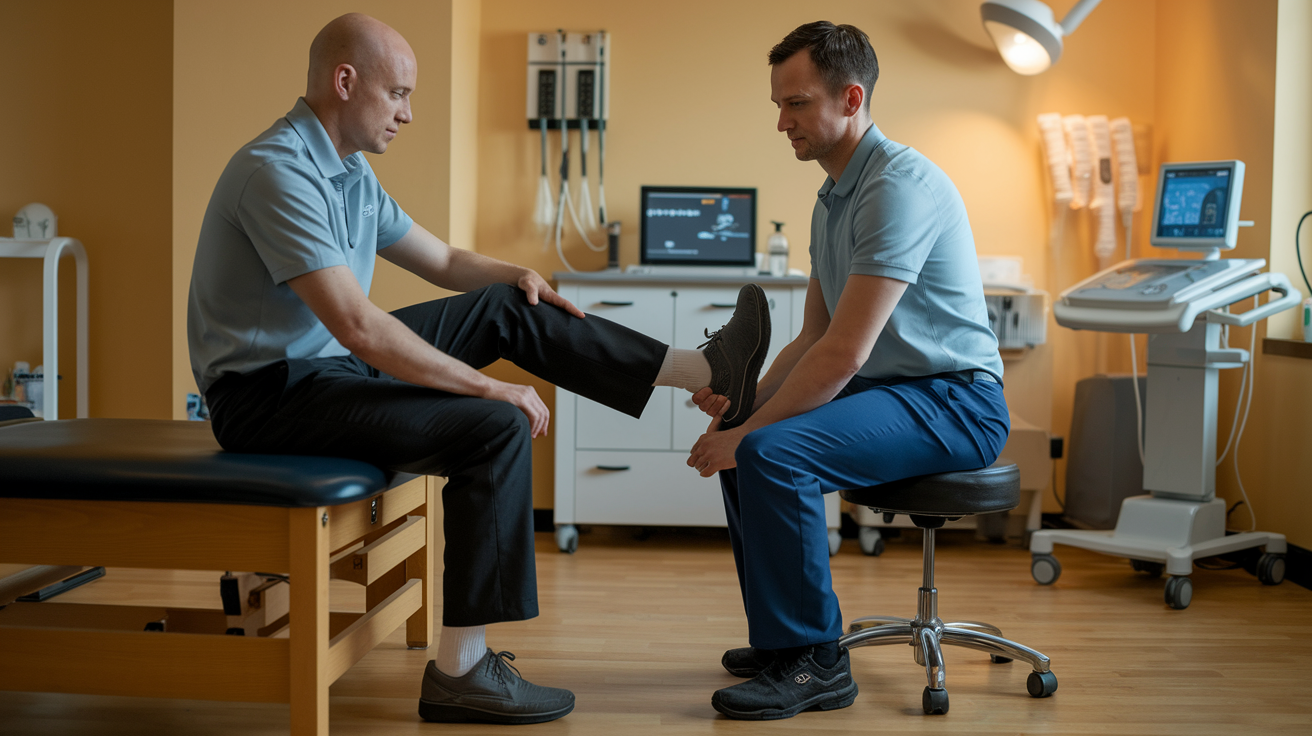
Most people see noticeable improvements in ankle mobility within 2 to 4 weeks of consistent exercise, especially if stiffness comes from underuse or mild tightness. But if you’ve been doing the drills regularly and your range of motion isn’t changing, or if you’re dealing with pain that doesn’t ease up after a few sessions, it’s time to talk to a physical therapist or sports medicine specialist.
Persistent limitation can signal an underlying issue. Old scar tissue from a previous sprain, joint impingement, or a structural problem that won’t resolve with stretching alone. Swelling that lasts more than 72 hours after exercise, a feeling of instability or “giving way” during normal walking, or sharp pain during specific movements (especially dorsiflexion or pushing off) are all red flags that warrant a professional evaluation.
A physical therapist can assess your ankle mechanics, identify compensation patterns, and design a targeted program that addresses your specific limitations. In some cases, manual joint mobilization, soft tissue work, or a short course of anti inflammatory strategies may be necessary to restore normal movement before strengthening exercises will work.
Don’t assume you just need to “stretch more” if the same limitation keeps showing up. Persistent restriction often has a reason, and finding it early prevents chronic issues down the line. If you’ve had multiple ankle sprains, notice one ankle feels significantly different from the other, or experience balance problems that affect your daily activities, schedule an appointment.
The right professional can tell you what’s normal post exercise soreness and what’s a sign to adjust your approach.
Final Words
Jump right in. This post gave five practical ankle mobility exercises with step-by-step cues, recommended reps, and common mistakes, plus a simple routine you can do 3-5 times a week.
We also covered how improving ankle range helps stride efficiency, shock absorption, and balance, and outlined progressions from beginner to advanced.
Safety tips and red flags were included so you can train without worsening pain. See a professional for persistent swelling, sharp pain, or instability.
Use these ankle mobility exercises for better walking and balance, start small, stay consistent, and you’ll feel steadier on your feet soon.
FAQ
Q: What ankle mobility exercises should I start with?
A: The ankle mobility exercises you should start with are ankle circles, standing calf stretch, heel-to-toe raises, band-assisted dorsiflexion, and joint mobilizations—each done slowly with clear form cues.
Q: How many reps and how often should I do these exercises?
A: The reps and frequency you should use are 8–12 reps per exercise, performed slowly, about 3–5 times per week—reduce on sore days and progress as range and control improve.
Q: How do ankle mobility exercises help walking and balance?
A: Ankle mobility exercises help walking and balance by reducing stiffness, improving stride efficiency and shock absorption, and preventing overcompensation at the knee or hip for steadier gait.
Q: How should I progress my ankle mobility training?
A: Progressing your ankle mobility training means moving from basic range-of-motion to loaded stretches and single-leg stability drills, increasing challenge every 1–2 weeks when form stays consistent.
Q: What signs show I’m ready to advance exercises?
A: The signs you’re ready to advance exercises are steady pain-free range of motion, easier walking, improved single-leg balance, and completing current sets without fatigue or loss of form.
Q: What common mistakes should I avoid when doing ankle mobility work?
A: The common mistakes to avoid are overstretching, bouncing, ignoring sharp or persistent pain, and rushing movements—focus on slow control, proper alignment, and breathing.
Q: Are ankle mobility exercises safe if I have ankle pain or a past injury?
A: Ankle mobility exercises can be safe after a past injury if you start gently and stop with sharp pain; see a clinician for swelling over 72 hours, instability, or ongoing sharp pain.
Q: How long will it take to notice improvements in ankle mobility?
A: The time to notice improvements in ankle mobility is often 2–6 weeks with consistent practice; small gains can show in days if you do 3–5 weekly sessions.
Q: Do I need special equipment for ankle mobility exercises?
A: The equipment you need is minimal—most moves use bodyweight; a resistance band, wall, or step helps with dorsiflexion and joint mobilizations but aren’t required.
Q: Can older adults or beginners safely do these ankle mobility exercises?
A: Older adults and beginners can safely do these exercises by starting seated or with support, using fewer reps, and checking with a clinician if they have balance issues or serious prior injuries.