

Think you need 30 minutes of stretching to stop waking up stiff?
You don’t.
This five-minute, standing routine moves your body head to toe and eases morning tightness.
No equipment, no mat, and you can do it beside your bed.
Each move lasts 30 to 60 seconds and targets common tight spots, neck, shoulders, hips, hamstrings, calves, and feet.
Do it most mornings and you’ll feel warmer, looser, and more ready to move.
Immediate 5-Minute Mobility Sequence for Reducing Morning Stiffness

This 5-minute morning routine gets rid of stiffness by moving your body from head to toe. No equipment needed. You can do it standing next to your bed or in whatever small space you’ve got. Each movement hits a common tight spot and takes 30 to 60 seconds, with short breathing pauses between.
The routine goes head to toe, five movements in five minutes. You’ll work through your neck, shoulders, hips, hamstrings, lower back, calves, and feet in order. No mat, no band, nothing special required. Before each stretch, breathe out slowly. It relaxes your muscles and helps you move further without forcing anything.
-
Neck Loosener – 15 tilts in each direction (forward, back, left, right) for 2 sets, about 60 seconds total. Move gently. Stay completely pain-free.
-
Shoulder Rolls – 15 slow circles forward, then 15 backward, about 30 seconds. Use smooth, controlled motion to undo whatever posture you held while sleeping.
-
Hip Circles – 15 slow clockwise circles, then 15 counterclockwise, about 40 seconds. Hands on your hips, move like a slow hula to loosen your lower back.
-
Forward Fold – Reach both arms overhead, then bend slowly at the hips. Don’t try to touch the floor. Let gravity do the work. Hold and breathe for about 60 seconds. You’ll feel it in your hamstrings and lower back.
-
Calf Stretch – 15 reps on each side, about 30 seconds per leg. Press your toes against a wall, keep your knee straight, and drive your hips forward. This one’s especially good if you wake up with heel pain or foot stiffness.
The sequence works for beginners and fits right after waking, after you’ve been sitting at a desk forever, or as a quick reset before a workout. You’re moving through a complete range without rushing. Total time is exactly 300 seconds.
Why Morning Mobility Helps Reduce Stiffness

Your joints and muscles feel stiff in the morning because you’ve been lying still for hours, your body temperature dropped a bit overnight, and the fluid inside your joints thickened without movement. Muscle fibers contract during sleep and don’t fully relax until you move them. If you’ve got plantar fasciitis or chronic tightness in your calves or feet, that tension builds overnight and makes your first steps feel painful or restricted.
Morning mobility delivers:
Increased circulation. Movement pumps blood into muscles and joints, raises tissue temperature, and brings oxygen and nutrients to stiff areas.
Joint lubrication. Gentle motion gets synovial fluid flowing, which reduces friction and makes joints glide more smoothly.
Neuromuscular activation. Controlled stretches wake up the connection between your nervous system and muscles. Better coordination, quicker reaction time.
Posture reset. Mobility drills undo the curled or static positions you held overnight. They realign your spine and ribcage.
Energy boost. Even five minutes of deliberate movement shifts you from half-asleep to alert and ready to move.
When you move through a full-body sequence first thing, you’re basically telling your body the day has started and it’s time to function at full capacity. You get less soreness during your first hour of standing, walking, or sitting. And you’ll notice how much more freely you move throughout the day.
Detailed Form Cues for Each Mobility Exercise
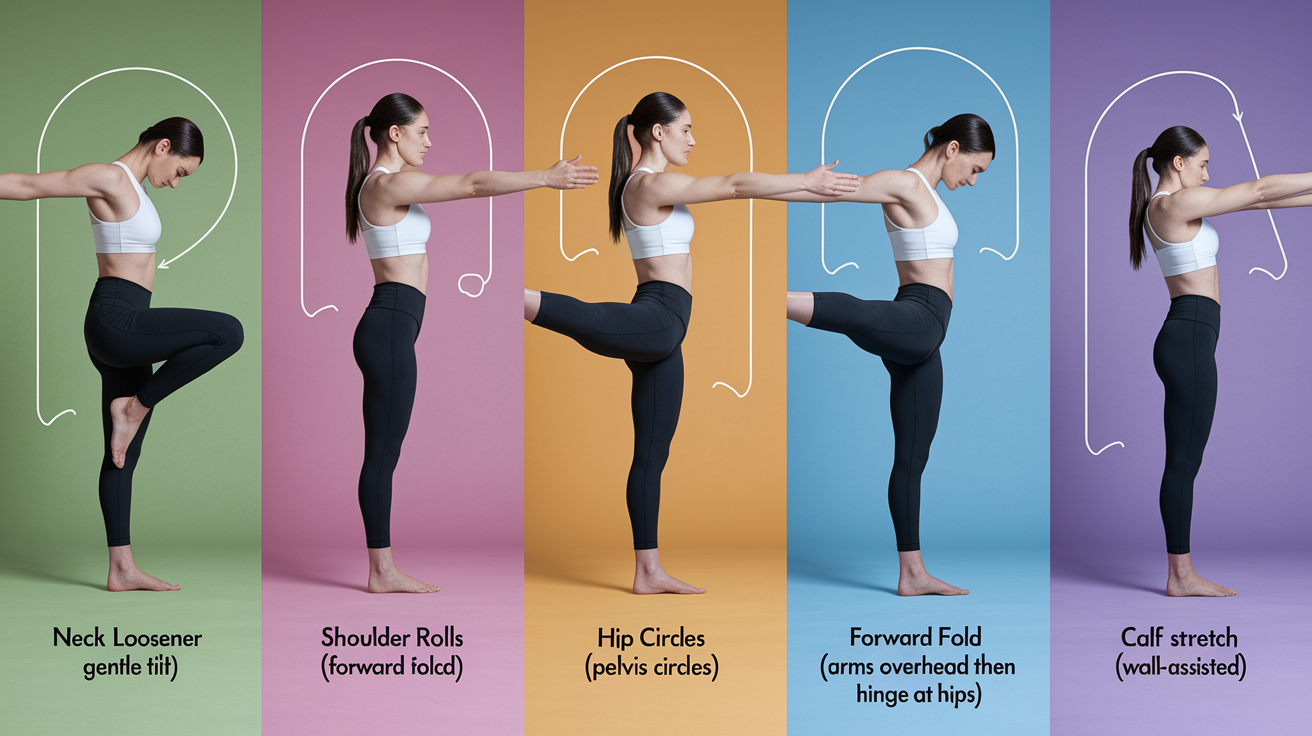
Proper form keeps the routine safe and effective, especially when you’re still waking up and your coordination isn’t fully online yet. Sync your breathing with each movement. Exhale during the stretch phase, inhale as you return to the starting position. This rhythm helps your nervous system relax and lets you move deeper without forcing.
For the neck loosener, keep your shoulders down and relaxed while you tilt your head. Don’t roll your head in full circles. Instead, move in controlled straight lines: chin to chest, ear to shoulder, eyes to ceiling. For shoulder rolls, imagine drawing large, smooth circles with your shoulder blades. Let your arms hang loose and focus on undoing the forward slump most people hold while sleeping on their side. Move slowly enough that you can feel each part of the circle.
For hip circles, plant your feet shoulder-width apart and keep your knees soft but not bent. Place your hands on your hips for stability and move your pelvis in a controlled hula motion, like you’re stirring a large pot with your hips. For the forward fold, start with your arms overhead to lengthen your spine, then hinge at the hips (not the lower back) and let your upper body hang. Bend your knees slightly if your hamstrings feel too tight. For the calf stretch, press your toes against a wall or sturdy surface, keep your heel on the ground, and push your hips forward while maintaining a straight knee. You should feel the stretch deep in your calf and Achilles tendon. Especially helpful if you wake up with heel pain or plantar fasciitis discomfort.
Simple Modifications for Beginners and Sensitive Joints

If you’re over 50, dealing with arthritis, or waking up with more pain than usual, you can still do this routine with a few smart adjustments. Common things that get in the way include reduced shoulder mobility, tight hips from prolonged sitting, sensitive knees, or chronic lower back discomfort that flares up after sleep. The goal is to move within a comfortable range that feels like a stretch, not a sharp pull or pinch.
Modify each movement with these options:
Neck movements. Reduce the range to half if full tilts cause discomfort. Do 8 to 10 reps instead of 15, and just one set instead of two.
Shoulder rolls. If standing rolls hurt, sit in a chair with your back supported and do smaller, slower circles. You can also do one direction at a time with a short rest between.
Hip circles. Hold onto a wall or countertop for balance if you feel unstable. Reduce the size of the circle and move even slower. Focus on control rather than range.
Forward fold and calf stretch. Keep a slight bend in your knees for the fold. Don’t worry about touching the floor. For the calf stretch, reduce the distance your toes are from the wall, or do the movement seated by pulling your toes toward your shin with a towel.
Go with seated or reduced-range versions on mornings when you feel especially stiff, sore, or unsteady. If you’re recovering from an injury or flare-up, cut the routine to 3 minutes by doing one set of each movement and skipping the forward fold until you feel ready. Work back to the full routine as your body adapts over the week.
Safety Guidelines and When Morning Stiffness Signals a Problem

Normal morning stiffness usually fades within 10 to 20 minutes of waking and moving around. You might feel tight in your lower back, hips, or calves, but the sensation should be dull and general, not sharp or stuck in one spot. As you move through the routine, stiffness should decrease. By the time you finish, you should feel looser and more comfortable.
Watch for these red flags that suggest something beyond typical morning tightness. If your stiffness lasts longer than 30 to 60 minutes after waking, even after moving and stretching, that’s not normal wear and tear. If you notice swelling around a joint, warmth to the touch, or redness, stop the routine and get evaluated by a healthcare provider or physical therapist. Progressive worsening over days or weeks, where each morning feels worse than the last, also signals that something deeper is going on. Movement alone won’t fix it.
When you’re doing the routine, stop immediately if you feel a sharp, stabbing pain or if any movement makes an existing ache significantly worse. Modify the range or skip that movement entirely. Mild discomfort that fades as you move is normal. Pain that lingers or intensifies is not. If a joint feels unstable or like it might give out, don’t push through. Use a wall or sturdy surface for support, or switch to a seated version.
Best Timing, Frequency, and Long-Term Progress Tracking

Do this routine every morning for the best results. The full sequence takes exactly 5 minutes, so it fits before your shower, while your coffee brews, or right after you get out of bed. If mornings feel too rushed, the routine also works well after you’ve been sitting for a long stretch, right before a workout to prep your joints, or at the end of a long day when stiffness builds up again.
Track your progress with these simple checks:
Stiffness score. Rate your morning stiffness from 1 to 10 each day before you start the routine. After two weeks of daily practice, compare your average score from week one to week two.
Range-of-motion check. Notice how far you can comfortably reach during the forward fold or how deep you can circle your hips. Small improvements in range usually show up within 7 to 10 days.
Posture feel. Pay attention to how upright and loose you feel after finishing the routine. Over time, you’ll stand taller and move with less hesitation throughout the morning.
Progress gradually by increasing the depth of each movement or holding stretches a few seconds longer once the current routine feels easy. You can also add small controlled pulses at the end of a stretch to explore a slightly greater range. Don’t rush the progression. If your body feels better and you’re moving freely by the end of week two, the routine is working exactly as intended.
Final Words
Do the exact 5-minute sequence: five head-to-toe moves (neck, shoulders, hips, hamstrings/lower back, calves) with simple timing and an exhale on each rep. No equipment—follow along and finish in five minutes.
Use the form cues, try seated or reduced reps for sensitive joints, and stop if you feel sharp pain. Track progress with a daily stiffness score or a quick range-of-motion check.
Make this 5-minute morning mobility routine to reduce stiffness a small daily habit to wake your joints and ease tightness. Keep going.
FAQ
Q: What is the 5-minute morning mobility sequence?
A: The 5-minute morning mobility sequence is an exact, follow-along, no-equipment routine of five movements designed to reduce morning stiffness and wake joints, taking exactly 300 seconds.
Q: Which exercises are included and how long does each take?
A: The routine includes neck loosener, shoulder rolls, hip circles, forward fold, and calf/foot mobility. Each exercise runs about 40–60 seconds, with short transitions that total five minutes.
Q: Do I need any equipment for this routine?
A: The routine doesn’t require any equipment; it uses bodyweight only. Use a wall or chair only if you need extra support or a seated option for painful mornings.
Q: How should I breathe during the mobility sequence?
A: You should exhale during each movement to enhance relaxation; inhale as you reset and exhale on the motion to sync breath with movement and ease tension.
Q: How often and when should I do this 5-minute routine?
A: You should do the routine daily—first thing, before workouts, or after long sitting. Five minutes daily builds consistency and helps morning mobility, even on busy days.
Q: How can beginners or people with sensitive joints modify the routine?
A: Beginners or those with sensitive joints can reduce reps to 8–10, perform one set, lessen range of motion, or choose seated and supported versions for comfort and safety.
Q: What are the red flags that mean I should stop or see a clinician?
A: You should stop and consult a clinician if stiffness lasts longer than 30–60 minutes, or if you have swelling, warmth, sharp pain, or symptoms that steadily worsen.
Q: How should I track progress and make steady improvements?
A: You can track progress by rating morning stiffness over two weeks, checking range-of-motion changes, and noting posture or energy. Progress by small increases in depth or control.
Q: Will this routine help chronic stiffness or runners?
A: This routine helps chronic stiffness and runners by boosting circulation, restoring joint lubrication, activating muscles, and improving posture, which reduces morning tightness and soreness.