

Think you need an hour every morning to do your best work? Think again.
This 10-minute routine busy professionals swear by is simple, repeatable, and built not to take your time but to free your focus.
No decisions, no guesswork, just five timed steps: hydrate, slow breaths, quick stretches, a one-line gratitude check, and a short visualization (mental rehearsal).
Do this for a week and you’ll notice calmer mornings, clearer priorities, and better focus when it matters most.
The Fastest 10-Minute Morning Routine Breakdown for Busy Professionals

This 10-minute morning routine works because you don’t have to think. Each step takes the same amount of time every day, so after a few rounds, your body just does it. No choices, no guessing.
Here’s what you’re doing and how long each piece takes:
- Hydration (1 minute) – Down a full glass of water right after you wake up.
- Breathing (1–2 minutes) – Slow belly breaths while you’re still in bed or sitting on the edge.
- Stretching (2–3 minutes) – Three basic moves to wake up your back, neck, and shoulders.
- Gratitude (3 minutes) – Write down one thing you’re grateful for and check your top priorities.
- Visualization (1–2 minutes) – Picture yourself handling your biggest task or meeting without freaking out.
Hydration as the First Step in a 10-Minute Morning Routine

Your body’s mostly water. After eight hours of sleep, you’ve been running dry for a while. Drinking water first thing does more than shake off grogginess. It clears out waste that piled up overnight, wakes up your metabolism, and cuts down on the stomach acid that causes heartburn.
Keep a glass or bottle on your nightstand so it’s right there when you open your eyes. If plain water feels like a chore, toss in a lemon slice for some vitamin C and a light digestive kick.
What morning hydration does for you:
- Replaces fluid you lost during seven to nine hours without drinking anything
- Gets your metabolism going as your body starts the day
- Lowers morning stomach acid and heartburn
- Helps your brain and muscles work at full strength right away
Breathing Techniques for a Calm 10-Minute Morning Routine

Slow breathing resets your nervous system before anything else happens. Studies show that six to ten deep breaths per minute pulls your body out of stress mode and into calm focus. Six breaths per minute is doable for most people without forcing it.
This takes one to two minutes and you can do it while you’re still lying down. You don’t need to get up, turn on lights, or move anywhere. That’s why it sticks even on mornings when you’d rather stay under the covers.
How to Perform Diaphragmatic Breathing
Lie on your back with your knees bent, feet flat. Put one hand on your chest, the other just below your ribs. Breathe in slowly through your nose, sending air down into your belly so the hand below your ribs rises while the one on your chest barely moves. Pause at the top for a second, then exhale slowly through slightly pursed lips. Count to four or five on the inhale, same on the exhale. That’s roughly one full breath cycle every ten seconds. Aim for six breaths per minute. Start with one to two minutes total.
Stretching and Mobility for a Productive 10-Minute Morning Start

Two to three minutes of stretching wakes up your nervous system, gets blood moving, and loosens the stiffness that sets in after lying still all night. These aren’t deep yoga poses. They’re simple movements you can do standing next to your bed or sitting on the edge.
What morning stretching does:
- Cuts down on muscle tension and joint stiffness from overnight
- Boosts blood flow and oxygen to your muscles and brain
- Improves flexibility and range of motion for the rest of the day
Lower Back Stretch
Sit on the edge of your bed, feet flat on the floor. Bend forward slowly and reach toward your feet, letting your back round gently. When you feel a light stretch across your lower back, hold for ten seconds. Sit back up and arch your back slightly the other way. About 30 seconds total.
Neck Mobility Rotations
Stay seated or stand next to the bed. Slowly rotate your head in a full circle clockwise a few times, then reverse and go counterclockwise. Keep it smooth. Don’t push the range. This loosens tight neck muscles in about 30 seconds.
Shoulder & Rib Cage Stretch
Stand up and lace your fingers together in front of you. Flip your palms away and raise your hands overhead as high as you can. Hold the stretch for a few seconds, feeling the lift through your rib cage and shoulders. Lower your arms and repeat once or twice. Takes about 30 to 45 seconds.
Gratitude and Journaling as Part of a 10-Minute Morning Routine

Writing down one thing you’re grateful for every morning has been shown to boost happiness, lower anxiety, and improve how you feel overall. This step takes three minutes and doubles as a quick planning session if you use a combined gratitude and daily planning journal.
Keep the journal and a pen on your nightstand or wherever you’ll sit after stretching. Write at least one gratitude item, then glance at your top two or three priorities for the day. You’re not building a full task list. You’re just grounding yourself in what matters before distractions start flooding in.
Three quick journaling prompts to rotate through:
- One person who made yesterday easier or better
- One small thing that worked well this week
- One reason today could be a good day
Visualization and Mental Rehearsal to Complete a 10-Minute Morning Routine

Visualization is the last step, and it takes one to two minutes. Close your eyes and mentally walk through your day. Picture yourself showing up to your first meeting calm and ready. See yourself finishing your most important task without getting pulled away. Imagine handling a tough conversation or decision without losing your cool.
This isn’t just daydreaming. It’s a mental roadmap that makes the real thing feel more familiar and less overwhelming. Athletes do this before competition, and it works just as well for busy professionals heading into packed workdays.
Run through two or three specific scenarios. Keep the images clear and realistic. If you’ve got a tough call at 10 a.m., see yourself staying on point and wrapping it up on time. If you need to finish a report, picture yourself sitting down and making steady progress without checking email every five minutes.
Night Before Preparation That Makes a 10-Minute Morning Routine Possible

A 10-minute morning routine only works if you remove friction the night before. Waking up to a messy space, missing supplies, or unclear next steps will kill the whole thing. Spending five minutes before bed setting everything up makes the morning automatic.
The goal is to wake up and move straight into step one without decisions, searching, or setup time. You’re not starting your day. You’re continuing something you already began the night before.
What to do the night before:
- Put a full glass or bottle of water on your nightstand within arm’s reach
- Set your journal and pen next to the water or wherever you’ll sit for gratitude
- Lay out workout clothes if you’re exercising after the routine
- Clear a small open space next to your bed for stretching
- Prep breakfast items or set the coffee maker so food’s ready after the routine
- Charge your phone in another room or turn it face down to avoid checking notifications first thing
Customizing a 10-Minute Morning Routine for Different Professional Lifestyles
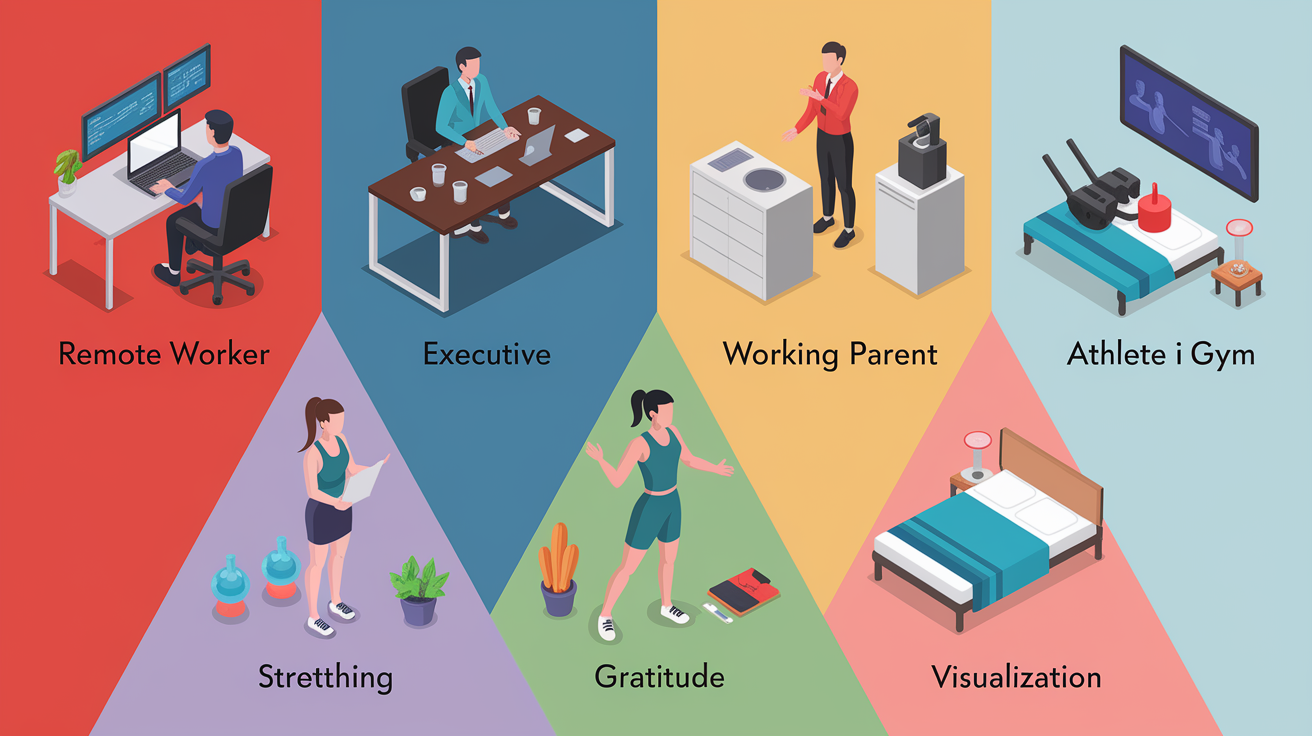
The five step structure works for most schedules, but you can adjust timing and order to fit your situation. The routine doesn’t need to be rigid. It just needs to be repeatable enough that you stop thinking about it and start doing it automatically.
For Remote and Hybrid Workers
Start the routine before opening your laptop or checking messages. Remote work blurs the line between waking up and being “on,” so this routine creates a clear boundary. Do all five steps without devices. Hydrate, breathe, stretch, journal, and visualize without screens in front of you. Once the ten minutes are done, you can check email or start work. Keeping devices out of the first ten minutes stops you from sliding into reactive mode before you’ve had time to ground yourself.
For Executives and Leaders
Focus on the visualization step and spend an extra minute if needed. Use that time to mentally rehearse big decisions, difficult conversations, or what matters most today. You can shorten stretching to one minute and breathing to one minute, then give three to four minutes to visualization and planning. Pair the gratitude journal with a quick list of the day’s two or three non-negotiable tasks. This keeps decision making sharp and prevents your morning from getting hijacked by urgent but unimportant requests.
For Working Parents
Prepare everything you can the night before, including kids’ breakfasts, lunches, and backpacks. Wake up ten to fifteen minutes before the kids do and get your routine done in that window. If your children wake early, combine steps. Hydrate while making breakfast. Do neck and shoulder stretches while standing at the counter. Write your gratitude entry while they’re eating. If a full ten minute block isn’t realistic, aim for a five minute version and protect it fiercely. Even a shortened routine keeps you grounded when mornings get chaotic.
Scaling Your 10-Minute Morning Routine as Habits Improve

Once the 10-minute routine becomes automatic, you can scale it to fit more time or different goals. Start small and add minutes gradually as your schedule allows. Habit formation works through repetition, so a consistent five minute routine beats an inconsistent 30 minute one. Build the baseline first, then expand.
You can also stack this routine onto an existing habit to make it stick faster. Do the breathing step right after brushing your teeth, or start hydration before you brew coffee. Habit stacking example: “After I brush my teeth, I’ll do two minutes of breathing. After breathing, I’ll stretch for three minutes.”
| Duration | What to Include |
|---|---|
| 5 minutes | Hydration (1 min), breathing (1 min), stretching (2 min), gratitude (1 min) |
| 10 minutes | Full five step sequence as outlined |
| 15 minutes | Add two extra minutes to stretching and breathing; extend visualization to three minutes |
| 20–30 minutes | Include a short walk, longer journaling session, or add a bodyweight strength circuit after stretching |
If motivation drops, shrink the routine back to five minutes instead of skipping it entirely. Showing up for a shorter version keeps the habit alive and makes it easier to scale back up when your energy or schedule improves.
Final Words
Get up, sip water, take slow breaths, stretch, write one grateful thing, and visualize your day — do it in about 10 minutes.
This post gives the exact 8–11 minute breakdown, plus tips on hydration, diaphragmatic breathing, quick stretches, a three-minute gratitude journal, visualization, night-before prep, and how to adapt and scale the routine.
Use this 10-minute morning routine for busy professionals to build steady habits. Start small, tweak as needed, and enjoy more calm energy throughout the day.
FAQ
Q: What is log10 equal to?
A: The log10 equals 1. The base-10 logarithm of 10 is 1 because 10 to the power of 1 equals 10.
Q: What would 10% of 10,000 be?
A: Ten percent of 10,000 is 1,000. Ten percent means one-tenth, so divide 10,000 by 10, which equals exactly one thousand.
Q: What is the meaning of 10?
A: The meaning of 10 is that it’s the integer after nine and before eleven, the base of our decimal system, and often a symbol of completeness or a full set.
Q: Is 10 a devil number?
A: The number 10 is not a devil number. Most cultures link that label to 666; ten usually stands for completeness, order, or a simple full set in everyday use.