
Think you need a full gym to get strong? You’re wrong.
With a pair of dumbbells you can hit every major muscle in about 30 minutes.
This post walks you step-by-step through a beginner full-body dumbbell routine that targets legs, chest, back, shoulders, arms, and core.
You’ll get a short warm-up, 6–10 simple exercises with suggested sets and reps, easy progressions, and single-dumbbell or no-bench options so you can train at home.
Start where you are and build steady strength without overcomplicating things.
Full Body Beginner Dumbbell Routine Overview (Complete Step‑By‑Step)

You can train every major muscle group with just a pair of dumbbells. Most beginners assume they need a full gym to see results, but you don’t. A complete full body dumbbell workout fits into 30 minutes at home or in a small space. This routine covers your legs, chest, back, shoulders, arms, and core in one session. No complicated machines. No long equipment list.
The structure’s simple. You’ll do 6–10 exercises that target different movement patterns, using 3 sets of 8–12 reps for most moves. That rep range builds muscle and endurance without demanding max strength or perfect technique right away. Train 2–3 times per week with at least 48 hours between sessions so your muscles can recover.
Spend 5–10 minutes warming up before you touch a dumbbell. Light cardio and mobility drills. Your working sets should feel challenging by the final few reps, but never so heavy that your form falls apart. Rest 60–90 seconds between sets to catch your breath and keep your movement quality solid. You can scale this routine over time by increasing weight, adding reps, or adjusting tempo.
Here’s what’s included in a full body beginner dumbbell routine:
- Goblet Squat (legs, glutes)
- Dumbbell Romanian Deadlift (hamstrings, glutes, lower back)
- Reverse or Stationary Lunge (legs, balance)
- Dumbbell Floor or Bench Press (chest, triceps, shoulders)
- One-Arm Dumbbell Row (back, biceps)
- Standing Dumbbell Overhead Press (shoulders, triceps)
- Dumbbell Crunch or Russian Twist (core)
- Optional: Farmer Carry or Plank (core stability)
If you’ve only got one dumbbell, you can still finish the routine. Use goblet variations, single-arm work, and split-stance movements. Adjustable dumbbells work great for home setups because you can increase load without buying multiple pairs. A bench helps but isn’t required. Floor press works just as well if you’re on a mat at home.
Lower Body Dumbbell Movements for Beginners
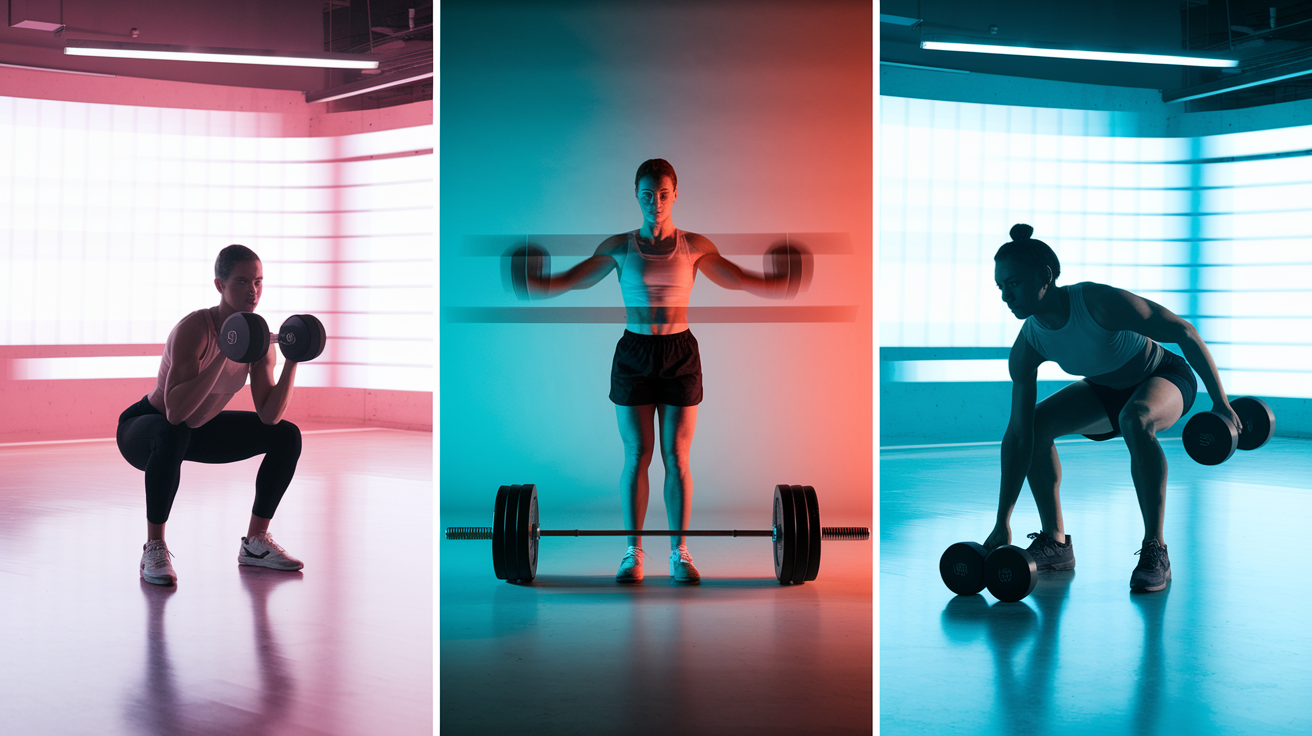
Training your lower body builds strength in the biggest muscle groups you have. It improves daily movement, balance, and overall work capacity. Beginners should learn three core patterns: the squat, the hip hinge, and the lunge. These teach your body how to move under load while protecting your knees, hips, and lower back.
The squat targets your quads, glutes, and core. The hip hinge loads your hamstrings, glutes, and spinal erectors, training the posterior chain. The lunge or split stance challenges single-leg stability and balance, which carries over directly to walking, climbing stairs, and preventing falls. Together, you get a complete lower body session without needing a barbell or leg machines.
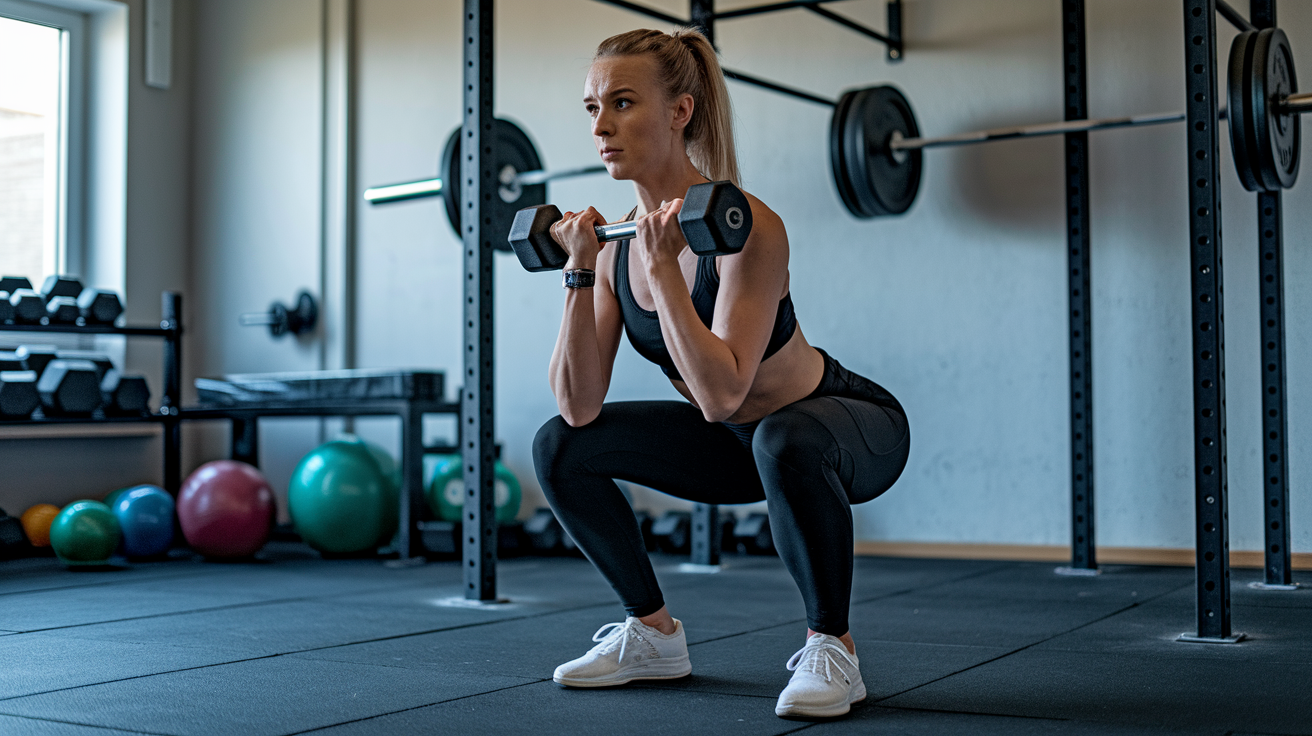
Goblet Squat
Hold one dumbbell vertically at chest height with both hands cupping the top. Stand with feet slightly wider than hip width, toes angled out about 15 degrees. Before you go down, take a breath and brace your core like someone’s about to tap your stomach.
Lower yourself by pushing your hips back and bending your knees until your thighs pass parallel. Your elbows should track between your knees at the bottom. This keeps your chest upright and stops your torso from folding forward. Pause briefly, then press through your entire foot to stand back up. Squeeze your glutes at the top.
Keep your knees tracking in line with your toes the whole time. If they collapse inward, reduce the weight or widen your stance a bit. Don’t let your lower back round at the bottom. If that happens, you’ve gone too deep for your current mobility. Start with 3 sets of 8–12 reps, resting 60–90 seconds between sets.
Dumbbell Romanian Deadlift
Stand holding a dumbbell in each hand, arms hanging straight down in front of your thighs. Feet should be hip-width apart with a slight bend in your knees. This is a hip hinge, not a squat. Your knees stay in roughly the same position throughout.
Push your hips back while keeping your spine neutral and chest up. The dumbbells stay close to your legs as you lower them toward the floor, tracking down your shins. You’ll feel tension build in your hamstrings and glutes. Lower until you feel a solid stretch in your hamstrings or until your torso reaches roughly parallel, whichever comes first.
Drive your hips forward to return to standing. Squeeze your glutes hard at the top. Never let your lower back round during the descent. If you can’t keep a flat back, the weight’s too heavy or you need to cut your range of motion. Do 3 sets of 8–12 reps with controlled tempo on the way down.
Upper Body Dumbbell Exercises for a Balanced Full Body Routine

A balanced upper body routine includes horizontal pushing and pulling (chest and back), vertical pressing (shoulders), and arm work to support those bigger lifts. Beginners don’t need isolation exercises for every muscle. Hit these basic movement categories and you’re training chest, back, shoulders, and arms in functional patterns that carry over to real life.
Horizontal pushing like the floor press or bench press builds your chest, front shoulders, and triceps. Horizontal pulling (rows) strengthens your back, rear shoulders, and biceps while improving posture. Vertical pressing (overhead press) develops shoulder strength and stability, protecting your joints as you get stronger.
You can finish a full upper body session with just a pair of dumbbells and a mat or bench. No bench? The floor press works just as well for building chest strength. Single-arm variations like the one-arm row let you correct strength imbalances and give each side individual attention. Especially helpful for beginners still learning to stabilize under load.
Here are six beginner-friendly upper body dumbbell exercises to include:
- Dumbbell Floor Press or Bench Press (chest, triceps, shoulders)
- One-Arm Dumbbell Row (back, biceps, core stability)
- Bent-Over Row (back, biceps)
- Standing Dumbbell Overhead Press (shoulders, triceps)
- Dumbbell Bicep Curl (biceps, forearms)
- Tricep Kickback (triceps)
Standing Dumbbell Overhead Press
Stand with feet hip-width apart holding a dumbbell in each hand at shoulder height, palms facing forward. Your elbows should be slightly in front of your torso, not flared out wide. Brace your core and keep your ribcage stacked over your hips. Don’t lean back or arch your lower back as you press.
Press both dumbbells straight up until your arms are fully extended overhead, finishing with the weights slightly behind your ears. Keep your shoulders packed down, away from your ears. Lower the dumbbells back to shoulder height with control, keeping tension the entire way down.
Don’t use momentum from your legs unless you’re intentionally doing a push press. If you can’t press the weight without leaning back or bending your knees, reduce the load. Do 3 sets of 8–12 reps, exhaling as you press up and inhaling as you lower.
Core Strengthening Dumbbell Exercises for Beginners

Core training isn’t just about abs. A strong core stabilizes your spine during every lift, improves balance, and protects your lower back when you’re moving weight. For beginners, simple weighted movements done with control beat high-rep crunches or complicated twists.
You don’t need heavy loads for core work. A light to moderate dumbbell adds resistance without messing up your ability to move slowly and maintain a neutral spine. Focus on controlled tempo, especially during the lowering phase. Stop immediately if you feel your lower back arching too much or any sharp discomfort in your spine.
Here are three beginner-friendly dumbbell core exercises to finish your workout:
- Dumbbell Crunch (10–15 reps for 2–3 sets). Hold a single dumbbell at your chest, lie on your back with knees bent, lift your shoulder blades off the floor by contracting your abs, then lower slowly.
- Russian Twist (20 total reps for 2–3 sets). Sit with knees bent and feet flat or elevated, hold one dumbbell with both hands, rotate your torso side to side tapping the weight to the floor beside each hip.
- Weighted Glute Bridge (optional). Lie on your back with a dumbbell resting on your hips, press through your heels to lift your hips toward the ceiling, squeeze glutes at the top before lowering.
Warm‑Up Routine Before Dumbbell Training

Skipping your warm-up is one of the fastest ways to feel stiff, move poorly, and increase injury risk. A proper warm-up raises your heart rate, gets blood flowing to your muscles, and primes your joints for the ranges of motion you’ll use during your workout. Five to ten minutes is enough without cutting into your training time.
Start with 3–5 minutes of light cardio to get your heart rate up and break a light sweat. Marching in place, jogging on the spot, or jumping rope all work. After that, move into dynamic mobility drills that take your joints through their full range of motion. These drills should mimic the movements you’re about to do under load, so your nervous system knows what’s coming.
Here are six warm-up movements to do before your dumbbell session:
- March in place or light jog (3–5 minutes)
- Bodyweight squats (8–10 reps, slow and controlled)
- Hip hinges (8–10 reps, hands on thighs, practice the pattern)
- Arm circles forward and backward (10 each direction, gradually increasing size)
- Shoulder pass-throughs with a light resistance band or broomstick (8–10 reps)
- One or two light warm-up sets of your first exercise at 50% of your working weight
Safe Progression and Weight Selection for Beginner Dumbbell Workouts
Choosing the right starting weight is one of the biggest questions beginners face. Find a load that makes the last 1–2 reps of each set challenging but still lets you complete all reps with solid form. If you finish your set feeling like you could easily do five more reps, the weight’s too light. If you can’t complete the target reps without your form breaking down, it’s too heavy.
Most beginner women start with dumbbells in the 5–25 pound range per hand depending on the exercise. Most beginner men start in the 10–40 pound range. Lower body movements like goblet squats and deadlifts typically allow heavier loads than upper body presses or arm isolation work. Start conservative, learn the movement pattern, then add weight in small steps as you adapt.
Here are five progression rules to follow as a beginner:
- Increase weight by 2.5–5 pounds per dumbbell once you can beat your target rep range by 2 reps for two workouts in a row.
- If you don’t have smaller weights, slow down your tempo (take 3–4 seconds to lower the weight) to increase time under tension instead.
- Add an extra set (moving from 2 sets to 3 sets) before increasing weight if the jump feels too big.
- Increase training frequency from 2 to 3 sessions per week once recovery allows and your schedule supports it.
- Cut rest time between sets by 10–15 seconds once your conditioning improves, but never trade form for speed.
Don’t chase weight increases too quickly. Beginners often see rapid progress in the first 4–8 weeks as the nervous system adapts, but that doesn’t mean you should jump 10 pounds every session. Small, consistent increases over weeks and months build sustainable strength and cut injury risk far better than ego-driven jumps that mess up your movement quality.
Sample Weekly Full-Body Dumbbell Training Plan for Beginners
The best beginner frequency is 2–3 full body sessions per week with at least 48 hours of rest between workouts. This gives your muscles time to recover and adapt while still providing enough training stimulus to see progress. You can train Monday/Thursday, Tuesday/Friday, or Monday/Wednesday/Friday depending on your schedule.
3‑Day Full Body Template
Each session includes lower body, upper body, and core work so you’re hitting every major muscle group multiple times per week. Rest days are just as important as training days. Use them for light walking, stretching, or complete rest depending on how you feel.
| Day | Session Focus | Example Exercises |
|---|---|---|
| Monday | Full Body A | Goblet Squat, Floor Press, One-Arm Row, Dumbbell Crunch |
| Wednesday | Full Body B | Romanian Deadlift, Overhead Press, Bent-Over Row, Russian Twist |
| Friday | Full Body C | Reverse Lunge, Floor Press, One-Arm Row, Plank |
Each workout should take 30–45 minutes including warm-up and cool-down. You can structure your session as straight sets (finish all sets of one exercise before moving to the next) or as circuits (rotate through 2–3 exercises with minimal rest). Straight sets typically take 35–45 minutes and let you lift slightly heavier. Circuits take 25–35 minutes and keep your heart rate elevated, adding a conditioning element to your strength work.
For example, a lower body and upper body superset might look like this: Romanian Deadlift for 8–12 reps, rest 30 seconds, One-Arm Row for 8–12 reps per side, rest 60 seconds, repeat for 3 total rounds. After finishing your main exercises, do 2 rounds of core work (Dumbbell Crunch and Russian Twist), then move into your cool-down.
Cool‑Down and Recovery Tips After Full Body Dumbbell Workouts

Your cool-down doesn’t need to be long, but skipping it leaves tension in your muscles and misses an easy chance to improve flexibility over time. Spend 5–10 minutes stretching the major muscle groups you just trained while your body’s still warm. This is also a good time to slow your breathing and mentally close out the session.
Focus on static stretches held for 20–30 seconds each, targeting areas that tend to get tight after lifting. Don’t force any stretch to the point of pain. Mild tension and a gentle pull are enough. Pair your stretches with slow, diaphragmatic breathing (inhale through your nose for 4 counts, exhale through your mouth for 6 counts) to help your nervous system shift out of work mode and into recovery mode.
Here are five stretches to include in your post-workout cool-down:
- Hamstring stretch (standing or seated, one leg at a time)
- Quad stretch (standing, pull one heel toward glutes, hold for balance)
- Hip flexor stretch (half-kneeling lunge position, push hips forward gently)
- Chest stretch (doorway or wall press with arm extended, rotate torso away)
- Shoulder stretch (pull one arm across your body with opposite hand, hold at chest height)
Final Words
Start by warming up 5–10 minutes, then aim for a ~30-minute session with 6–10 moves, 3 sets of 8–12 reps, and 60–90 seconds rest. Do this 2–3 times per week with at least 48 hours between sessions.
Focus on squat, hinge, push, pull, plus a short core finisher. Use one or two dumbbells, choose a weight that leaves 1–2 reps in reserve, and add small increases when you can.
Use these dumbbell exercises for beginners full body as a simple plan you can repeat. Small, steady steps win—keep at it.
FAQ
Q: Can you work out full-body with just dumbbells?
A: Working out full-body with just dumbbells is effective—cover lower body, upper body, and core with 6–10 moves, 3×8–12 reps, 60–90s rest, about 25–30 minutes, 2–3×/week.
Q: What is the 3-3-3 rule for working out?
A: The 3-3-3 rule for working out refers to doing three sets of three reps per exercise, a simple strength-focused scheme using heavier loads, longer rests, and low reps to build raw strength.
Q: Do dumbbells help with bone density?
A: Dumbbells help with bone density by providing weight-bearing resistance that stresses bone and encourages maintenance and growth; aim for regular progressive overload 2–3×/week and check with a clinician if needed.
Q: What is a good full-body dumbbell workout routine?
A: A good full-body dumbbell workout routine includes Goblet Squat, Romanian Deadlift, Floor Press, One-Arm Row, Overhead Press, Lunges, Bicep Curls, and a core finisher; do 3×8–12 with 60–90s rest.