
What if the reason you’re stuck isn’t willpower but a messy plan?
Everywhere you look, someone claims their method is the only way.
This post offers a clear 12-point checklist so you can stop guessing and start doing.
You’ll learn how to record baseline numbers, set three SMART goals, and track cardio, strength, flexibility, nutrition, and rest each week.
Use simple milestones at 4, 8, and 12 weeks to see real change and keep momentum.
Complete Starter Goal Checklist for Fitness Beginners
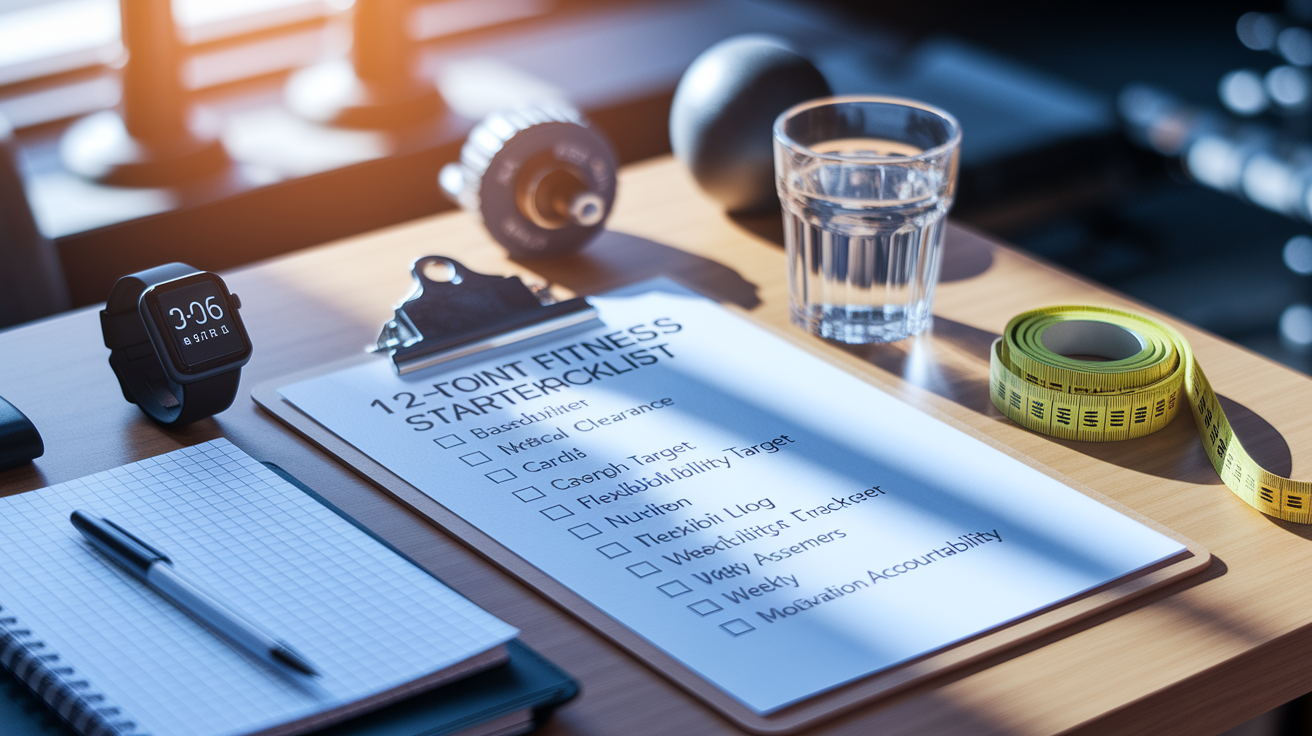
12-Point Fitness Starter Checklist
| Checkpoint | What to Do |
|---|---|
| Record baseline metrics (Week 0) | Weight, resting heart rate (bpm), body fat % (if available), strength test (push-ups in 1 min), endurance test (1-mile run time or 12-minute run distance). Check and log these stats every week. |
| Get medical clearance | Speak to a healthcare professional before starting. Complete recommended strength and cardiovascular tests if suggested. |
| Set 3 SMART goals | Each goal should be Specific, Measurable, Attainable, Realistic, and Timely. Example: “Walk 30 minutes, 4 times per week, for the next 3 months.” Include a deadline for each goal. |
| Cardio target | Walk or move 20–30 minutes, 3–5 times per week, or aim for 7,000–10,000 steps per day. Track daily step count and weekly cardio sessions. |
| Strength target | Complete a bodyweight or simple strength circuit 2–3 times per week. Start with 8–12 reps, 2–3 sets per exercise. Log exercises, reps, and sets weekly. |
| Flexibility target | Stretch for 10–15 minutes daily, or do yoga or mobility work 2 times per week. Note duration and frequency in your tracker. |
| Nutrition and habits baseline | Consult a nutritionist for a personalized eating plan. Track daily water intake and aim for 7–8 hours of sleep each night. Log sleep hours and rest days weekly. |
| Weekly activity tracker | Use a 7-day planner to log activity type, duration (minutes), intensity (light/moderate/hard), steps, and a quick mood or motivation note. |
| Recovery and rest log | Schedule and record rest days each week (aim for 1–2). Track weekly rest-day count and sleep hours to ensure recovery. |
| Milestone checkpoints | Set measurable targets at 4 weeks, 8 weeks, and 12 weeks. Examples: increase push-ups by 5 reps, walk an extra 10 minutes, or improve 1-mile run time by 1 minute. Check progress and celebrate small wins at each milestone. |
| Weekly assessment and adjustment | Review your weekly tracker every 7 days. Adjust goals if something feels too hard or too easy. Share charts with a coach or nutritionist for feedback. |
| Motivation and accountability | Choose activities you enjoy. Write down one or two accountability contacts (workout buddy, trainer, online community). Celebrate small victories like hitting a week of consistent workouts or one extra rep. |
You know what to do. Walk more. Lift something heavy. Eat better. Sleep enough.
But knowing doesn’t translate into doing, especially when you’re staring at a thousand conflicting articles and every fitness influencer swears their method is the only one that works.
That’s why a structured checklist matters. It gives you one clear path instead of twenty confusing ones. You’re not figuring out what comes first anymore. You’re just checking boxes.
This checklist doesn’t promise magic. It covers what actually works when you’re starting from zero: baseline numbers so you can see where you’re beginning, SMART goals that keep you honest, and weekly tracking for cardio, strength, flexibility, nutrition, and rest. Everything’s measurable. Minutes per session. Reps and sets. Step counts. Sleep hours. You’ll know if you did the work or didn’t.
The milestone checkpoints at 4, 8, and 12 weeks aren’t arbitrary. They give you natural pause points to look back and see what’s actually changing. Maybe you added two push-ups. Maybe your mile time dropped by 30 seconds. Maybe you strung together two solid weeks without skipping a workout. Those aren’t small things when you’re building from scratch. They’re proof the system’s working, and that proof keeps you going when motivation dips.
Progress beats perfection every time. You don’t need to nail every single box every single week. You just need to show up more often than you skip. Track it. Adjust when something’s too hard or too easy. Celebrate the small wins. That’s how beginners turn into people who don’t think of themselves as beginners anymore.
Final Words
Use the checklist as your next step: seven concrete goals, baseline metrics, SMART templates, and 4/8/12-week milestone fields so you can plan cardio, strength, flexibility, nutrition, and daily habits without guessing.
A simple, structured approach cuts overwhelm and keeps you consistent. Track weekly, tweak what’s not working, and celebrate small wins.
Keep this goal checklist for fitness beginners visible—on your fridge or phone—and treat it like a map. Small steps add up. You’ve got this.
FAQ
Q: What should be included in a starter goal checklist for fitness beginners?
A: The starter goal checklist for fitness beginners includes measurable cardio, strength, flexibility, nutrition, hydration, sleep targets, and fields for 4-, 8-, and 12-week milestones to track progress.
Q: What baseline metrics should beginners record?
A: Beginners should record baseline metrics like weight, BMI, body-fat percentage, resting heart rate, push-ups in one minute, and a 1-mile or 12-minute run time for comparison.
Q: How do SMART goals apply to fitness beginners?
A: SMART goals for fitness beginners mean making goals specific, measurable, attainable, realistic, and timely—like “walk 30 minutes five days a week for four weeks” with a clear measurement.
Q: What are simple weekly targets for cardio, strength, and flexibility?
A: Simple weekly targets are cardio 20–30 minutes, 3–5 times; strength training 2–3 sessions; flexibility 10–15 minutes daily; plus 7,000–10,000 steps most days.
Q: How often should beginners track progress and for how long?
A: Beginners should track baseline once, then weekly measurements for weight, heart rate, and workouts, reviewing progress at 4-, 8-, and 12-week checkpoints.
Q: What realistic 4-, 8-, and 12-week milestones can beginners aim for?
A: Realistic milestones: 4 weeks—consistent workouts and 1–2 small gains; 8 weeks—noticeable endurance or strength increases; 12 weeks—measurable improvements in baseline tests and habits.
Q: How should beginners plan a weekly workout schedule?
A: Beginners should plan a week with 3 cardio days, 2 strength days, daily short flexibility, and at least two rest or light activity days—adjust intensity by how you feel.
Q: How can beginners adjust goals if progress stalls?
A: Beginners can adjust goals by reducing intensity or frequency briefly, focusing on consistency, retesting baselines, and making small changes to nutrition, sleep, or workout variety.
Q: How do nutrition and hydration fit into a beginner checklist?
A: Nutrition and hydration in a beginner checklist mean aiming for protein at meals, adding a vegetable or fruit, drinking water through the day, and meeting daily calorie needs for energy.
Q: How much sleep should beginners aim for?
A: Beginners should aim for seven to eight hours of sleep most nights to support recovery, energy, and consistent workouts; prioritize regular bedtime and good sleep habits.