
Forget machines — the barbell is the fastest way to build real power.
Starting Strength is a simple, three-day program for true beginners who want steady, measurable strength.
It focuses on five big lifts — squat, deadlift, bench, press, and power clean — and asks you to add a little weight every session.
That linear progression (small, regular weight jumps) makes novice gains stack fast while keeping training short and focused.
If you want clear, practical steps to get stronger without confusing workouts or endless extras, this program shows you how.
Core Structure and Purpose of the Starting Strength Novice Program

Starting Strength is a barbell program for true beginners who want to get strong without wasting time. You’ve got five movements: back squat, deadlift, bench press, overhead press, and power clean (or barbell row if cleans aren’t your thing). It’s an A/B rotation spread across three days per week. Each session is built around heavy compound lifts done at low to moderate volume. The whole point is building raw strength by adding weight to the bar every single session.
The program runs on linear progression. That means you add a small amount of weight each time you train that movement. Usually about 5 pounds per session on the main lifts. This works because novices recover fast and can adapt to new loads at a pace that’d be impossible for intermediate or advanced lifters. Weekly gains can stack up to 7.5 to 15 pounds per lift depending on the movement and how your body responds.
Starting Strength operates on minimum effective volume. That’s the bare minimum required to trigger a growth response. Fatigue stays manageable and technique stays sharp while you’re still learning how to move heavy weight. You’re not chasing muscle soreness or variety. You’re chasing numbers that climb steadily week after week.
Five things that define this program:
Simplicity: Six movements total. No complicated splits or accessory exercises cluttering the plan.
Frequency: Three workouts per week with at least one rest day between each session.
Progression: Add weight every session as long as you complete the prescribed sets and reps.
Volume: Standard working sets are Squat 3×5, Bench Press 3×5, Overhead Press 3×5, Deadlift 1×5, Power Clean 5×3.
Focus: True novices only. This program is built for someone with little to no experience with barbell training.
How the Starting Strength Workout Schedule Works (A/B Rotation Explained)
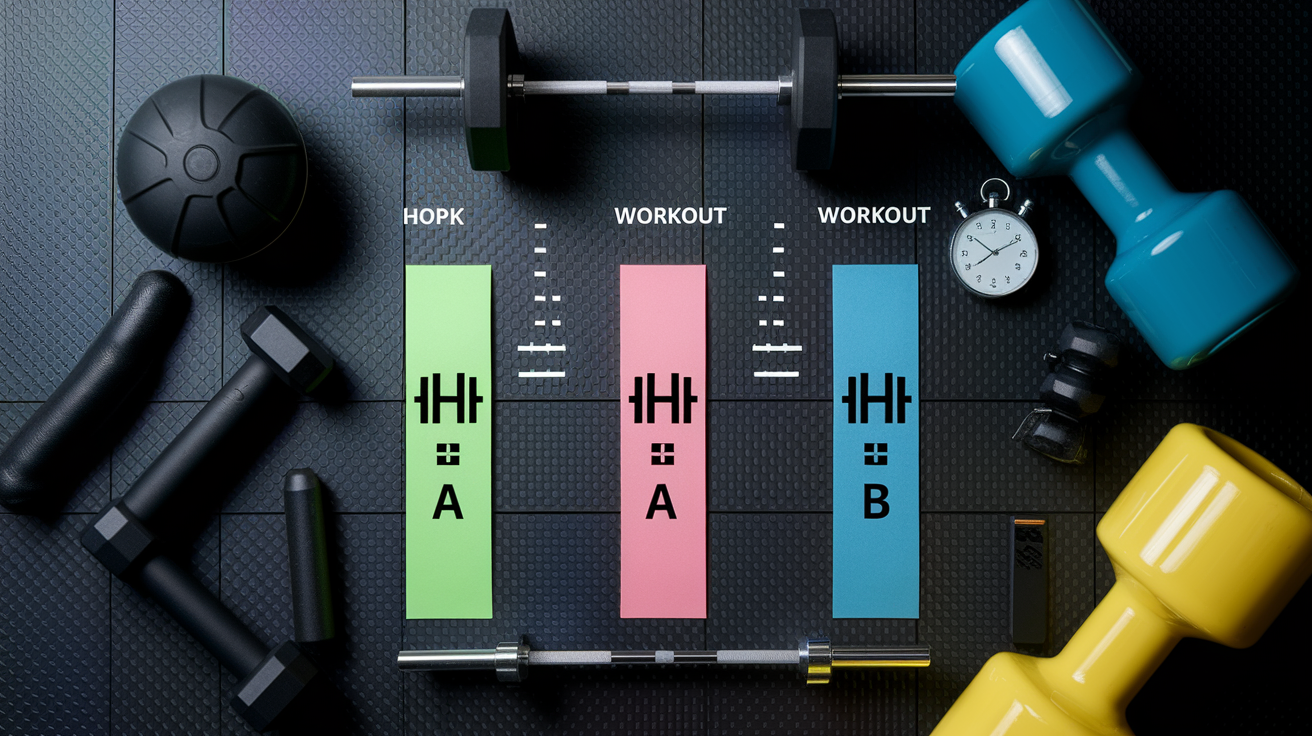
The program runs on a two workout rotation called A and B. You train three days per week and alternate which workout you perform. Week one follows an A/B/A pattern, and week two flips to B/A/B. The rotation continues indefinitely until you can’t make linear progress anymore. Each session always starts with the squat, follows with an upper body pressing movement, and finishes with a pulling or explosive lift. This order matters: squat first while you’re fresh, push second, pull or power movement third.
Before your working sets, you ramp up with progressive warm up sets. Here’s a common warm up example for a 275 pound squat working weight: start with the empty 45 pound bar for two sets of five, then 135 pounds for two sets of five, then 185 pounds for one set of three, then 235 pounds for one set of two, and finally your working sets at 275 pounds for three sets of five. Each warm up set prepares your nervous system and reinforces the movement pattern without creating fatigue. Rest between sets runs 2 to 5 minutes, or longer if you’re still breathing hard or feel fatigued.
| Workout | Exercises | Sets/Reps |
|---|---|---|
| Workout A | Squat, Overhead Press, Deadlift | Squat 3×5, Press 3×5, Deadlift 1×5 |
| Workout B | Squat, Bench Press, Power Clean (or Row) | Squat 3×5, Bench 3×5, Power Clean 5×3 |
Stick to the same gym, same time of day, and same equipment when possible. Consistency in your environment makes it easier to stay consistent with the work itself.
Exercise Technique Essentials for the Starting Strength Big Lifts

Squat
Starting Strength pushes a hip drive squat, often described with the cue “lean so far forward that your nipples point to the ground.” This works well for lifters with long torsos or long femurs who are naturally hinge dominant, but it can feel awkward or unsafe if you’re quad dominant or have short femurs.
Key squat cues regardless of your build:
Keep the bar directly over your midfoot through the entire rep.
Brace your core hard before you descend. Big breath in, hold pressure.
Break at the hips and knees at the same time, not one then the other.
Drive your hips up and forward out of the bottom without letting your chest collapse.
Bench Press
The bench press in Starting Strength is done with a controlled descent and an explosive press. Your shoulder blades should stay retracted and pinned to the bench the whole time.
Bench press cues:
Set your feet flat and push them into the floor to create full body tension.
Pull the bar down to your chest rather than letting it drop.
Touch the bar somewhere between your sternum and lower chest, not up near your neck.
Press the bar in a slight diagonal line back toward your face, not straight up.
Deadlift
Deadlifts are performed for one working set of five reps, not three sets like the squat. The setup is everything. If your hips are too high, you turn it into a stiff leg pull. If your hips are too low, you turn it into a squat with the bar in your hands.
Deadlift cues:
Stand with the bar over your midfoot, not your toes.
Grip the bar, then pull your shins to the bar without moving the bar forward.
Squeeze your chest up and lock your lats down before you pull.
Push the floor away rather than thinking “lift the bar.”
Overhead Press
The overhead press is a strict standing press with no leg drive. It’s one of the hardest lifts to progress because your shoulders are smaller muscles and don’t adapt as quickly as your legs or back.
Overhead press cues:
Start with the bar resting on your front delts, elbows slightly in front of the bar.
Press the bar straight up while moving your head back out of the way.
Once the bar clears your forehead, push your head through and lock out with the bar over midfoot.
Squeeze your glutes to keep your ribs down and avoid overarching your lower back.
Everyone’s squat will look a little different depending on limb length, hip socket angle, and torso proportions. If the extreme forward lean feels unstable or puts too much strain on your lower back, adjust your stance width, toe angle, or torso angle until the bar stays over midfoot without forcing an uncomfortable position. Video yourself from the side to check bar path and body mechanics. The program’s one size fits all squat cue is a starting point, not a law.
How Linear Progression Works in the Starting Strength Program
Linear progression means you add weight in a straight line over time. If you complete all your working sets and reps at the prescribed load, you add weight the next time you perform that lift. The standard jump is 5 pounds per session for most lifts. On the deadlift, some lifters can handle 10 pound jumps early on because it’s only one set and you’re fresh. On the overhead press, you may need to drop to 2.5 pound jumps (using fractional plates or microweights) once the load gets heavy relative to your bodyweight.
Progress stacks quickly at first. If you add 5 pounds to your squat three times per week, that’s 15 pounds per week. Over a month, that’s 60 pounds. Over three months, a beginner can realistically add 100+ pounds to their squat if nutrition and recovery stay dialed in. The deadlift often climbs even faster because you’re only doing one heavy set, which keeps fatigue low.
Typical progression scenarios you’ll run into:
You complete 3×5 at 135 pounds on the squat. Next session, you squat 140 pounds for 3×5.
You complete 1×5 at 185 pounds on the deadlift. Next session, you deadlift 195 pounds for 1×5.
You complete 3×5 at 95 pounds on the overhead press. Next session, you press 97.5 pounds for 3×5 using 1.25 pound fractional plates.
You fail the third set on bench press at 155 pounds. You get 5, 5, 3. You stay at 155 pounds next session until you complete 3×5.
You complete all reps on the power clean at 115 pounds for 5×3. Next session, you clean 120 pounds for 5×3.
Your squat stalls at 225 pounds twice in a row. You reset to 90%, about 205 pounds, for one week, then resume adding weight.
Microloading becomes necessary once your press and bench get heavy. Fractional plates (0.5 lb, 1 lb, 1.25 lb) let you keep progressing when 5 pound jumps stop working. Without them, you’ll hit a wall sooner than necessary.
Handling Stalls, Resets, and Progression Plateaus in Starting Strength

A stall happens when you can’t complete all your working sets and reps for two consecutive sessions on the same lift. When that happens, you perform a reset: for one week, do your warm ups as usual, then complete one working set at 90% of your best set of five. After that week, resume adding weight in small increments.
Here’s an example calculation: your best squat session was 225 pounds for 3×5. You attempt 230 pounds and only manage 5, 4, 3. You try 230 again the next session and get 5, 5, 4. That’s two failures. For your next squat session, calculate 90% of 225, which is about 205 pounds. Round to the nearest 5. Perform your warm ups, then one working set of 205×5. The following week, start back at 210 and add weight each session again.
Common reasons you stall before you should:
Skipping meals or not eating enough total calories to support strength gains and recovery.
Inconsistent sleep, especially getting less than 7 hours multiple nights per week.
Jumping weight too aggressively. Adding 10 pounds when 5 would have kept you progressing.
Poor technique that breaks down under heavier loads, forcing you to grind reps or miss lifts.
Not taking full rest between sets, especially on the squat where fatigue builds fast.
Resets aren’t failures. They’re a programmed way to back off, let your body catch up, and then push past the old ceiling. Most lifters will reset once or twice per lift during a novice run before they need to move to an intermediate program.
When to Move Beyond the Starting Strength Program

You know it’s time to transition to intermediate programming when you can’t add weight session to session even after multiple resets. For most lifters, that happens after 3 to 6 months of consistent training. Young men often hit benchmarks like a 40 to 50 pound increase on the squat and a 50 to 70 pound increase on the deadlift before progress slows. Women and older lifters typically see smaller absolute jumps, 10 to 30 pounds on the squat, 10 to 30 on the deadlift, but experience the same pattern of steady gains followed by repeated stalls.
Once linear novice progression stops working, you can extend progress for a few more weeks by moving to an intermediate layout. One common bridge uses a two week rotation that spreads volume and intensity differently across the week.
| Week | Workout | Exercises | Sets/Reps |
|---|---|---|---|
| Week 1 | Monday | Squat, Bench Press, Pull-up | 3×5, 3×5, 3×8 |
| Week 1 | Wednesday | Front Squat, Overhead Press, Deadlift | 3×5, 3×5, 1–2×5 |
| Week 1 | Friday | Squat, Bench Press, Chin-up | 3×5, 3×5, 3×8 |
| Week 2 | Monday | Power Clean | 5×3 |
When that intermediate layout stops producing progress, move to a true intermediate program like the Texas Method or another template that uses weekly progression instead of session to session progression. The goal at that point is to continue building strength while managing the higher fatigue that comes with heavier absolute loads.
Nutrition, Recovery, and Supportive Habits for Faster Starting Strength Progress
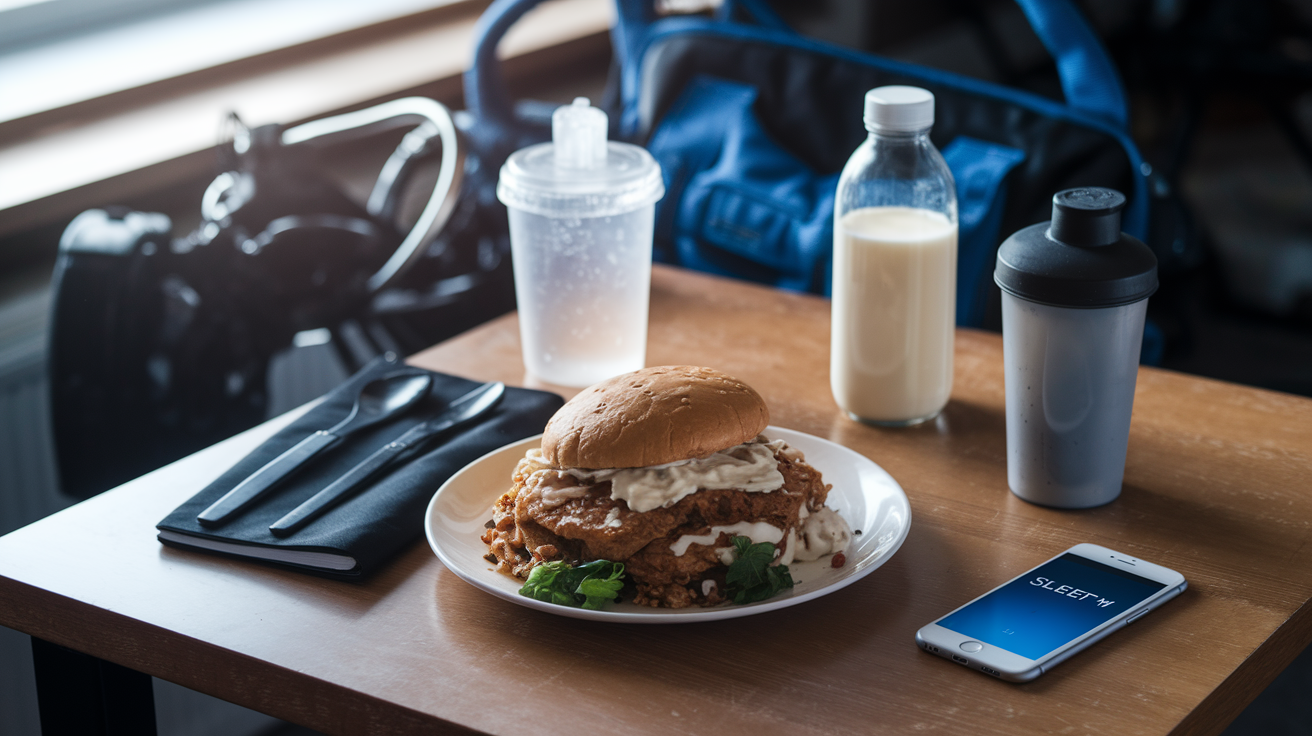
Novice strength gains happen fast, but only if you give your body the fuel and rest it needs to recover between sessions. High calorie intake is critical, especially for younger lifters or anyone who starts underweight. The classic Starting Strength nutrition recommendation is four large meals per day plus a gallon of milk, which works out to roughly 2,400+ extra calories from the milk alone. You don’t have to follow that exact plan, but you do need to eat enough protein and total calories to support muscle growth and strength adaptation. A solid target is around 0.8 to 1 gram of protein per pound of bodyweight daily, spread across meals.
Sleep is non negotiable. Your body repairs muscle tissue and strengthens your nervous system during deep sleep. Aim for 7 to 9 hours per night, and stay as consistent as possible with your sleep and wake times. If you’re getting 5 or 6 hours regularly, you’re leaving strength on the table no matter how good your training is.
Five recovery habits that support faster progress:
Log every workout with weights, sets, reps, and quick form notes so you can track patterns and spot problems early.
Take your scheduled rest days seriously. Don’t add extra cardio or conditioning unless it’s light walking.
Stay hydrated throughout the day, especially on training days when you’re sweating and pushing heavy loads.
Eat a balanced meal with protein and carbs within a few hours after training to kickstart recovery.
Manage life stress where possible. Chronic high stress raises cortisol and interferes with strength adaptation.
Consistency beats perfection. If you miss a meal or get a bad night of sleep, don’t skip your workout. Just go in, do the work, and get back on track the next day.
Practical Tips and Common Mistakes in the Starting Strength Program

One of the biggest mistakes beginners make is adding too much weight too soon. It feels good to load the bar heavy, but big jumps lead to technical breakdowns, missed reps, and early stalls. Stick to 5 pound increases even when it feels easy. The weight will get heavy soon enough.
Another common fault is skipping video analysis. You can’t see your own bar path, hip position, or back angle while you’re under the bar. Set up your phone on the side and record at least one set per session. Watch it between sets or after the workout. Look for the bar drifting forward on the squat, hips shooting up first on the deadlift, or elbows flaring out on the bench press. Small technical errors compound under heavier loads.
Keep a detailed training log in a notebook or app. Write down the date, the lift, the weight, the sets and reps you completed, and any notes about how it felt or what you noticed on video. Logs let you see progress over weeks and months, which matters more than how any single session feels. They also make it easy to calculate your 90% reset weights or spot patterns when a lift stalls.
Key Things to Remember When Running the Starting Strength Program

This program works because it’s simple and it forces you to show up consistently. You don’t need to think about periodization, deloads, or advanced programming. You just need to squat, press, pull, and add a little weight each time. Early gains happen fast, sometimes weekly jumps that surprise you, but the foundation you’re building now sets up everything that comes later.
Form always comes before weight. If you have to sacrifice technique to complete a rep, the weight is too heavy. Drop back, nail the movement pattern, and build back up. Bad reps under heavy weight create bad motor patterns that are hard to undo later.
Four quick reminders to keep progress rolling:
Small, consistent increments beat big jumps every time.
Rest days are part of the program, not optional add ons.
If you’re stuck, check your sleep, food, and technique before blaming the program.
Linear novice gains don’t last forever, but they last longer when you’re patient and consistent.
Final Words
Squat, deadlift, bench, press, and power clean or row, run those as A/B workouts three days a week with the standard sets: squat 3×5, bench 3×5, press 3×5, deadlift 1×5, power clean 5×3.
Add about 5 lb each session while keeping technique tight. Use warm-up ramps, log sessions, reset to 90% after two failures, and prioritize sleep and protein.
Stick with the basics and consistency. The starting strength program is a simple, proven way to build strength early on, and you’ll see steady progress if you keep at it.
FAQ
Q: Is Starting Strength still a good program?
A: The Starting Strength program is still a solid option for true beginners who want fast, simple strength gains. It uses five core lifts, three days/week, and adds about 5 lb each session.
Q: What is the 3-3-3 rule in the gym?
A: The 3-3-3 rule refers to using three sets of three reps as a low-rep strength scheme, and increasing weight when you can complete all sets with good form across sessions.
Q: What is the 5 5 5 30 rule?
A: The 5 5 5 30 rule usually means five sets of five reps with roughly 30 seconds rest between sets; for heavy barbell work use longer rests and prioritize technique.
Q: How should a beginner start strength training?
A: A beginner should start strength training by learning basic barbell lifts, training three days a week, using small weight jumps (about 5 lb), practising form, and logging workouts for steady progress.