

Want a controversial take?
A sideways job change can be smarter than a promotion.
Think of career movement like a ladder and a map: vertical moves climb the ladder, horizontal moves redraw your map.
Both shift your job, income, and social standing, but in different ways.
This post explains horizontal versus vertical mobility, compares their benefits and risks, and helps you decide when to move sideways or aim up so your next step actually gets you where you want to go.
Quick Definitions

Horizontal Mobility
Horizontal mobility is when you move sideways. Same level, different spot. A nurse switching from a public hospital to a private one across town? That’s horizontal. Still a nurse, still the same credentials, just a new setting. You’re not climbing or falling. You’re shifting across the board.
Vertical Mobility
Vertical mobility is when you move up or down the ladder. Your status, pay, or authority changes. An admin assistant getting promoted to senior exec? That’s upward. A supervisor losing their job during a downturn and taking a warehouse gig? That’s downward. The key thing is your place on the ladder actually shifts.
Side-by-Side Comparison

| Aspect | Horizontal Mobility | Vertical Mobility |
|---|---|---|
| Core definition | Lateral movement within the same level | Movement up or down the hierarchy |
| Direction of movement | Sideways across similar roles | Upward (promotion) or downward (demotion, layoff) |
| Status change | Little to none | Yes, either more prestige or less |
| Typical pay change | Minimal or none | Increase going up, decrease going down |
| Skill/role change | New exposure, same responsibility tier | More (or less) responsibility and decision-making weight |
| Organizational examples | Department transfer, cross-functional rotation, internal secondment | Analyst to manager promotion, demotion after performance issues |
| Social examples | Moving neighborhoods in the same class, switching universities with similar credentials | Earning a professional degree that boosts income and standing, business failure dropping class position |
| Measurement metrics | Title change without grade shift, geographic code update | Income percentile shift, prestige index movement, promotion tracking |
| Frequency in careers | More common, people shift laterally for skills or better fit | Less common, promotions are competitive and slower |
| Typical time span | 6 to 24 months per move | Multi-year gaps, often 2 to 7+ years between promotions |
| Impact on long-term trajectory | Builds broader skills, can set you up for vertical moves later | Directly shapes lifetime earnings, resources, and social access |
Real-World Examples

Workplace Examples
A marketing specialist leaves Company A for an identical role at Company B. Same title, same pay range, just a different team. That’s horizontal.
When a military captain retires and becomes a high school teacher, their income and prestige stay roughly level even though the work is completely different. Still horizontal.
Cross-functional rotations let an engineer try product management for six months at the same grade. The point is learning, not a promotion.
Internal secondments send a mid-level analyst to a partner office overseas for a year. Pay and title don’t budge, but they gain international experience.
In the military, a lateral reassignment moves a logistics officer from one base to another without changing rank. Same tier, new location.
Social Examples
A family relocates from one suburban neighborhood to another in the same income bracket. Lifestyle and occupation stay stable.
A restaurant server quits hospitality to drive a taxi. Both jobs sit at a similar spot on the prestige scale, so it’s horizontal even though the work changed.
A student transfers from one state university to another with equivalent ranking and programs. The credential value doesn’t shift.
When one spouse’s job requires relocation, the other finds a similar-level position in the new city. Occupation stays constant, geography changes.
Advantages and Disadvantages

Horizontal Mobility
Advantages:
You pick up new skills fast without the weight of a bigger title. Learning new tools, processes, and team dynamics happens naturally.
Lower risk than gunning for a promotion. If the new role doesn’t pan out, it’s easier to pivot back to a similar-level job than to recover from a failed promotion.
Better job fit or work-life balance. Sometimes the role itself is fine, but the team or location isn’t. A lateral move can fix that without starting over.
You build a wider network and gain exposure to different departments, which sets you up when vertical openings appear.
Disadvantages:
Your pay and status don’t move much in the short term. You’re trading adjustment time for skills, not a raise.
People might think you’re stuck. Managers or peers may wonder why you haven’t been promoted, even if your lateral moves were strategic.
You won’t gain leadership experience right away. Staying at the same level means no direct reports or budget authority yet.
It can take several moves before you see vertical progress, which feels like spinning your wheels if you’re only tracking title changes.
Vertical Mobility
Advantages:
Higher salary and faster wealth building. Promotions usually bring real pay bumps and better benefits.
More authority and responsibility. Your resume improves, and you get actual decision-making power.
Each step up opens doors to roles you couldn’t access before. Long-term trajectory improves significantly.
You gain access to higher-level networks, resources, and mentorship that accelerate future opportunities.
Disadvantages:
More stress and longer hours. Greater responsibility means harder decisions and higher performance pressure.
Promotions take longer to come around. Waiting 3 to 5 years between moves is typical in many fields.
Higher stakes if it doesn’t work out. A demotion or failing at the new level can set you back further than a lateral misstep.
You might lose work-life balance or social support. Climbing often means less time with family, friends, or hobbies, and sometimes isolation from former peers.
Factors Influencing Mobility
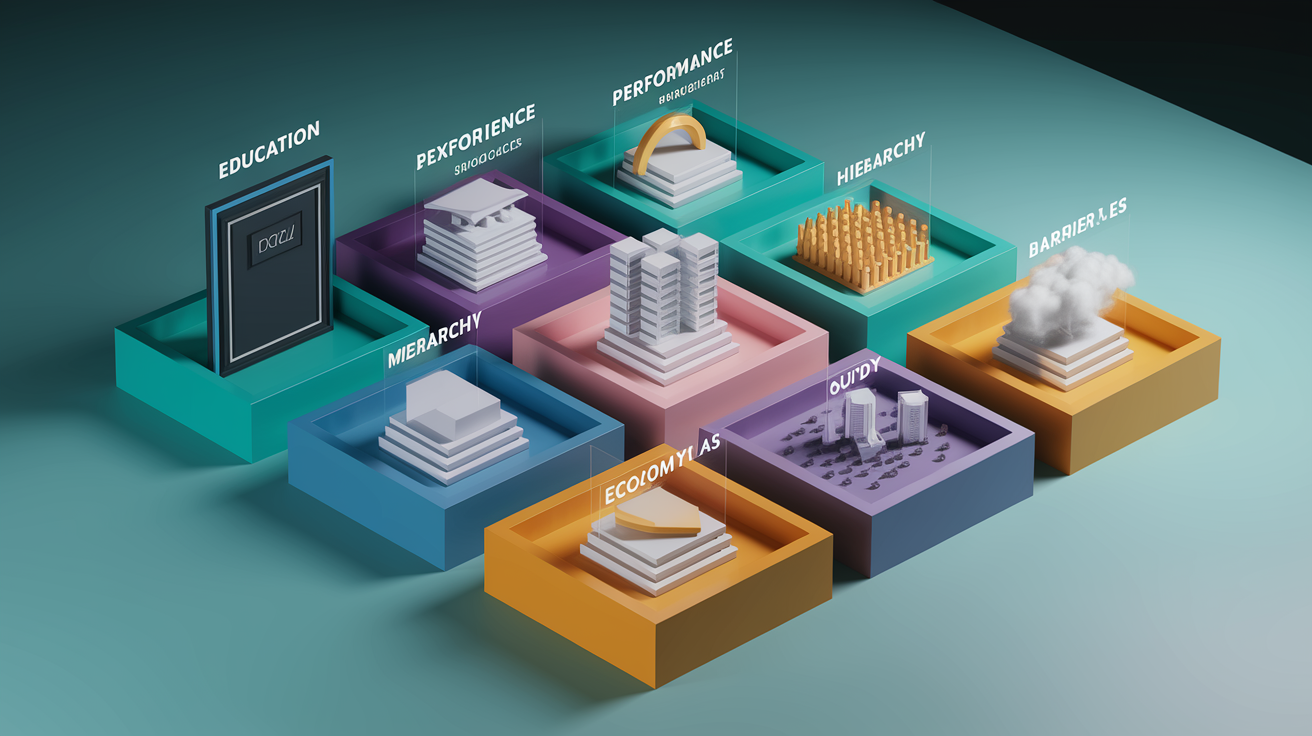
Seven things shape whether you move laterally, climb, or slide down:
Education level is the strongest signal. A university degree opens vertical doors. Specialized credentials or graduate training speed up promotions and widen lateral options.
Relevant experience tells employers whether you’re ready for the next level or better suited for a lateral skill-building role. They weigh tenure, project outcomes, and proven competence.
Performance evaluations control access to promotions. Strong reviews build the case for moving up. Weak ones limit you to lateral moves or worse.
Mentorship and networking provide visibility and sponsorship. A mentor who advocates for you can fast-track a promotion. A broad network surfaces lateral opportunities you’d never find on a job board.
Organizational hierarchy depth matters a lot. Flat organizations have fewer rungs, so lateral moves become the main growth path. Deep hierarchies offer more promotion tiers but make each step more competitive.
Macroeconomic conditions expand or squeeze mobility. Growth creates promotions and lateral openings. Recessions bring layoffs, demotions, and frozen advancement.
Institutional discrimination and policy constraints either block or enable movement. Bias based on gender, race, or background limits vertical access for qualified people. Policies like tuition support or anti-discrimination enforcement open pathways.
Impact on Career Development and Social Stratification

Short-Term Career Outcomes
Horizontal moves deliver immediate skill gains. A software developer rotating into DevOps learns deployment pipelines without waiting for a promotion. That skill becomes currency later.
Pay barely changes in the short term. A lateral transfer might hold salary flat or offer a cost-of-living bump, but it won’t match what a promotion brings.
Job satisfaction can jump when a lateral move fixes a bad manager or mismatched culture, even if title and pay stay the same.
Long-Term Effects
Promotion pipelines often require lateral breadth first. Companies promote people who’ve seen multiple functions or locations because they understand the business more fully. A series of horizontal moves builds the resume for senior leadership.
Class mobility depends on vertical movement over time. Moving from working class to professional class in your own lifetime requires promotions, advanced degrees, or entrepreneurial wins. Horizontal moves alone won’t shift your social class.
Intergenerational effects show up when parents’ upward mobility gives kids better education, networks, and starting positions. A nurse who earns an advanced degree and climbs to nurse manager provides her children with resources and expectations that weren’t available in her own childhood.
Broad vertical mobility affects inequality and social fluidity across society. When upward paths stay open, talent can rise and class lines soften. When vertical mobility gets blocked, stratification hardens and gaps persist across generations.
Measurement Approaches
Promotion rate per year tracks how often employees move up. A 10% annual rate means one in ten people climbs a level each year.
Income percentile movement shows whether your earnings are rising compared to peers. Jumping from the 40th to 60th percentile over five years signals upward mobility even if your job title stayed put.
Occupational prestige indices score jobs based on education, income, and social standing. A shift from 45 to 65 means vertical mobility. A shift from 45 to 47 suggests horizontal.
Number of lateral moves before first promotion reveals whether horizontal exploration is strategic or a holding pattern. Two lateral moves followed by a promotion looks smart. Five with no promotion might signal stagnation or structural barriers.
Final Words
Start by testing the quick screen and trying one drill for each plane. Do them before workouts or on rest days; three short sessions this week is enough.
We unpacked what horizontal and vertical mobility mean, showed simple tests, and gave easy drills and progressions. You also got busy-day options and cues to keep form safe.
If you focus on small, consistent steps that address horizontal vs vertical mobility, you’ll unlock smoother movement and fewer stiff spots. Keep it steady. Small wins add up.
FAQ
Q: What is the difference between horizontal mobility and vertical mobility?
A: The difference between horizontal mobility and vertical mobility is that horizontal mobility means moving within the same social level (different job or place) while vertical mobility means moving up or down the social hierarchy.
Q: What is an example of horizontal mobility?
A: An example of horizontal mobility is a teacher transferring to another school or city while keeping the same job level and pay, showing change of position without a rise or fall in status.
Q: What is an example of vertical mobility?
A: An example of vertical mobility is an entry-level worker getting promoted to manager (upward mobility) or losing a job and taking lower-paid work (downward mobility), both changing social status.
Q: What are the four types of mobility?
A: The four types of mobility are horizontal (same-status moves), vertical (upward or downward status change), intragenerational (within one person’s lifetime), and intergenerational (between parent and child generations).