

Most goal advice keeps you busy, not moving forward.
Personal goal setting should do the opposite: give you a clear path and daily choices that add up.
This post walks you through a practical system, start with a 12-month vision, pick 1 to 5 priorities, turn each into a SMART goal (specific, measurable, attainable, relevant, time bound), break goals into weekly and daily actions, and track what matters.
You won’t get perfect weeks, but you will build momentum and clearer choices for each day.
Start with one goal and one metric, then scale up as reviewing becomes routine.
Foundations for Effective Personal Goal Setting

Personal goal setting gives you direction. When you’re deciding what to aim for this year, this quarter, even this week, you need a target. Without one, you drift. You show up, stay busy, but never build the momentum you want. Goals tell you where you’re going. They separate what matters from what’s just filling time.
Most people know goals help. The question is how to set them so they actually guide your daily decisions and weekly priorities. That starts with clarity. A goal like “get healthier” doesn’t tell you what to do Monday morning. But “lose 10 kg in 6 months by tracking calories and running 3× per week” does. Clarity turns intention into a plan.
Measurement keeps you honest. When a goal includes numbers (£500 saved per month, 24 books read this year, 5 km run three times per week) you know if you’re on track or falling behind. Measurement lets you adjust before small gaps become big ones.
Here’s the basic sequence for effective personal goal setting:
• Start with a simple vision of what you want across a few life areas in the next 12 months.
• Pick 1 to 5 priorities from that vision. More than five usually means nothing gets the focus it needs.
• Convert each priority into a SMART goal with a specific number and a deadline.
• Break each goal into 6 to 12 smaller actions you can schedule weekly or monthly.
• Assign a success metric you can track consistently.
• Schedule your review cadence: daily habit checks, weekly progress reviews, monthly metric updates, quarterly strategy resets, and an annual vision review.
If that sounds like a lot, start with one goal and one metric. The system scales once the habit of reviewing and adjusting is in place.
Using the SMART Framework in Personal Goal Setting

SMART goals work because they remove guesswork. Each letter adds a layer of structure that turns vague hopes into actionable plans. When you say “Save £6,000 by December,” you can work backward and know exactly what’s required each month, each week, even each day.
The SMART framework has been around for decades because it consistently produces follow through. It forces you to define success up front, set a realistic scope, and pick a finish line. That clarity makes it easier to start and harder to ignore when progress stalls.
Here’s what each part means:
• Specific — State exactly what you’re aiming for, not a general direction. “Get fit” is a direction. “Run 5 km without stopping” is specific.
• Measurable — Include a number, frequency, or unit you can track. Examples: lose 10 kg, save £500 per month, read 2 books per month.
• Attainable — Set a target you can realistically hit with consistent effort. Stretch yourself, but don’t pick a number that requires luck or resources you don’t have.
• Relevant — Make sure the goal aligns with what actually matters to you right now. A promotion might be relevant this year. An unrelated side project might not be.
• Time bound — Attach a deadline. Without one, “someday” rarely arrives.
Example: “Save £6,000 by December 31” (345 days from January 1). To hit that, you need to save £17.39 per day, £121.74 per week, or £500 per month. By the end of March, you should have saved £1,500. By mid year, £3,000. If you’re behind at the monthly check in, you know immediately and can adjust your spending or find extra income before the gap gets too big.
Structuring Personal Goal Setting with OKRs, WOOP, and Backcasting
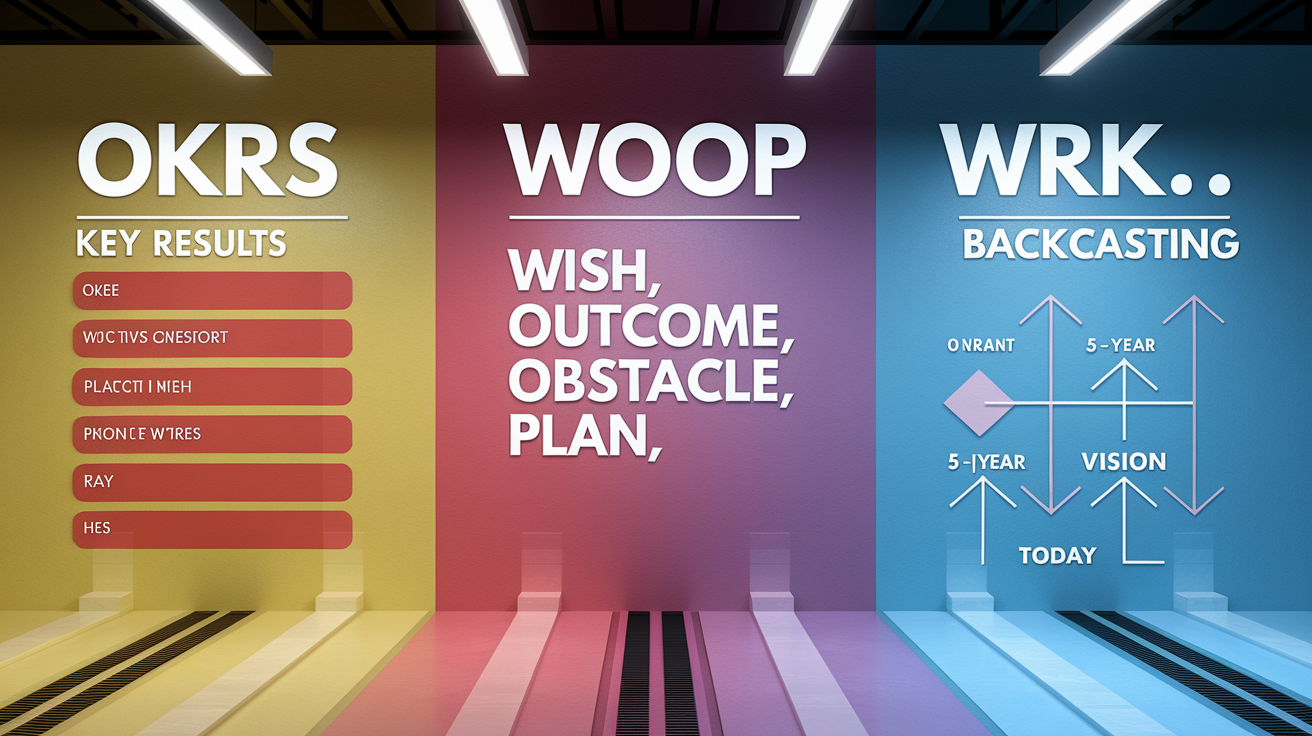
SMART goals are the foundation. But other frameworks add flexibility for different situations. OKRs help when you need measurable progress markers inside a bigger objective. WOOP works for short term behavior changes where obstacles are predictable. Backcasting is useful when you’re planning something multi year and need to map the steps backward from the finish line to today.
OKRs (Objectives and Key Results) pair one clear objective with 2 to 5 measurable key results. The objective is qualitative and directional. The key results are the numeric proof you’re making progress. You review OKRs every quarter, which keeps you from committing to rigid annual plans that stop making sense by June. Many people modify at least half their goals by mid year and abandon at least one entirely by year end. That’s normal. OKRs expect you to learn and adjust.
WOOP stands for Wish, Outcome, Obstacle, Plan. You name what you want, visualize the positive outcome, identify the most likely obstacle, and create an if then plan to handle it. It’s designed for short term behavior shifts like starting a daily walk or cutting back on screen time before bed. WOOP forces you to think through friction before it stops you.
Backcasting starts at the long term vision and works backward. If your 5 year goal is to run your own consultancy, backcasting asks: What needs to be true in year 4? Year 3? This year? This quarter? That reverse timeline keeps your weekly actions connected to the distant target, so you’re not just reacting to what’s urgent.
| Framework | Core Structure | Best Use Case |
|---|---|---|
| OKRs | 1 Objective + 2–5 measurable Key Results, reviewed quarterly | Projects and performance goals that need regular progress checks and flexibility to pivot |
| WOOP | Wish → Outcome → Obstacle → Plan (if then format) | Short term behavior changes with known friction points |
| Backcasting | Start at 5 year vision, map backward to present actions | Long term aspirations that require phased milestones and early groundwork |
Breaking Down Personal Goals Into Smaller Steps

A 12 month goal looks manageable on paper. Overwhelming on Monday morning. Breaking it into 6 to 12 smaller actions, each with its own mini deadline, turns one big target into a sequence of realistic tasks. This is the pyramid model: put the ambitious goal at the top, list 2 to 4 intermediate sub goals underneath, then list the micro tasks that move each sub goal forward.
Micro tasks are small enough to fit into a normal week. “Write 1,000 words per day for a month” is a micro task. “Run 5 km three times this week” is a micro task. “Do three pushups every morning” is small, but it builds the habit of showing up. The size matters less than the consistency and the connection to the larger goal.
Here’s the step by step sequence for breaking down a goal:
- Define the main goal using SMART criteria. Include the number and the deadline.
- Set 2 to 4 sub goals that represent meaningful progress markers on the way to the main goal. Each sub goal should be achievable within 1 to 6 months.
- Allocate monthly tasks for each sub goal. What needs to happen this month to keep each sub goal moving?
- Assign weekly actions tied to those monthly tasks. Be specific about frequency: twice per week, every Monday and Thursday, etc.
- Specify daily micro tasks when daily repetition matters. Examples: log food, write 500 words, do 10 minutes of stretching.
- Schedule check ins to review whether the smaller steps are actually advancing the sub goals and the main goal. Weekly is the minimum. Monthly is essential.
Example: Main goal is “Become a published author within 2 years.” Sub goals: build a blog with 500+ monthly readers, draft a 100,000 word manuscript, submit proposals to 10 literary agents. Monthly tasks under “build a blog”: write and publish 4 posts, share each post on two platforms, reply to every comment. Weekly action: write one post draft, schedule one social share. Daily micro task: write 300 words before breakfast.
Tracking Progress in Personal Goal Setting

Tracking is how you know if effort is turning into results. Without measurement, you’re guessing. With it, you see patterns. What’s working, what’s stalled, and when to change course. The goals you track are the ones you improve.
Set a review rhythm that matches the speed of your goal. Fast moving goals need weekly or even daily check ins. Longer goals need monthly metrics and quarterly strategy reviews. The cadence tells you how often to look at the numbers and decide if you’re still on the right path.
Here’s the recommended review schedule and time commitment for each:
• Daily habit check (2 to 5 minutes). Mark off whether you did the micro task. Examples: logged meals, wrote 500 words, did the morning workout.
• Weekly progress review (30 to 60 minutes). Compare this week’s output to the target. Did you hit the weekly action? If not, what got in the way?
• Monthly metric update (60 to 90 minutes). Update the key numbers: weight, savings balance, pages written, applications submitted. Compare to the monthly target and adjust next month’s plan if you’re behind.
• Quarterly OKR reset (2 to 4 hours). Review whether your objectives and key results still make sense. Modify or drop goals that no longer align. Set new key results for the next 90 days.
• Annual vision review (half day session). Reflect on the past year, update your 5 year vision, and set 1 to 5 priorities for the year ahead.
Use simple tools: a spreadsheet with your key performance indicators, a habit tracking app, a bullet journal with weekly spreads, or a Kanban board with cards for each action step. The tool matters less than the routine of recording and reviewing.
Concrete example: If your goal is to read 24 books this year, that’s 2 books per month or roughly 20 pages per day. Track pages read daily in a simple log. At the end of each week, count total pages. At the end of the month, count finished books. If you’re at 1.5 books by month end, you know you need to pick up the pace or adjust the annual target to 18 books instead.
Maintaining Motivation and Accountability in Personal Goal Setting

Motivation fades when progress is invisible or when no one else knows you’re trying. Accountability and small rewards keep you engaged even on weeks when willpower is low. Research on implementation intentions shows that planning the when, where, and how of a behavior makes you two to three times more likely to follow through.
Habit stacking is one of the simplest accountability tactics. You attach a new micro task to an existing routine, so the cue is automatic. The formula: “After (or before) I do [current habit], I will do [new habit].” Examples: “After I pour my morning coffee, I will meditate for one minute.” “Before I get in the shower, I will do ten pushups.” “After I set my toothbrush down, I will floss.” The existing habit becomes the trigger, and the new behavior rides along.
Here are five motivation and accountability strategies that work:
• Public commitment. Tell a friend, post your goal on social media, or join a group working toward similar targets. Public stakes raise the cost of quitting.
• Milestone rewards. Celebrate at 25%, 50%, and 75% completion. Pick small, meaningful rewards that don’t undermine the goal (a massage after hitting your first savings milestone, not a shopping spree).
• Visual progress tracking. Use a progress bar, a streak counter, or the Seinfeld Strategy: mark an X on the calendar every day you complete the task. Don’t break the chain.
• Accountability partner. Check in with someone weekly. Share your metric, your win, and your plan for next week. Knowing someone will ask keeps you honest.
• Implementation intentions. Write down the exact day, time, and place you’ll do each action. “During the next week, I will do 20 minutes of strength training on Monday at 7:00 a.m. in my garage.”
Combine two or three of these. Visual tracking plus an accountability partner is more powerful than either alone.
Avoiding Common Pitfalls in Personal Goal Setting

The most common mistake is setting too many goals at once. When you’re juggling five priorities, none of them get the consistent attention required to make real progress. Energy and time are finite. Spreading them thin means you’ll probably miss all five targets instead of hitting two or three.
Other frequent pitfalls: vague goals with no measurement, over optimistic timelines that ignore how long tasks actually take, and skipping the review rhythm so drift goes unnoticed for months. Each of these has a straightforward fix. Limit active goals to 1 to 5. Enforce SMART criteria on every goal. Add 25% buffer time to your initial timeline estimate. Schedule recurring weekly and monthly reviews and treat them as non negotiable appointments.
Misalignment is harder to spot but just as damaging. If you’re chasing a goal because it sounds impressive or because someone else expects it, you’ll hit the target and feel empty. Or you’ll resist the work because it conflicts with what you actually value. Before committing, test the goal against your core priorities: health, relationships, autonomy, impact, whatever matters most to you right now. If the goal doesn’t support at least one of those, reconsider it.
Abandoning a goal isn’t always failure. Research shows that letting go of unattainable or misaligned goals reduces stress, improves sleep quality, boosts feelings of competence, and lifts mood. Goals are experiments. When the experiment reveals that the target was wrong or the cost too high, changing course is the smart move. Many people modify half their goals by mid year and drop at least one entirely by year end. That’s learning, not quitting.
Real World Examples for Personal Goal Setting

Concrete examples make the process easier to start. Below are sample goals across six common life areas, each written with a clear metric and a deadline. Use these as templates and adjust the numbers to match your situation.
| Life Area | Example Goal | Metric | Deadline |
|---|---|---|---|
| Career | Earn a promotion to senior analyst | Complete 3 certifications, lead 2 projects, submit quarterly performance reviews | 12 months |
| Health & Fitness | Lose 10 kg and improve cardiovascular endurance | Track calories daily, run 5 km 3× per week, lose 1.5–2 kg per month | 6 months |
| Finance | Build an emergency fund of £6,000 | Save £500 per month via automatic transfer, review spending weekly | 12 months |
| Relationships | Spend quality time with partner and stay connected with parents | Schedule 2 hours of partner time twice per week, call parents twice per month | Ongoing, reviewed quarterly |
| Personal Development | Read 24 non-fiction books to expand knowledge and perspective | Read 2 books per month, track pages daily (target ~20 pages/day) | 12 months |
| Lifestyle & Habits | Establish a consistent morning routine that improves focus and energy | Wake at 6:30 a.m. 5 days per week, complete 10 minute stretch + 5 minute journal | 90 day trial, then reassess |
Career example in detail: “Earn promotion to senior analyst within 12 months.” Sub goals: complete Project Management Professional certification by March, earn Google Analytics certification by May, lead cross functional project by June, deliver quarterly self assessments highlighting new skills and project outcomes. Monthly tasks: study 10 hours for current certification, schedule one networking coffee per month with a senior colleague, document wins and metrics for quarterly review. Weekly actions: study 2.5 hours, update project tracker, send one progress email to manager.
Health example in detail: “Lose 10 kg in 6 months.” That’s roughly 1.5 to 2 kg per month. Sub goals: track all meals and stay within 1,500–1,800 daily calorie range, run 5 km three times per week, add two strength sessions per week. Monthly tasks: meal prep on Sundays, weigh in every Monday morning, adjust calorie target if weight loss stalls. Weekly actions: run Monday, Wednesday, Friday, strength train Tuesday and Thursday, log food daily.
Finance example in detail: “Save £6,000 in 12 months.” That’s £500 per month, or roughly £115 per week. Sub goals: automate £500 transfer to savings account on payday, reduce discretionary spending by £150 per month (track subscriptions, dining out, impulse purchases), increase income by £100 per month through freelance work or overtime. Monthly review: compare actual savings to £500 target. If short, identify which category caused the gap and adjust next month.
Final Words
Put the plan into action: craft a clear vision, pick 1–5 priorities, convert them to SMART goals, break those into weekly and daily steps, and set regular review checkpoints.
Use OKRs, WOOP, or backcasting where they help, track progress with simple tools, and build tiny habit cues so momentum grows.
Personal goal setting works when you keep goals measurable, review often, and tweak as life changes. Start small, stay consistent, and you’ll see steady progress.
FAQ
Q: What are your personal goals examples? / What are the 5 personal SMART goals?
A: Personal goals examples and five personal SMART goals include: save £6,000 in 12 months (save £500/month); lose 10 kg in 6 months; read 24 books/year; earn a promotion in 12 months (3 certifications); call parents twice/month.
Q: What are SMART goals for cerebral palsy?
A: SMART goals for cerebral palsy are specific, measurable, attainable, relevant, and time-bound targets, for example improving walking endurance to 10 minutes continuous in 12 weeks, set and reviewed with a therapist.
Q: What are the 5 C’s of goal-setting?
A: The 5 C’s of goal-setting are Clarity, Challenge, Commitment, Confidence, and Control. Clarity is a clear target; Challenge is a stretch; Commitment is ownership; Confidence is belief; Control is action focus.